
What Happened Before the Words
Memoir to the Impossible


When I found my biological family, I realized that things had happened to me before I had words or memories for them. Intrinsic moments were unrecorded or forgotten.
Did those things even happen? How real or meaningful were those occurrences to me? What is the truth of one’s origin when there is no original story to tell?
Many people are troubled by these questions. Adoptees live with them in a particular way because of how our origins are recorded, sealed, and rewritten by law.
I never questioned the circumstances or location of my birth. What I knew of my origins came from my adoptive parents; they drove from Sumter, where my dad was stationed, to Rock Hill and brought me back to their tiny apartment. The tone of my mother’s notes, which begin with my joining them in late February 1952, reflects their excitement and their duty to their new parenting roles. Everything else is thin. A thinness that speaks volumes in myth, mystery, and magic.
My baptismal certificate served as my valid identification until I attempted to obtain an updated passport at age forty. As a military dependent, I had traveled overseas with my family, and at age nine, I posed for a passport photo with my adopted baby sister and my mother.
I was astonished to learn that South Carolina law denied me access to my original birth certificate, the document I needed for a new passport, when I was a married adult. Until then, I had accepted the legal suppositions handed to me: the vocabulary of my baptismal certificate from Saint Ann’s Church in Rock Hill that doubled as a South Carolina document, and the myths it carried. The document’s new information glared: Birthplace, Greenville, S.C., Saint Francis Hospital. I needed the full story.
My request to Vital Statistics triggered the release of an amended birth certificate. The person on the other end of the line casually mentioned she would obtain the information from Catholic Charities in Charleston, since I had none. Clearly, what she sent was not an original document. It displayed the names of the parents who had raised me.
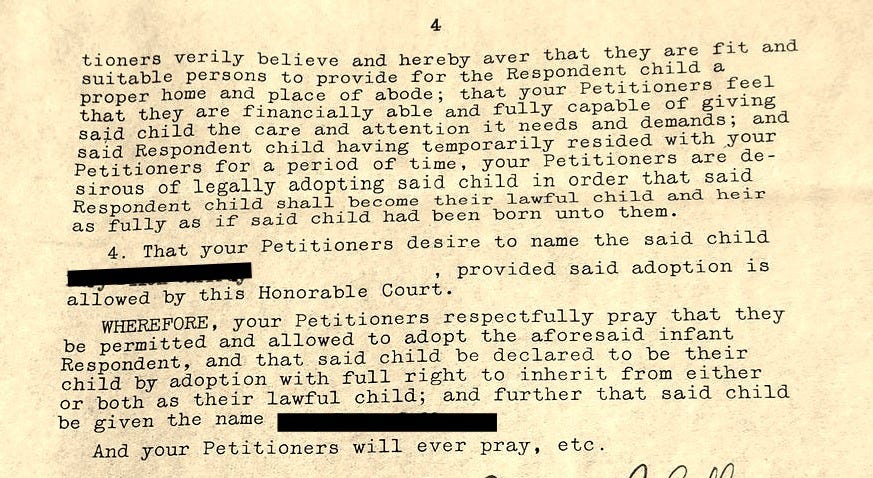
My adoptive mother mailed me the adoption papers, the original packet from the law firm in Rock Hill. “I don’t know why you would want these,” she wrote.
I contacted a local adoption triad search and support group in Philadelphia. My awareness and righteous indignation were now raised. Too much had been kept from me. It was time to search for my first mother.
Would she be alive?
Step one in the search was to obtain my original birth certificate. Two years of calls and letters ensued before she and I reunited.
Accuracy does not ensure understanding. Many adoptees’ lives are shaped by a strange doubleness: belonging and not belonging; being someone’s daughter while also somehow standing slightly outside the familial circle. Not ostracized, certainly, but carrying the sense of existing just beyond its edges.
One mother is lost. Another offers the silver platter of adoption, with its uneasy privileges and obligations.
Adoptee Riddle of Unbelonging
A formula of lies obliterated my origins
and gave me a chance for a better life.
What life might I have had?
Removed from the powerless
given to those who had
what I needed to live,
but who weren’t mine.
Where were mine, the lost ones?
All are left behind in a riddle of unbelonging.
At the age of seventy, I finally held my original birth certificate. Life writing honors what can be documented, yet beneath the evidence lies an earlier layer of experience that precedes the record.
When an infant is separated from her mother in the first hours of life, the event does not live in time but in the newborn’s nervous system. The displacement. The dissociation. Mirrors that hold questions.
Many adoptees recognize their heightened sensitivity: a quick response to emotional undercurrents and an ability to read the room. Perhaps these are survival adaptations. Or call it primal wounding, intuition, or an extra-sensory awareness, the separated newborn’s vigilance. Always waiting and watching. Adjusting to loss before she has words for it.
This is where the story begins to change.
I did not set out to write magical realism, though I was intrigued by the form. I would be approaching fiction for the first time, which was daunting given the relative ease I had cultivated in writing personal narrative. The process of writing my own story, the stir of memory and emotion, had brought me closer to understanding my truth.
Memoir allows the evidence to stand: the military family transfers, bases, and separations; the impermanence, the tensions, transitions, the discipline, and the dinner-table silences.
Still, something essential lay beyond literal description. I needed a language strong enough for the contradictions of adoption, and the language that could hold the truth that both love and harm are real. Magical realism allows those tensions to remain intact.
In my new book, written under the pen name Islay Corwin, the central character is afflicted with mirror-sight: the ability to see through reflections and across thresholds. The inherited trait opens a conversation about adoptee heritage and reflects the effects of newborn separation, as the child senses the world long before language arrives.
The earliest impressions, formed in the womb and in the first moments of life, are stored in the nervous system, in the body itself. They may last a lifetime, as trauma clinicians have long observed.
The adoptee at the center of the story carries three names. One was taken from her. One was given to her. One she ultimately claims for herself.
Most adoptees require little explanation of this. Severance disrupts the self, and reunion does not magically reset or repair. Stella’s meeting with Ellen is tender, awkward, and necessary. It offers a connection to biological family, yet the wound of loss remains and cannot be undone. Not in the child whose first bond was broken, not in the first mother whose circumstances shaped an impossible decision, nor in the adoptive mother who loves fiercely yet imperfectly, her protectiveness shadowed by insecurity.
Adoption discourse often presses toward simple answers.
Was it a rescue, or was it a rupture?
Are you grateful? Angry?
Do you belong to this family, or to another?
Of course, the answer is yes.
Where ordinary language struggles to hold such complexity, magical realism widens the frame, allowing truths to exist that resist the narrow limits of literal description. The mirror remembers what the record sealed away.
For many years, I searched for the right words to describe something that happened before I could speak. In the end, the language that came closest was the one that allowed for magic, not because magic is untrue, but because some truths loom too large for the literal.

Note: This essay was originally published as “Expressing the Inexpressible.”
It has been revised and expanded. I wanted to share it widely, because it sits near the heart of my work.
Spring is on the way!

Happy to hear of your new writing project, Mel! And your essay here makes so much sense to me as a sister adoptee.