

Winter Haibun - A Farmland Reverie
Springfield Twp., Bucks County, PA
In memory, I escape from the moral uncertainty of the times into a place where sweet air satisfies, and the spirit of nature presides. A touch of rustic charm once inspired me to restore a German merchant-farmer’s house in Bucks County, Pennsylvania, and create an acre of gardens. After Mr. Trumbauer improved an earlier version of an 1800s farmhouse, it was a charming turn-of-the-century village home. We did our research and, within our budget, paid homage to its original character.
One sparkling, still morning when ice and snow encased the valley, I pulled on layers of wool and down, laced up insulated boots, and, careful on the unshoveled steps, I trudged beyond our carriage house into a crisp, crystalline world.
German immigrant families from the Rhineland and the Palatinate left Schoharie-Albany, where British rule had taken their farmlands in the 1700s. With their cattle, they trekked overland along the Delaware and Lehigh rivers, and their vast farms of corn and wheat spread through the fertile valleys. They displaced the indigenous Leni Lenape, who were forced to leave their campgrounds as they had when the earliest Dutch and Huguenot colonists arrived.
Our village remained alive with grain and dairy commerce through the 1950s. Old fallow fields are now copses of scrub oak, wild dogwood, juniper, crabapple, and vine that have sprung up where the plow avoided rocks, providing food and cover for wildlife. I follow deer tracks below glistening boughs to a silverberry enclosure, where blue jays and cardinals feast on the tiny red fruits, and excited finches flit through the twigs. Snow has drifted in the snow-muffled thicket where deer sheltered overnight; the air still holding their musk and hot breath.
Where I sit on a mature, uprooted, golden-barked mulberry tree screened by branches, an array of remnants of farm life is visible through the snow: an antique tractor long ago lodged in mud, its steering wheel a rusted peace sign; an abandoned mule plow replaced by gas power, and a ruined tire wheel that succumbed to shale shards in this fertile soil. I breathe a meditation, grateful for my parka, wool hat, mittens, warm boots, and the pure air.
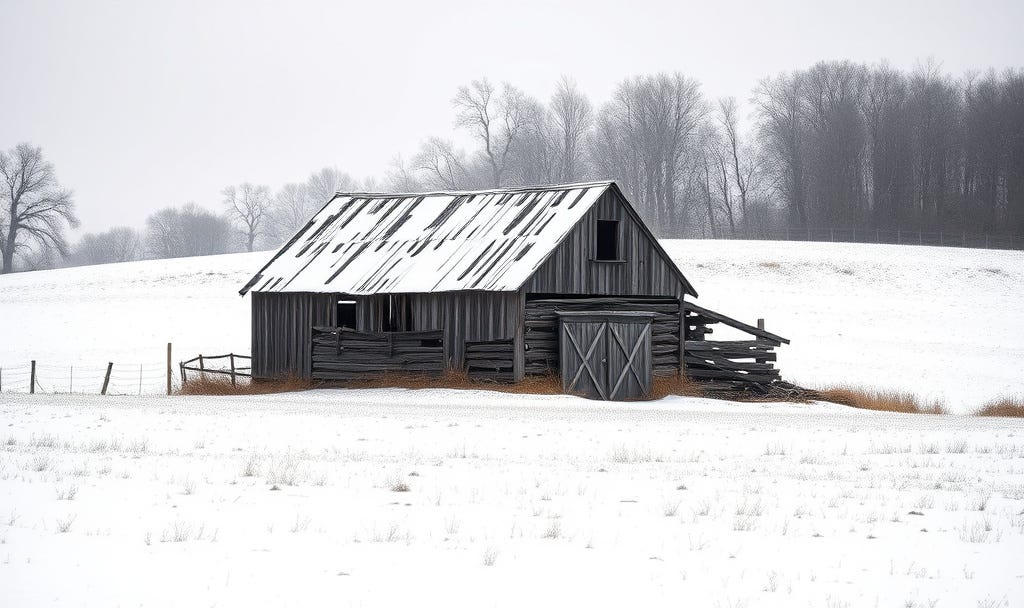
Our elderly neighbor’s property begins behind our carriage barn, but I’m not intruding here. He came in the 1950’s, his home a way-stop built, like ours, in the early 1800s. From my vantage on the fallen mulberry, I glimpse back toward his dilapidated barn. Collapsed and useless, the slate roof was sadly neglected through too many winters. Had he made repairs, shored up the massive chestnut footings, and repaired the board siding, the barn might have withstood the weight of heavy snow.
Even amid ruin, the land reshapes itself, purposed. The crumbled fieldstone wall that once divided our parcels, another centuries-old relic, is a habitat for the white ferret that crosses the rubble, hunting field mice. Lithe and lean, she is absorbed into the snow-scene. I peer through woody growth, senses alive to the brilliant cardinal’s cheery tune and the screech of nuthatches. Finches flit in and out of the brush, swaying on frost-weakened twigs. They all share my space, but I don’t complain.
I linger in quiet, in the private depths of nature, perhaps the last of a millennium, while, maybe, the backhoe and builder are next. I think of the children who trudged through these snow-covered woodlands, fields, and hillsides. Sere grasses nod in the breeze. Light snowflakes drift like my thoughts.
A collapsed corn bin,
the bleakness of a snow field
No more cows remain
©Mary Ellen Gambutti
First published November 22, 2017, in Vignette Review.
Thanks for stopping by!

Such a wonderful description.
A lovely evocation of place.