The Lady of the Lake: On Healing and Inheritance
An Excerpt From Through the Iron Gate: The Rosemere Records
The Lady of Llyn y Fan Fach
An Excerpt From Through the Iron Gate: The Rosemere Records
August 2, 2026
Friends, I’m glad you’re here. My interest in Celtic mythology, folk and fae lore deepened as I began to write Through the Yew Hedge last year. It seems to me, I started with W.B. Yeats pulling in epigraphs from his wonderfully apt poem, The Stolen Child. And I devoured the stories he collected to preserve Irish tales and verse. The Irish foundational myths around the Tuatha de Dannen swept me away. Most recently, I found a great resource in the online classes of Dr. Gwilym Morus-Baird, CelticSource. I’m not aspiring to learn Welsh, but I love the music of the language and deep poetic resonance, the complex praise and transformation poetry of Taliesin, and what I’ve been learning of the Welsh Bardic tradition. Dr. Morus-Baird’s audiobook, Taliesin Origin, is an enjoyable listen.
I’m not an expert herbalist, but my history in horticulture continues to draws me to stories with botanical framing, and I have a working knowledge of herbs.
Note: I do caution readers to seek expert advice in administering or ingesting herbs.
Story at Hand: Readers whose inheritance or lineage have been severed by adoption or other form of displacement, I hope you’ll enjoy this popular Welsh folktale of herbal healing. In my novellas’ mythology, the Latin for healing, Sanatio, fits the overall theme of The Garden & the Gate; Protection, Recovery, Restoration, and Preservation; the novellas’ shape and the adoptee’s experience: Sanatio, healing and restoration.
Lady of the Lake / The Myddfai Physicians passage from Through The Iron Gate, scene near the end, Helen and Stella.
When the hawthorn was in blossom, and the garden was slipping out of winter, Helen and I were sitting in the Rosemere on a February evening. The Franklin stove, ticking with heat, drew the damp from the plaster walls, while we sipped tea on the worn, cobalt blue velvet sofa. Helen found herself remembering the Folklore of the Estate: the story she had recited at twilight in the Medieval Garden on Midsummer, on what felt like eons ago. She shook her head, recalling the Pierce lecture and what it did to open her eyes to the complex, even nefarious version of “The Three Who Remained.”
But she relaxed into the moment with the fond memory of her fireside stories with me in the living room of the Tudor Manor. “I recall another legend, about the Myddfai tradition. I showed you the copy of the 1861 translation that Elizabeth kept in the Hidden Library, The Physicians of Myddfai, translated from the Red Book of Hergest.” Helen scattered wisdom like seeds, trusting some would take root. “Do you remember? It’s the fourteenth-century Welsh manuscript, bound in red, of poetry, prose, history, and the medical practices of Rhiwallon and his sons, the Physicians of Myddfai; their ancient herbal remedies and healing arts.”
Helen recited by heart, her cadence expressive, as with each storytelling.
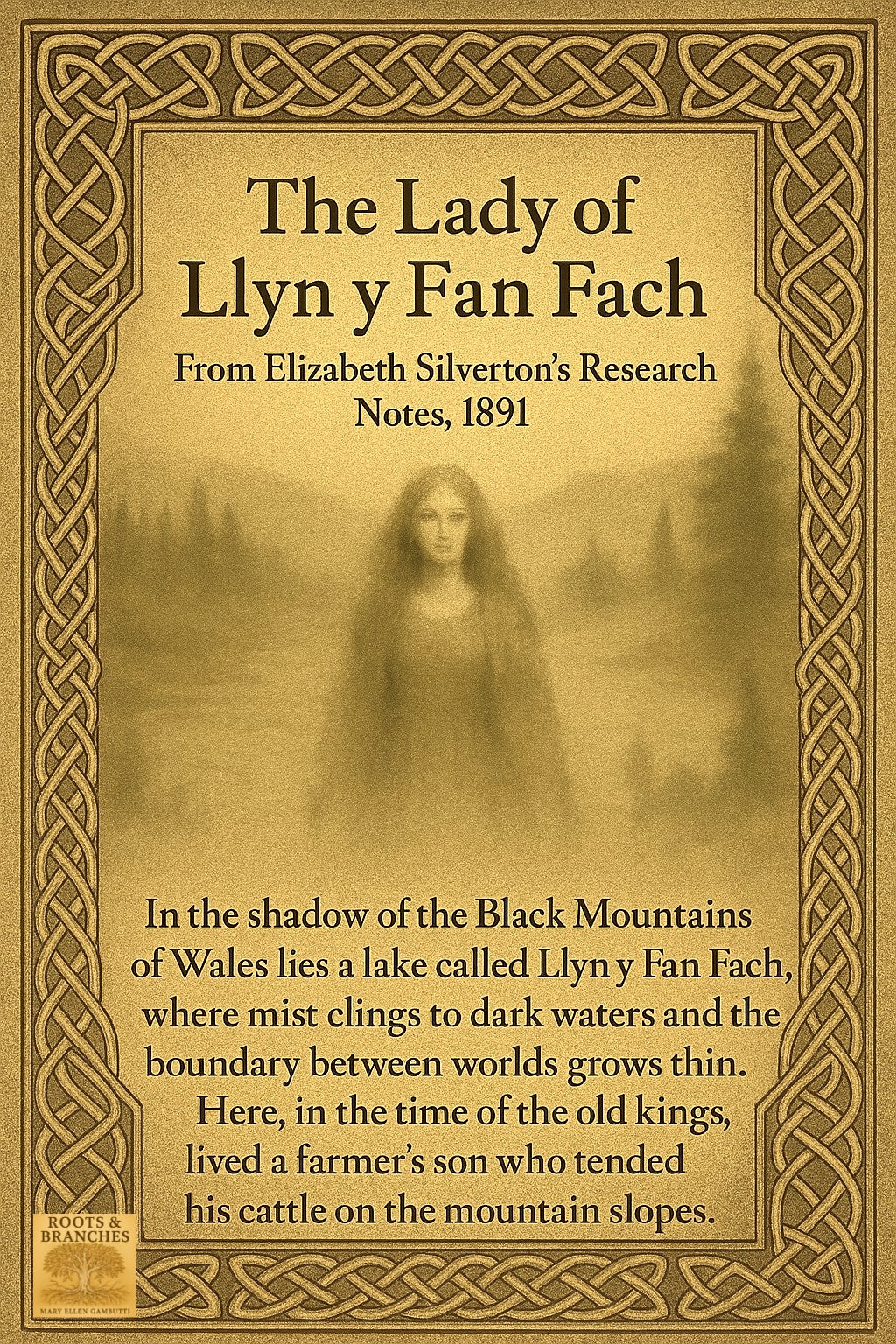
“In the shadow of the Black Mountains of Wales lies a lake called Llyn y Fan Fach, where mist clings to dark waters and the boundary between worlds grows thin.
“Here, in the time of the old kings, lived a farmer’s son who tended his cattle on the mountain slopes. One Bealtaine morning, as he watched his herd drink from the lake’s edge, the waters began to shimmer with an inner light. From their depths rose a woman of such beauty that she seemed woven from moonlight and morning mist. Her hair fell like silver water, and in her hands she carried herbs that glowed with their own luminescence.”
Helen told of the farmer’s son offering the lady rough barley bread and his hand in marriage. The Lady refused both the hard bread and his proposal. The next day, he offered unbaked dough, which she refused. On the third day, he brought his mother’s perfectly baked bread, and the Lady accepted both his gift and his proposal of marriage.
“‘I will live with you in the world above,’ said the Lady of the Lake, ‘and I will teach you secrets known only to my people. But know this: if you strike me three times without cause, I must return to my realm, and all I have given I will take back.’
“She bore him three sons, and to them she taught the healing arts of her people; which plants held fever-breaking powers, how to read the language written in leaf and root, and the proper times for gathering when the moon blessed their potency. She showed them gardens that existed in both worlds, plots where fairy flowers grew alongside earthly herbs.
‘Each plant holds a key,’ the fae mother told her sons as they walked among the healing beds. ‘But the key unlocks different doors depending on the need of the one who seeks healing. A wise physician reads not just the herb, but the person who requires it. Read the patient, not the symptom.’”
I had seen the words in Elizabeth’s cipher. I had read them in Ann Fairchild’s Blue Book, translated into kitchen remedies for the sight.
Helen continued: “The legend says he struck her, and although the nature of the blow, whether accidental or an innocent tap, is not known, upon the third blow, she returned to the lake. She brought her fairy cattle dowry with her and disappeared. Nonetheless, her healing wisdom remained.
Her three sons were the first Physicians of Myddfai, and their fame spread through Wales and beyond. Kings summoned them to court. Their descendants tended the sick with healing arts learned from their fairy mother. They created gardens that bridged two worlds. Five hundred remedies are recorded by monks at the monastery of Strata Florida, preserved through centuries of use, and translated in the nineteenth century.
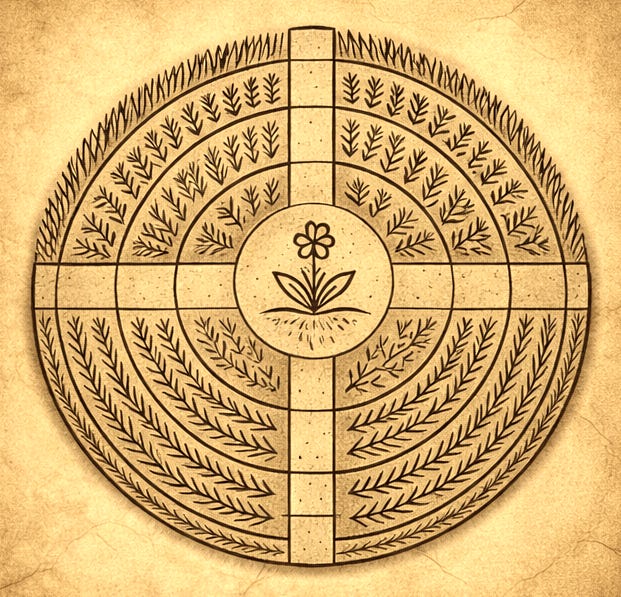
Elizabeth Silverton brought the Welsh physicians’ tradition with her to this country with her plan to design the Monastery Garden, adhering to their principles. The concentric circles and the quadrants. The placement of healing herbs by sympathy rather than taxonomy. The reflecting pools, positioned where the boundary between seeing and being seen grows thin.
The Red Book’s ancient remedies and Elizabeth’s Victorian cipher both encode the knowledge that healing requires reading the whole person, and that the green world offers a wider view of medicine.”
She paused. The stove had settled to embers.
“Yet, Elizabeth still participated in a system of selective healing. That tended some and abandoned others. That read the patient, as the Lady taught, but only when the patient arrived with certain resources. The Lady of the Lake gave her knowledge freely. To her sons. To their descendants. To anyone who sought healing. She placed no conditions on who could receive it. Whereas, the Physicians treated anyone who came to them. The tradition was open. Elizabeth built the garden according to the Myddfai principles, then let the fae decide who could partake of the healing. The knowledge was used, and it was rationed.”
The fire had gone to ash. The cedar scent pressed in through the old walls. The physicians of the lake kept no single book, but many leaves written in differing hands. They held that plants remember the waters from which they rise. Therefore, the distiller must use water drawn near the place of growth, lest the spirit of the herb wander. Fire, vessel, water, and plant must stand in the right relation. When these four are joined with patience, the plant yields not only medicine, but memory.
Attributed to the Physicians of Myddfai
Thanks for being here. Until next time.