Hello, Readers, Friends ~ I hope this note from Beyond the Hedge finds you well.
In my March 30th post Where Worlds Meet, I wrote about my foray into “the in-between” from an adoptee’s standpoint, in my novella, Through the Yew Hedge: A Tale of Identity Magic. Somewhere in that crossing from memoir to fiction, I began to understand something about integration, from the Fae, from Ruth Ann-Stella-Questa, and from how we are restored and find ourselves.
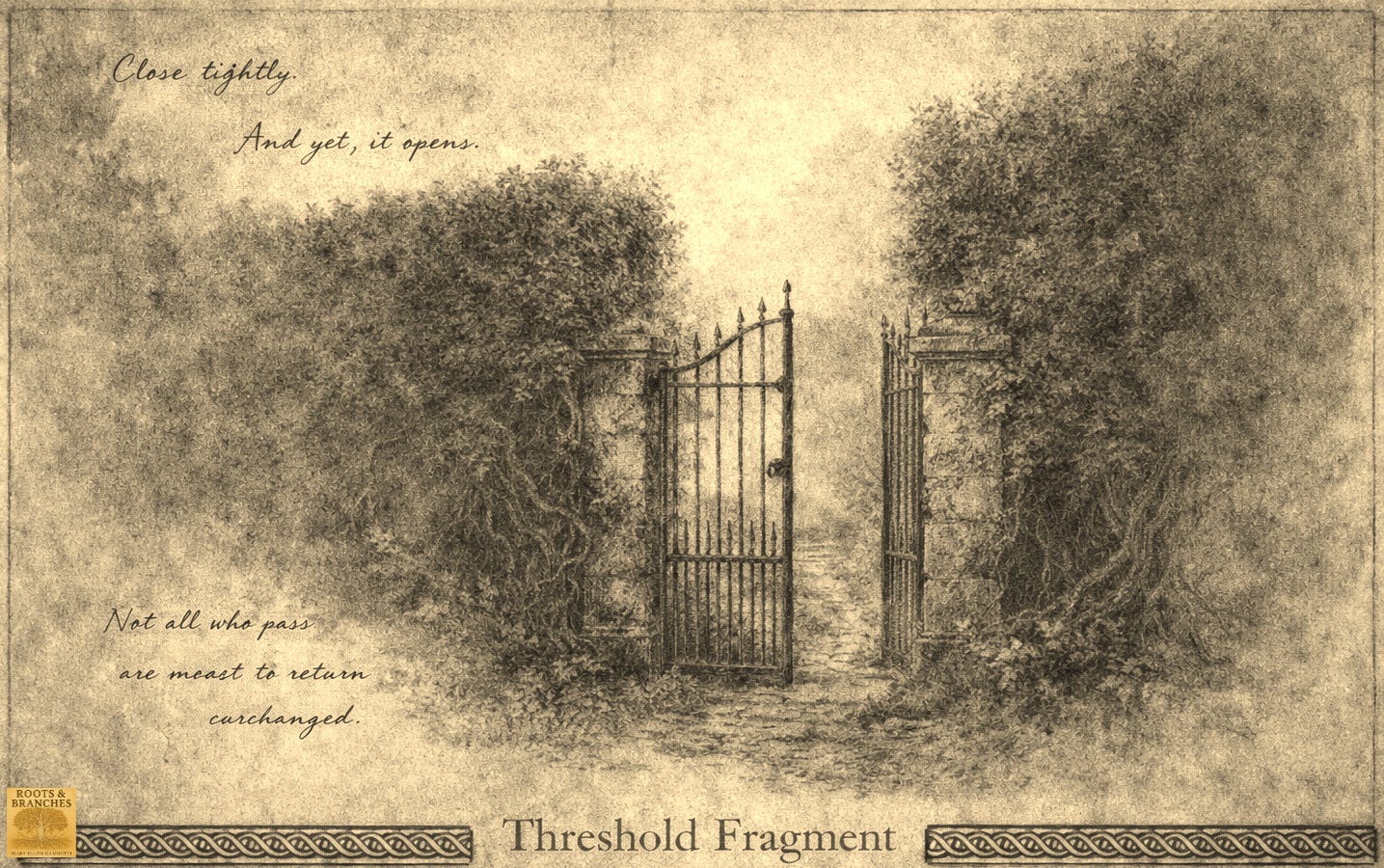
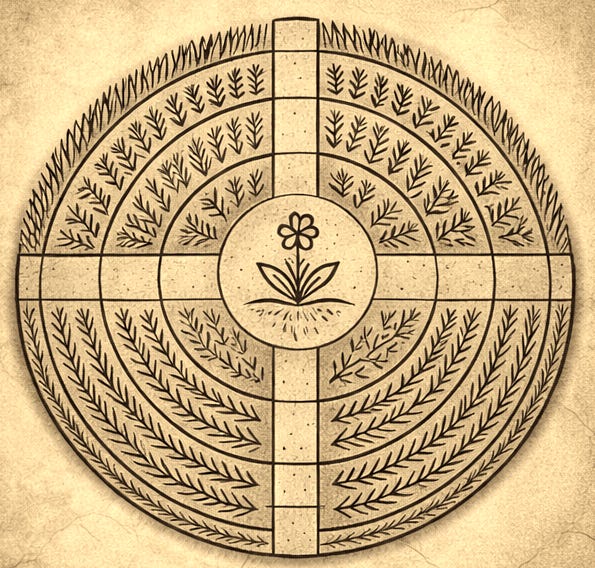
The Yew Hedge is the mysterious threshold where origins blur, and ancestral memories live just beyond reach. For adoptee Stella, the Medieval Garden, where cultivated quadrants meet wild cedar groves, is her place of integration. Two landscapes exist in relation to each other: the rational, ordered rows of herbs representing her adoptive life, and the Cedar Forest Fae, her otherworldly guardians, who carry her origins.
Wholeness is not choosing one over the other. It is becoming the gardener who walks between them.
Three things a healer must hold: the root that is hidden, the water that remembers, and the wound that does not speak. For not all illness declares itself, and not all cures are without cost.
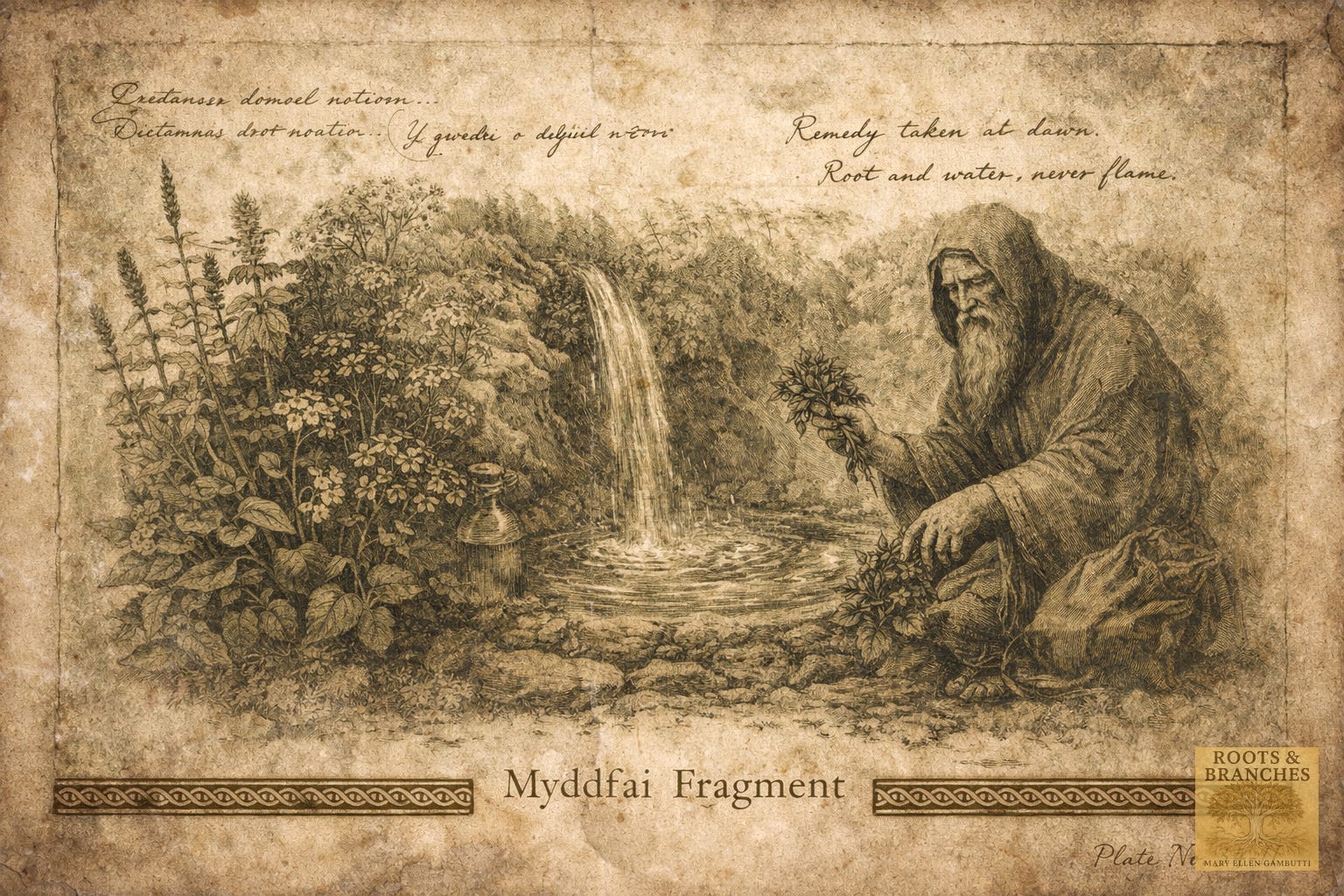
In the tradition of the Welsh 13th-century Physicians of Myddfai, healing was a relational act between the visible and the invisible. Helen’s observation in the novel that “water is a threshold element” mirrors the adoptee’s unique position — at the border between the “Otherworld” of their origins and the empirical reality of their upbringing.
For an adoptee, the “empirical” is the life that can be seen and accounted for: their legal name, their adoptive family, their cultural environment. The “mythic intuition” reflects the more spectral connection to biological origins and ancestral inheritance; present, but not fully accessible. Just as the Myddfai physicians merged herbal knowledge with unseen understanding, the adoptee is asked to hold both lived experience and what precedes it, allowing something coherent to emerge over time.
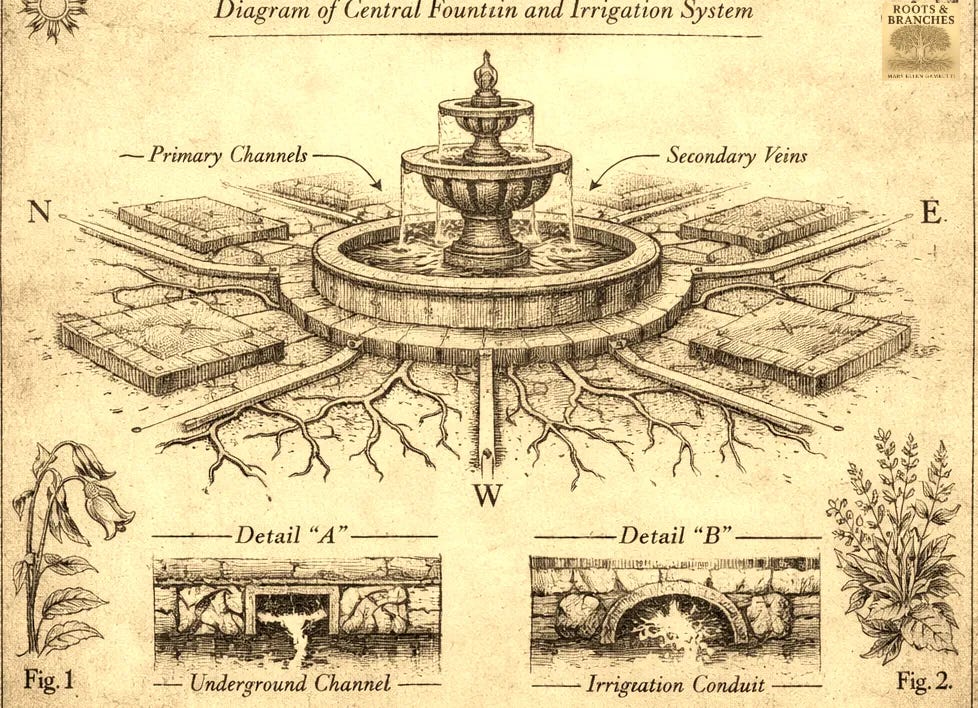
In the Substack serialization of the novella, there’s a scene called “The Estate’s Arteries” where Sarah, James, and Helen discover that what appears ornamental is not ornamental, and what appears separate is not separate. Beneath the visible paths, something is always moving.
As I wrote that scene, I stood at that garden corner with my characters, imagining their conversation. I thought of the adopted daughter I once was, and of my reunion with my first mother and half-siblings. The language is familiar to adoptees: we search for missing pieces, for fragments of identity and heritage. We anticipate that healing arrives as an answer: a record found, a truth uncovered, our story completed.
The life that might have been,
The story that is told,
The story that was withheld —
This is what it means to be adopted.
As the estate’s arteries suggest, wholeness is not a static destination. It is the permeability between worlds, the courage to let the water of one’s history flow through the stone of one’s present. As with our heroine, the work is complex.
Ruth Ann. Stella. Questa.
The adoptee must bridge disparate worlds to achieve wholeness; to integrate their lived experience with the “Otherworld” of their pre-adoption history to form a cohesive identity. Her oral tradition is fractured, so she takes up the act of telling, writing the story in her own language. Finding metaphors to make it live in the present.
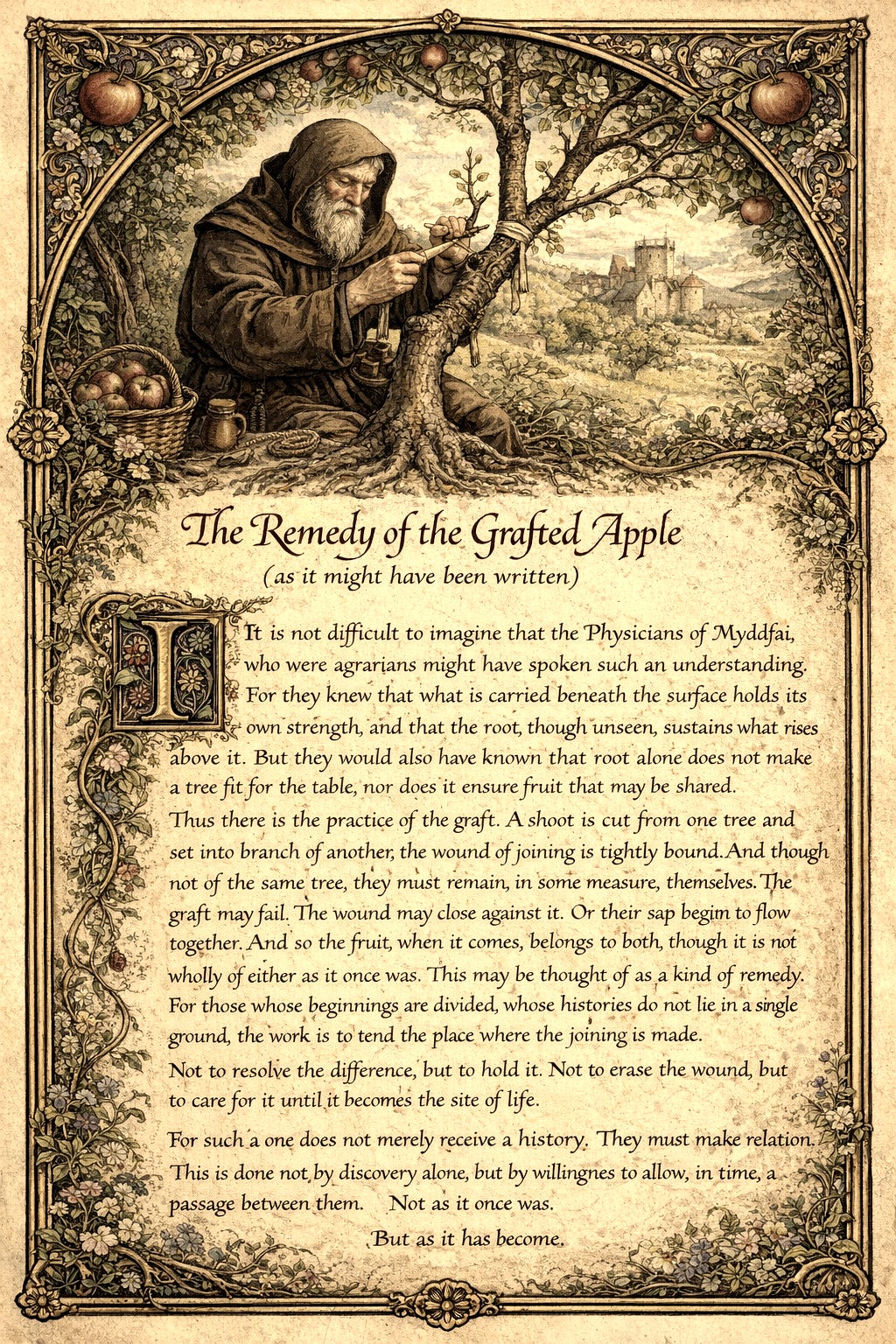
What appears ornamental, a certain tilt of the head, a specific affinity for the garden, a recurring dream, is rarely a mask. Like Elizabeth’s hidden irrigation network, these are the connections between what has been divided.
Integration is the recognition that we are the medium through which these stories flow. We are in the garden corner, where the archivist’s facts and the folklorist’s myths finally meet, carrying a heritage that, though it cannot be held in one place alone, sustains the entire estate of the self.
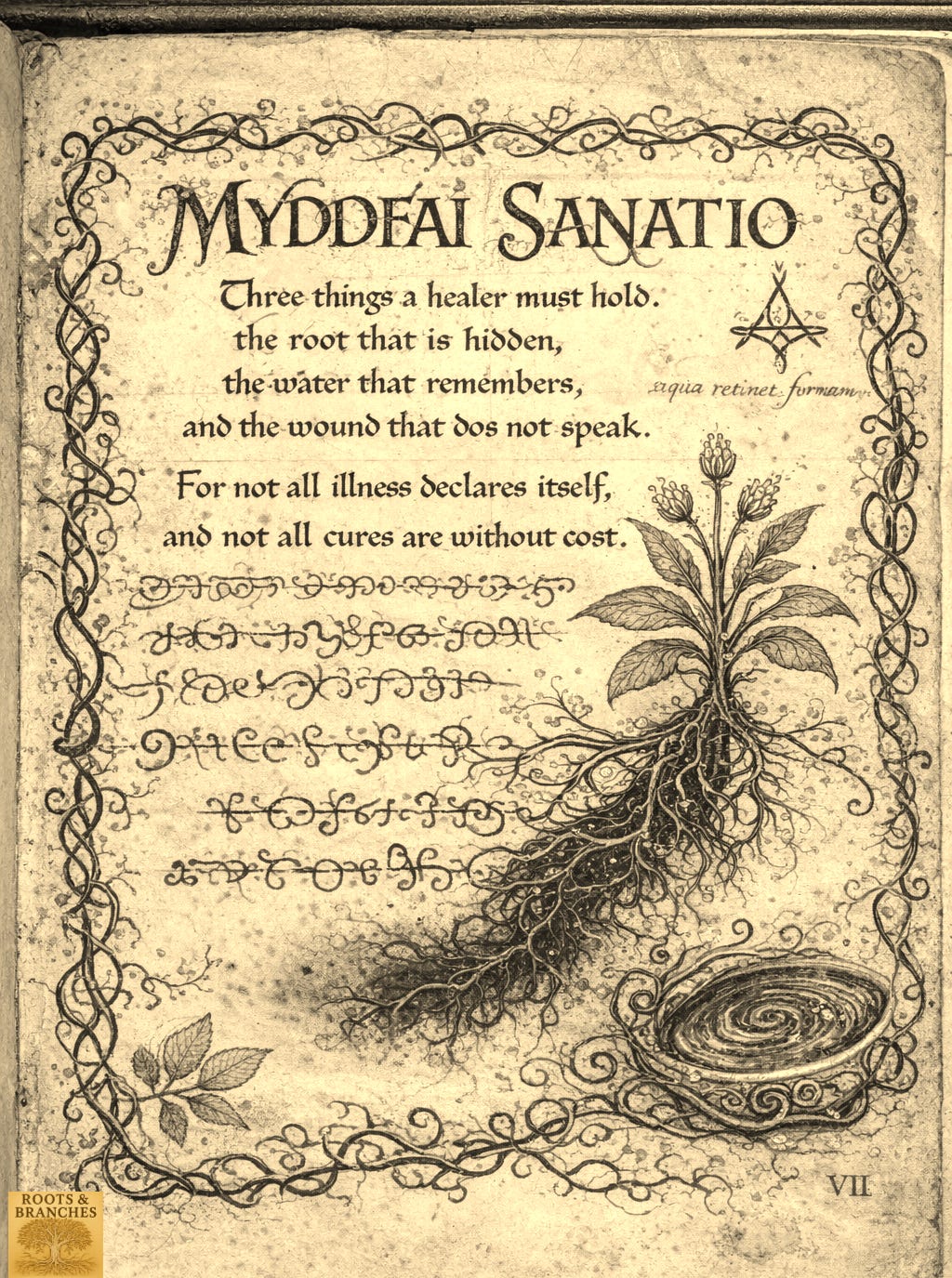
Sanatio is the Latin word for healing and restoration. The Physicians of Myddfai understood healing through three interwoven ways of knowing:
Revelation — knowledge received rather than discovered, carried across unseen thresholds. Stella, the half-fae adoptee.
Observation — the natural world studied with care, patterns learned through attention and time. Sarah, the scientist.
Virtue — the ethics of the healer, and the participation of the patient, shaping what knowledge can become. Helen, the keeper of the story, understands that how knowledge is held matters as much as what is known.
This is our work, particularly as adoptees, but perhaps more broadly. Perhaps the past, the origins, aren’t resolved, and we don’t force coherence; we don’t insist on one true narrative, but soften what was sealed. To restore what was severed, might we allow an undercurrent, the confluence of more than one truth:
A circulation. A permeability. A relation.
Not resolved, but woven.
Thank you for reading! If you’re familiar with Through the Yew Hedge or following the journey, what role do gardens play in your life? What does “sanatio” mean to you? What systems have you discovered moving beneath the visible ones in your own life? If you are an adopted person, are there stories or myths that resonate or hold importance to you? We welcome you to drop us a note.