

Part Three - Questa, continues with Midsummer and Summer Solstice
The Estate has begun to speak unspoken stories. What was once myth has become mystery, hinting at deeper work: a record of survival, of watchfulness, of bloodlines that endured by adapting. As the sun reaches its height, the living and the not-quite-forgotten gather. What has been hidden is no longer content to remain unnamed, and Stella claims her powers.
Midsummer
Fifty days from our spring celebration of Ellen’s homecoming, our reunion, and the start of her new life on the Estate, I awakened to Charles’s and James’s calling to each other across the lawn. From my window, I saw father and son at work wrestling with the Estate’s white canvas canopy, like worker ants on the Medieval Garden terrace. It was a repeat performance; its premiere having been the day of my infant naming ceremony, on the occasion of my adoption at age six months. Today, my birth mother, Ellen Fairchild, would be with me, and our extended family would celebrate high summer, sharing a meal in the shade of the canopy.
Large festive gatherings on the Estate had taken place several times during my childhood. Sarah and James invited friends from the Village and the university to picnic and lounge on the wide lawns. Winston enjoyed the company of a few friendly fellow canines, chasing a ball or frisbee. Sarah and James homeschooled me, so there weren’t many opportunities to socialize with children my age. Although it wasn’t discussed, I knew our Estate family was insular and that Sarah’s discomfort with my mirror-sight influenced her decision to limit my interactions off the Estate. Yet, I don’t recall being lonely. Considering my relationship with the Garden, Grandma Helen, the Hawthorns, and my companion, Winston, not to mention my mentor, Cedra, my days were full, and my adopted childhood was, if not carefree, somewhat contented.
I overheard Sarah and Margaret say that it would be best to keep the day sedate, since Ellen might find it difficult to cope with a true carnival-like Midsummer event. Nonetheless, the Estate hummed with preparation. Margaret and Helen were busy in their kitchens preparing dishes that honored the solstice: savory casseroles and quiches with vegetables from the Keeper’s Cottage kitchen garden, to be served with Helen’s whole-grain bread studded with herbs, honey cakes fresh from the wood-burning AGA, and fresh strawberries.
“Threshold days deserve proper marking,” Margaret noted.
Charles’s pony wagon made several basket-laden forays with the essence of summer down to the terrace. Margaret recruited her lean and limber son to decorate the Medieval Garden for our gathering. She planned for him to wind and weave wild meadow flowers across and amongst the quadrants’ boxwood edging through the herbs and Yew Hedge. So James did, and reached with his long arms, looping and trailing stems and festoons over the arbor.
When the rented camp table signalled dinner’s readiness with a sigh — was it a gentle groan? —- Charles and Margaret ushered us to the buffet, coaching us with a familiar, “Help yourselves. Plenty to go around, and don’t be shy!” So we each filled plates and took our chosen seats, and we all “tucked in” at Charles’s urging.
Music floated across the terrace: the ethereal sound of Celeste’s Celtic harp. She was a graduate student of musicology. Her draping satin green dress, as she perched on the wide edge of the Iron Fountain’s reflection pool, seemed to reflect the gleam of the slanting light. Strings chimed under her lithe fingers; their graceful bardic tones reverberated against the ancient iron.
As the sun began its slow descent and the harpist’s music wove through the evening air, Helen cleared her throat.
“I’d like to share a story, if you’re willing to listen. One that feels appropriate for this place—and this moment.”
We settled into our chairs. Sarah leaned forward, her skeptical eyebrow appeared as it did so often when her mother prepared to tell an old tale. The Garden, too, leaned in to listen.
Folklore of The Estate
Helen’s story was new to us. The Folklorist, whose sparkling hair shone as the sun dipped behind the Cedar groves began, and all of us were politely hushed.
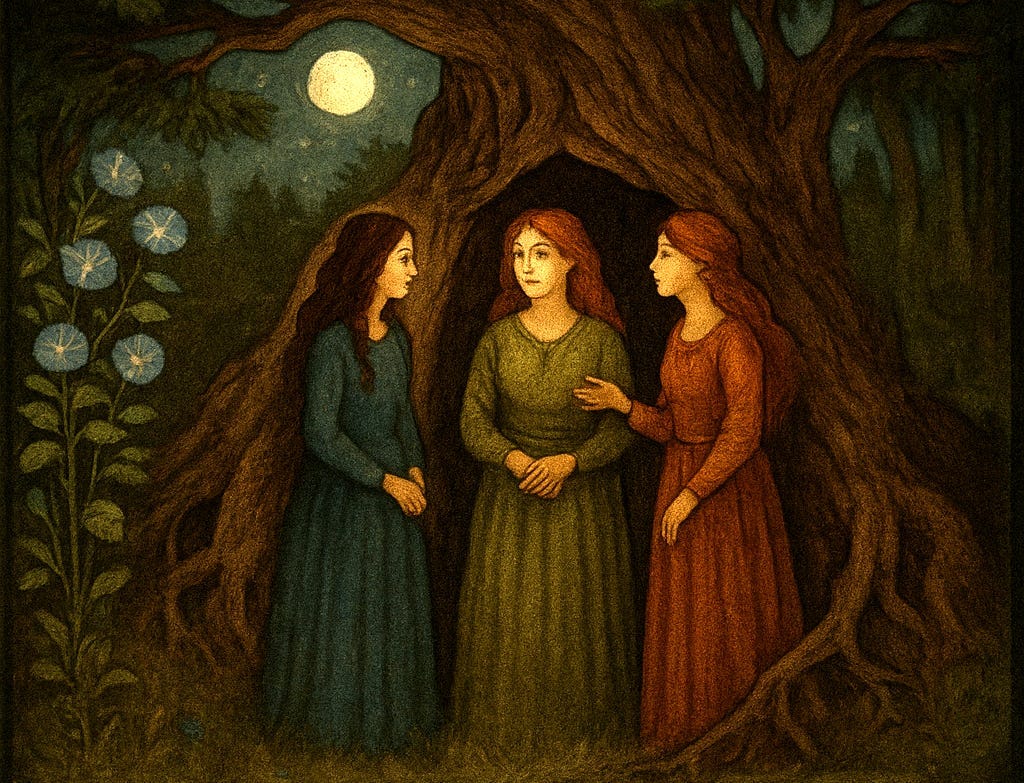
It’s local lore from the deeper origins of The Silverton Estate: the. story of three sisters and something unusual in this land long before Elizabeth Silverton’s crew laid the first stones. Rumors of the sisters’ odd ways aroused suspicion in the Village. Worse yet, there were threats of retribution for perceived wrongdoings. For fear of persecution, the sisters retreated to The Cedar Grove, where they were said to dwell beneath the roots of one of the largest trees. It was believed that the Cedars’ magic sustained them.
One sister was said to be a guardian of growing things. She understood the language of roots and branches. She knew that the trees bridge the earth and sky. As the legend goes, the second sister was a keeper of thresholds and transitions; veils between moments, between seasons, what was and what might be, and between day and night. The third sister was said to tend the blossoms that bloom between worlds; messengers between seen and unseen realms.
Folklore tells us that when Elizabeth planned The Garden, she preserved what remained of the vast primeval Cedar Forest. The legend goes that she was aware that the sisters dwelt there, and rather than disturbing their sanctuary, she preserved it, designing The Medieval Garden to honor their ancient guardianship.
James interjected, “I’ve heard that Cedra, or maybe a predecessor, was key to the preservation and conservation of the Forest remnant. I heard that on campus from the time I was an undergrad. We know that Elizabeth’s bequest ensured her Estate would be maintained as a botanical paradise where study, physical and contemplative nurturing could continue.”
“Yes, James,” Sarah said, “I recall you mentioned that when you first showed me around, before Mom and I moved in – before Stella came to live here.”
Margaret nodded slowly. “My grandmother used to say something like that. She believed Miss Elizabeth knew about things not written in books.”
Helen added, “Folklore often arises around the qualities of rare settings. Whether these stories are preserved as literal truth, symbolic, or the wisdom of generations, is for each listener to decide.”
Our storyteller lifted her hands in a soft expression of conclusion. I saw the glint of perhaps in her eye, as she turned toward the forest’s swaying branches beyond the Yew Hedge.
The harp, the spray and trickle of the Iron Fountain and in its reflection pool were the sound and light that had accompanied Helen’s ancient tale. I thought of the three sisters who had chosen love over fear, sanctuary over suspicion, and how their choice rippled down to this moment. This garden, this gathering of people who had found their way to each other across time and space.
“The light’s changing,” Charles observed. “Perhaps it’s time,” without specifying the time for what, but we took his cue. James gathered the remains of our feast, while Margaret and Helen collected the dishes, loading the remnants onto the pony cart.
“We’ll leave the canopy for tonight,” said Charles. Ellen, Sarah, Helen, and I watched the terrace settle into twilight. The harpist packed her instrument. Helen stood, extending her hand to Ellen. “Shall we?” Ellen responded, “I’d like that very much.”
What began as a family celebration became a ceremony. Spring’s fragile beginnings had ripened into fullness at the Solstice. The season of power had arrived, and what still remained as a story now stepped forward to claim its full voice.
The Second Council
Summer Solstice
The spring of reconnection had bloomed with a promise of power, and the boundaries were brilliantly permeable. On the morning of our Midsummer festivities, the Council summoned Ellen, Sarah, and me to an evening ceremony of reconciliation. Helen was warmly welcomed.
Sarah and I walked arm in arm with Ellen between us; Helen had my right hand. We needed no lanterns; twilight stars and the day’s last gold lit the sandstone paths from the Terrace to the Concentric Circles, our appointed meeting place.
The Rings drew me inward, as they had attracted the Fairies who transported me through the mirror portal on a Winter Solstice dawn. I stepped over the outermost herbs, the barrier of Rosemary, Sage, and Rue, and faced my Mentor where she had instructed me with dewdrop reflections so long ago.
Wearing the long, brown, hooded robe of The Silverton Monastery Garden, Abbess Cedra proclaimed:
The Council recognizes this gathering as sacred. Here, diverse bloodlines converge. Ruth Ann, Stella, Starlit Bridge Between Worlds, you stand in a line older than the Cedar Forest, a lineage that knew Brigid as The Flame, as Keeper of Thresholds, and Healer. You have proved to be a Seeker of Truth and Change. Your Earth Mother, Ellen, bears within her the dormant fire of the Tuatha Dé Danann, gods who once walked among the green hills of Éire.
We three women stood in the Fairy Council’s midst: the adoptive mother, the birth mother, and the halfling daughter. An Adoption triad. A Constellation. A living spiral of entwined love, loss, and finding.
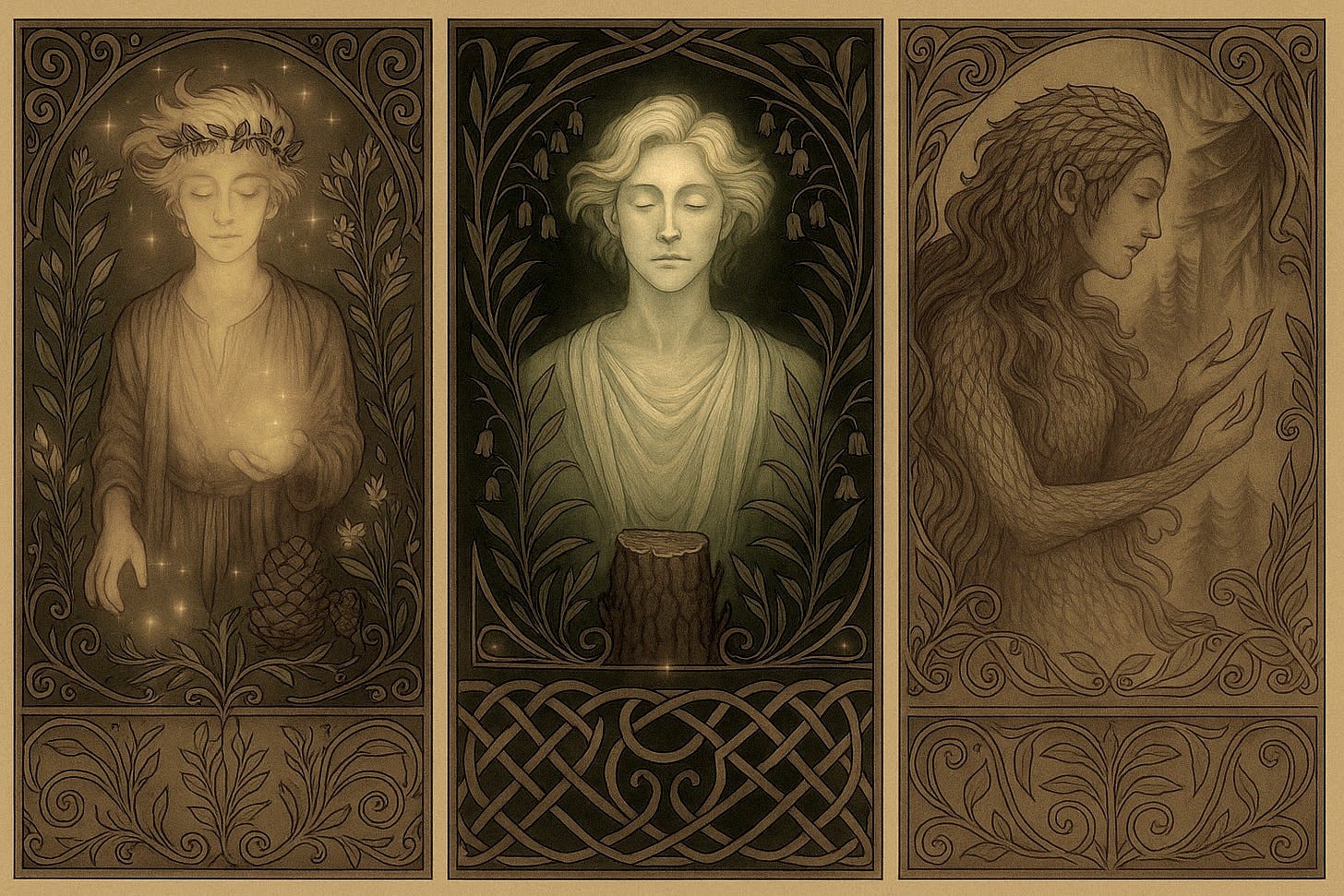
Stella’s Response: I was born under crossing stars. The child, Stella, rode her tricycle on the sandstone walks and dabbled in the fountain pool. I was called to rekindle an ancient Fae line by Cedra of the Cedar Root, Eleris of the Shifting Veil, and Selwyn of the Blooming Flame. In shadow and silence, they guided me to this place. At the height of sun and season, my Guardians bear witness to what was written in The Garden’s bones.
Puca on the Spiral Path:
Eleris and Selwyn join Cedra, and together, we shape-shift into black velvet horses with glowing red eyes. We are Púca, with good fortune and felicitations, with a breath of ominous. The paths have aligned. Watch us move!
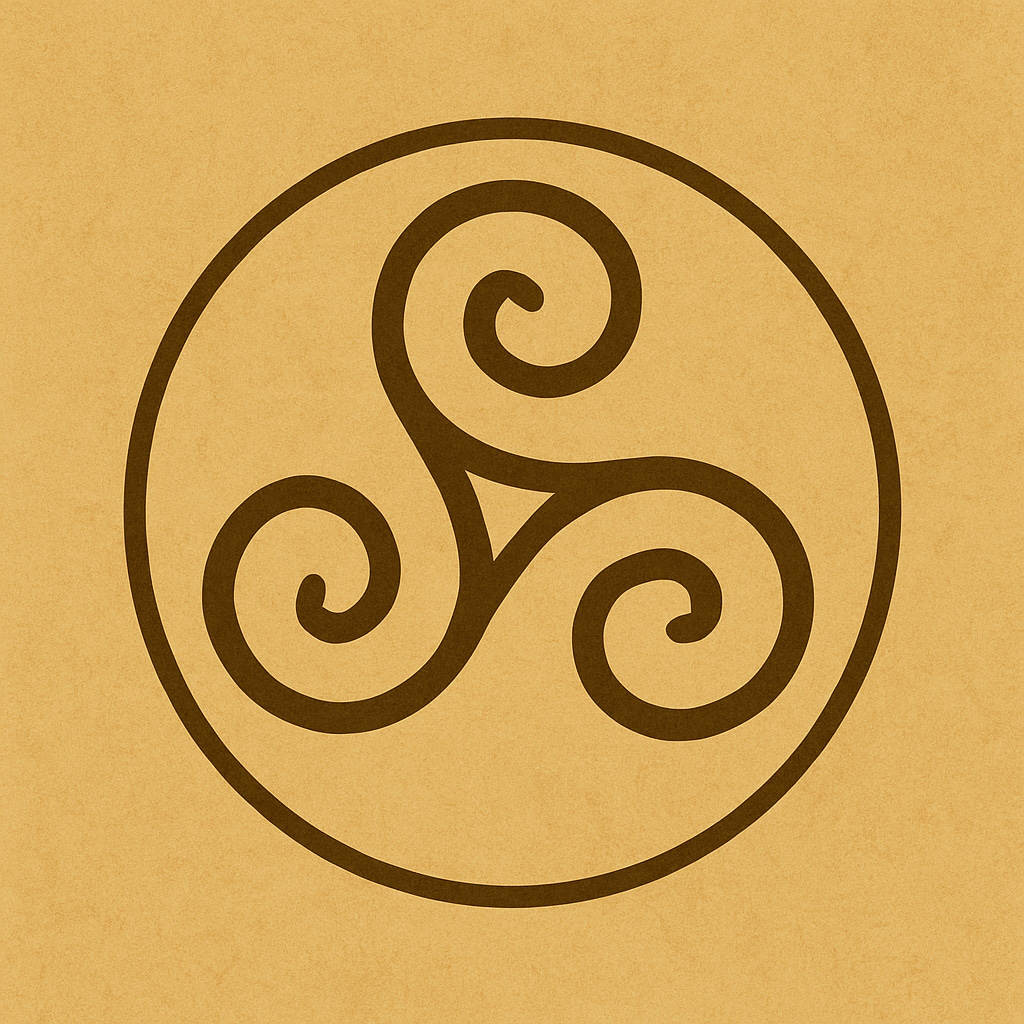
The long-legged creatures walk a slender path on The Garden’s rings, their hooves leaving traces of silver Summer Solstice light. Wearing crowns of cedar greens and rowan berries, the Púca weave a path—the triskele—the triple knot. As each hoof rises, frost-light forms a translucent and solid reflective wall, a mirror held by The Garden’s Sacred Geometry. They spiral inward, circling the Fairy Ring; the frosted wall of light, visible only to those with the Sight. The Púca reach the center and return to their Council forms: Cedra, now in Cedar Dryad shape, Eleris and Selwyn return to Elven folk, as they carried me here one long past Winter Solstice Eve—all of us more or less human.
Cedra: Ruth Ann, Stella, the Seeker—Questa, now witnessing your single self. You were found here at the Winter Solstice. Now, at the Summer Solstice, you’ve found yourself.
Eleris: Names hold power in our realm, the name given at birth, the name grown into, and the name chosen— all are facets of your true self.
Selwyn: What do you call yourself, Child of Two Worlds, Daughter of Two Mothers, Keeper of Three Names?
I am Ruth Ann, born of fairy blood, Stella, raised in Sarah’s love, and I am Questa, and I chose my truth.
Cedra: Questa, by choosing, so shall you be known in all realms.
With that, the Fae Council returned to their home in The Cedar Grove. The glow of triple-spirals lit the Garden paths to the Potting Shed, Manor House, Guest Cottage, and the Keeper’s Cottage.
No longer in shards or fragments, my facets whole, I felt a reconciliation between Ruth Ann’s human heart, Stella’s fairy sight, and Questa’s full acceptance.
I turned toward Ellen’s sigh to see Sarah take her arm to steady her. I saw wonder in her eyes. Her soft whisper had grown in strength, and she called to me across the Herb Circle:
“The name was in my dreams before you were born, Questa, ‘The One Who Seeks.’”
Sarah replied, “The perfect name for a bridge-walker. Protect, love, and teach.”
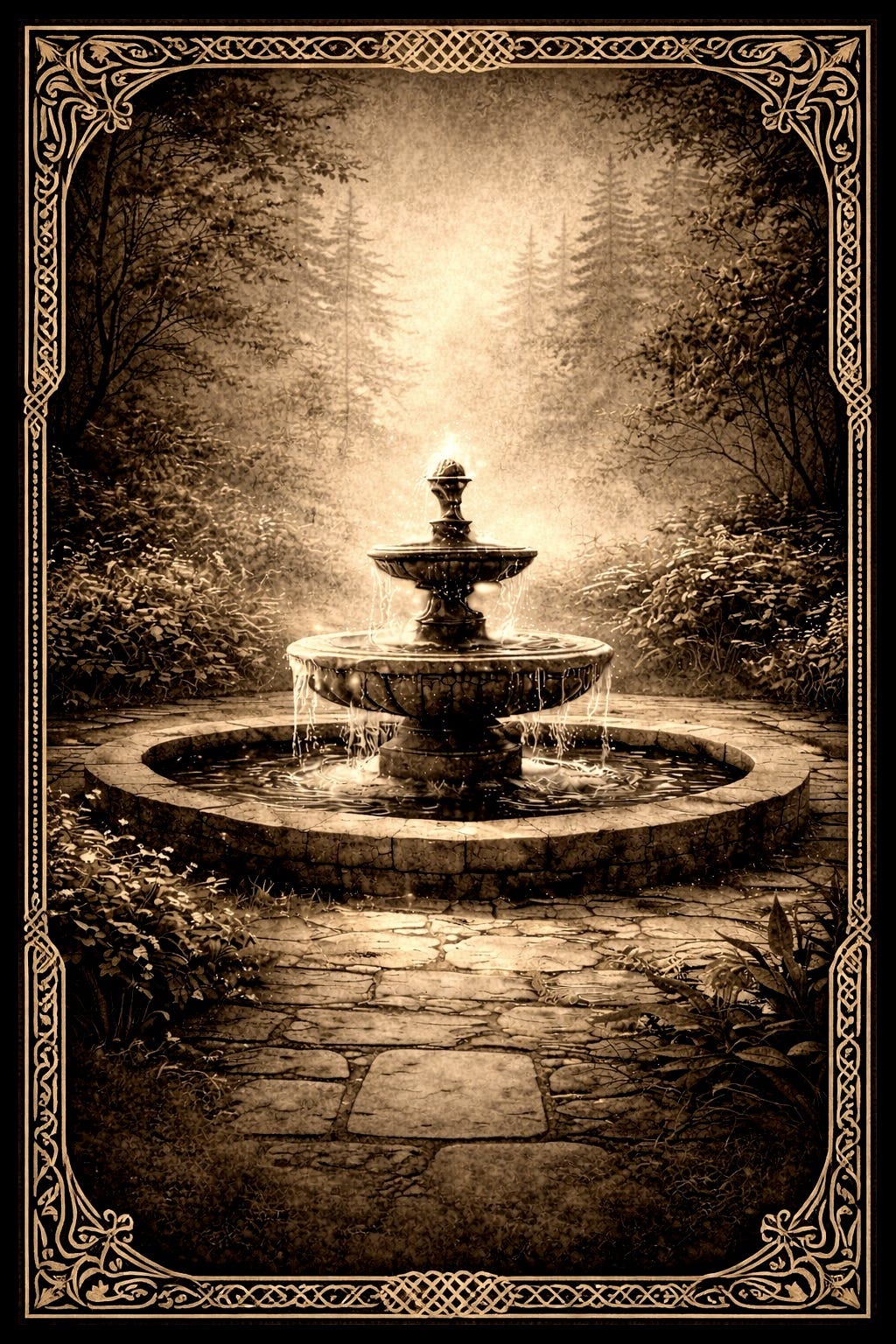
Gentle Iron Fountain music drifted in the faint glow of the triskele lights, from the place where our Midsummer celebrations had begun. The longest day was ending, but this reconciliation was the beginning of a love that transcends the boundaries between worlds.
End Episode 1
We hope you have enjoyed this episode! Ahead, there is much more to learn, celebrate, and grieve. Next Wednesday, the work turns inward and backward: to family patterns carried in silence, and DNA as evidence and inheritance, as we read what is revealed when biology, history, and love speak to one another.
Please join us! Begin at the Prologue or anywhere in the story that suits. All episodes are free in advance of my release as e-book and softcover.
We’d love to hear your comments!
Mel and Islay