

Adoption Myth and Magic
I’m so glad you’re here for another episode of our magical realism novella, “Through the Yew Hedge: A Tale of Identity Magic.” It’s a long post this week, friends, and it’s free, as will be the rest of the series.
The Garden has always responded to Stella’s attention, but her adoptive mother, Sarah Caldwell, botanist and resident plant curator of The Silverton Estate Garden, must learn new ways of wondering when she witnesses the impossible. Part Two draws to a close when a mysterious blue book reveals truths that have been waiting beneath the yew hedge all along...
Sarah’s Garden Wonder
The late afternoon light slants golden through The Garden, creating long shadows across the lawn. Stella moves through The Garden with confidence that belies her ten years. She pauses to caress a leaf, to touch a blossom, or converse with the natural world. Flickering catches her eye. An iridescent blue butterfly alights on her pointed finger. Her face is lit with wonder; her smile is like a blooming rose.
Now, a monarch butterfly circles her twice and settles on her forehead. She converses with delicate creatures. They stay on her finger and head as she walks to a wilting Echinacea. I’d noted this morning that it is weak despite the conditions.
She lowers herself to the plant, the butterflies still balancing, and the drooping purple petals straighten in time-lapse; its soft green stem, nearly bent to the soil, rises to its proper stature. The plant now appears to have recovered its health. Stella is a child of mystery, a living bridge between the realms of possible and impossible.
When the butterflies took flight, disappearing over The Yew Hedge, I noticed the black rose appeared among the herbs. It was a variety I’ve not been able to identify. It seems to bloom when Stella is near—astonishing!
Helen once told me, watching me struggle to document the Garden’s responses to Stella’s presence, that what happens, even though you can’t explain it, may be real in another realm. My knowledge of soil and microclimates can’t always account for the wonder I witness. When there is magic, I can let the documentation rest...
“Mom? Is dinner ready?”
“Almost, Grandma will call us soon.” She looked at the echinacea and said, “I see it’s doing better. Did you... do something to help it?”
“It was thirsty, but not for water. It needed attention. Plants are like that sometimes. They just need to be seen. Like people,” I continued with the straightforward wisdom of childhood. “You can give someone food and clothes, but they still need to be seen to grow properly.”
How many times have I measured and documented Stella’s development, height, weight, and verbal milestones, while missing what an essential quality?
As we walked toward the house, Sarah noticed how The Garden responded to me. The morning glory vines extended beyond their support. The roses turned like faces following the sunlight. Herbs seemed to release their fragrances more strongly in my wake. I was a nurturing presence in her life, as she was in mine. I needed her for physical care, it’s true, but her love and affection were life-affirming.
The black rose is in the herb bed, its petals absorbing rather than reflecting the evening light. Might this oddity deserve a new category? Perhaps what is out of the ordinary isn’t always an error to be corrected or changed, but a path to understanding.
“Mom? Are you coming?” I called. “Right behind you,” she replied.

Adoption Matters
At the edge of the herb garden, Sarah watched me transplant seedlings, placing each tiny plant into prepared soil. The afternoon light caught my copper hair, highlighting that I was a child from another woman’s body.
“You have good hands for this,” she said, “you have dexterity and patience.”
“The plants like me handling them. They like my touch. Plants tell me what they need.”
Sarah nodded, struck by the parallels between our task and our relationship.
“You know, gardening has taught me as much or more about raising you than parenting books have.”
“How? I’m not a plant, Mom.”
“Of course not, you’re a human child, Sweetheart. The designer must choose the right plant for the soil and light conditions to give the plant a good start. For plants to grow and thrive, the gardener’s routine must include nourishment in the form of food, water, and a healthy environment. Some plants require the sun, and some need shade. And yes, Stella, touch. That is love.”
Sarah touched the tiny thyme plant. “When I adopted you, I had ideas about who you would become. Now I understand that your nature is your own. Raising a child not born to you means that when you arrived in the world, you were another woman’s natural child.”
“You’re saying I’m like a garden you didn’t plant?” I asked, amused.
Sarah replied, “Gardeners and parents participate in something larger than ourselves.”
I had an answer: “Something like, Elizabeth designed these gardens, but they keep changing and becoming something new?”
“Exactly!” Sarah said with a surge of pride at my insight. “The Garden stays part of its original design while it responds to its caretakers. I may never know everything about you, Stella, but I try to learn how to respond to your unique needs, and care for you with love.”
She brushed soil from her hands, a scientist finding words for what her heart had known for years. “That’s not a limitation of our relationship. It’s what makes it beautiful.”
Need for Truth
Sarah had always been honest about my adoption, although not always straightforward.
“I was happy to find you,” she would say, pressing her forehead to mine.
“Out of all the babies in the world, I chose you.”
But she never disclosed how she found me, or why she didn’t show me my birth certificate. I wouldn’t learn the limits to adoptees’ access to their truthful origin stories until much later. “A closed adoption,” I overheard her say to Helen.
“What else do you know about me? Are there papers about me?”
“Yes,” Sarah answered in that careful way. “There are papers that are kept safe until you need them. Until you’re older.”
“Where? Where are the papers?” The questions lingered like the pain of separation.
Buried Secrets
Sarah’s protective instincts had heightened after my first major mirror incident. She told herself I wasn’t ready for the facts of my original circumstances, yet she questioned her objectivity.
Are my emotions overriding my good judgment? What would Helen say?
Her mother would argue that children deserve the truth when it’s presented appropriately.
I know secrets can be unhealthy. Can reveal themselves at inopportune moments.
She buried her fears. No one had witnessed the impossible blooms surrounding the infant in the Ring. Except Charles! She recalled that he drove us to the house in the one-horse sleigh that Winter Solstice morning. The legal documents couldn’t possibly capture the magic of how the black rose appeared as if it were announcing my arrival. Some truths require context to be properly understood.
Sarah’s ambivalence churned her thoughts until she concluded that the adoption decree and related papers, with their sterile language and the conspicuous absence of birth parents’ names, revealed nothing of importance to me. At eleven years old, there was nothing in them that I needed to know. I sensed she was holding back an important part of my story; the story that was vital to me, not to her.
My questions about documentation and origins had become precise. More pointed. More difficult to deflect with comforting generalities. It was no longer enough that I be told “You were chosen” and “You were loved above all the others.” Perhaps it was a maternal angst that triggered her impulse to hide my vital papers. Perhaps it was her self-righteousness: “I’m in control. I make the choices about what is best for my daughter.”
Concealment
One night, Sarah waited until my bedroom door was closed for over an hour before unlocking the file drawer in her study to remove a thick, elastic-bound manila folder. She took the back stairway down two flights to the basement Archives’ back room, to the least-used range of six-foot-tall steel file cabinets; the farthest cabinet, and slid the steel step stool over so she could reach the top drawer. She clutched the chrome handle and yanked. Force needed to open the old metal drawer. She winced at its protesting screech. In the process, while wedging my records in among file folders of out-of-date receipts, catalogues, and antique inventories, a loose piece of backer board slid to the floor.
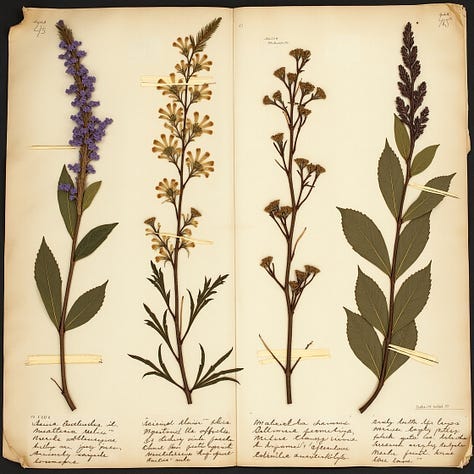
Sarah stepped off the footstool and bent to pick it up. She knew it was the material used to mount pressed flowers and other botanical specimens, but it wasn’t a finished herbarium floral plate; it was a blotchy note scrawled in ink on water-stained backing, in what appeared to be Elizabeth Silverton’s handwriting. A draft of enumerated items, ideas, some underlined, some crossed out.
This is how she sees and wants to present the medieval monastery-style garden’s structure and function. Why does my heart jump? Was this fragment intentionally filed in this remote cabinet? Picked up by someone who thought it was important enough to save, but didn’t know the Archives? Was it found on the grounds or under the potting bench, Elizabeth having dropped it while she worked? Was it stashed here like I stashed the papers?
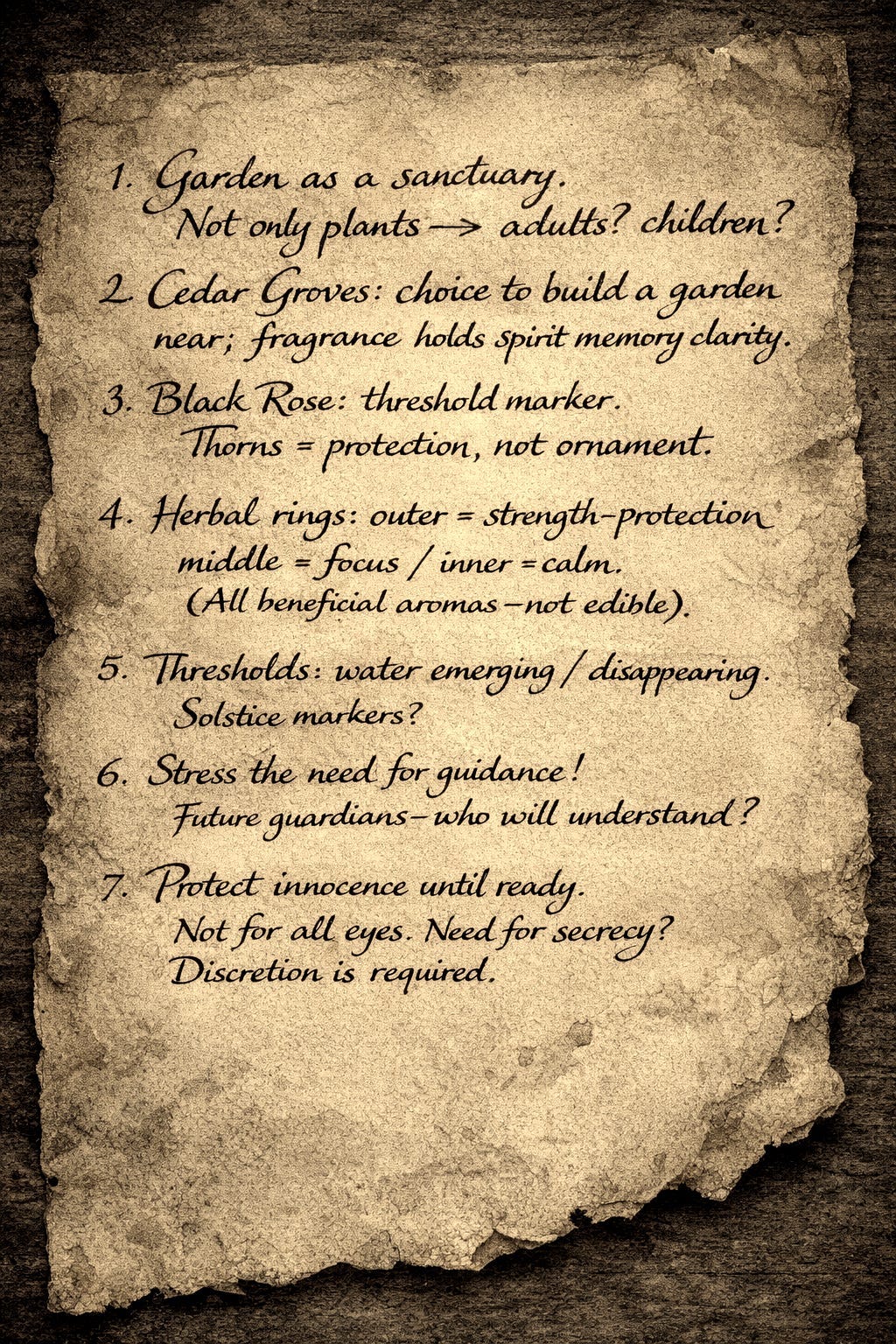
1. Garden as a sanctuary. Not only plants → adults? children?
2. Cedar Groves: choice to build a garden near; fragrance holds spirit memory clarity.
3. Black Rose: threshold marker. Thorns = protection, not ornament.
4. Herbal rings: outer = strength - protection / middle = focus / inner = calm. (All beneficial aromas - not edible).
5. Thresholds: water emerging / disappearing. Solstice markers?
6. Stress the need for guidance! Future guardians—who will understand?
7. Protect innocence until ready. Not for all eyes. Need for secrecy? Discretion is required.
This list rings a bell. Maybe Elizabeth was aligning her thoughts, preparing to write the personal note I uncovered in her private Herbarium a while ago, softened for others’ view.
It was the coarse, card-like material Elizabeth would have had on hand while pressing flowers, perhaps left behind in haste, picked up by a gardener, former curator, or groundskeeper; it was tucked away aimlessly. Memorabilia of the Foundress. Once confidential, it had become public. Hidden among mundane, antique files. Uncovered in Sarah’s act of concealment.
Elizabeth wouldn’t have anticipated that a trusted future curator might struggle with similar decisions about disclosure. That’s crazy, Sarah. Snap out of it!
She cast a worried glance at the open file drawer where she had just buried my personal records, where Elizabeth’s jumbled, misfiled fragment of truth was hidden for fear of controversy; academia masking her lack of convention. For a female scientist of the Victorian era, credibility meant conformity.
Sarah was also constrained by convention and how she appeared to her peers, and she documented my unusual responses to plants as botanical anomalies. Her choice, now that her concealment mission had become more complex, was whether to trust that the truth might serve me better than her protective secrecy.
I should give it to James...
Briefly, she considered that the note should be kept with its polished counterpart in the Archives. But she chose to replace it in the drawer from whence it had flown when my thick folder jostled it.
Sarah, now morose, retreated to her bedroom, leaving my adoption decree, the police report, and evidence of my birth mother’s name in the top file drawer.
To protect my daughter.
In the end, Sarah’s sympathy and respect for Elizabeth’s work, and for her own role as curator, were deepened by all that she’d learned. She resolved to keep her commitment to her unmet mentor.
She rationalized that her documentation of my unusual responses honored Elizabeth’s work. She, too, researched and recorded phenomena that her contemporaries wouldn’t condone nor couldn’t explain. A capable, single woman whose academic work masked her private projects.
Elizabeth’s note demonstrated her courage to trust that curators would one day validate her observations, with or without explanation. Sarah tortured herself with the notion that she could be limiting a child, not hers by birth. Yet she stood in the way of my learning about myself.
Regardless of Stella’s origins, doesn’t she have a right to know?
Sarah had a plan for my future, sure. But did it align with my inherent needs? Perhaps my adoptive mother was faced with a moral dilemma.
Under the Microscope
Once again, Sarah’s approach to me became intrusive, as she moved from casual notes to structured experiments. We had traveled this route several years earlier after my first strange mirror perception.
Always reserved, I became more self-conscious, sneaking around the edges of The Estate, seeking interactions with plant life, hiding my moments of quiet joy. The black roses ceased to be my magical companions. To Sarah, our connections were “anomalous botanical responses.”
When I returned from an afternoon’s wander in the Cedar Grove, she confronted me:
“You documented a half-hour with the trees. Did you notice any changes in reflections or in the breeze? Bark patterns?”
Her questions weren’t merely social. She scrutinized me. She was judgmental. Critical. She disrupted my thoughts. My privacy. I avoided her when she worked in The Garden. I saved my deepest connections for moments of solitude.
My bedroom mirror, the one reflective refuge Sarah rarely monitored, was where I could practice the techniques Cedra gave me without Sarah analyzing each ripple and fluctuation.
“Your mirror-sight seems to be intensifying,” Sarah observed one morning, noting how the hallway mirror rippled as I passed.
Sarah’s surveillance added to my fractured identity.
I asked myself, was I, Stella, Sarah’s daughter, a scientific subject? Was I Ruth Ann, the abandoned child with unexplained abilities? Was I someone else entirely? My heightened awareness of adoption made for a perfect storm of identity confusion. If Sarah, who had raised me from infancy, needed to document me like a rare botanical specimen, how weird and different must I be, I wondered. Unanswered questions about my origins were pressing. Bewildering.
Helen noticed my withdrawal. “Your mother loves you,” she said one afternoon in the Hidden Library. “She’s trying to understand in the only way she knows how.”
“By treating me like an experiment?” I asked, more bitterness in my voice than I intended.
“By creating structure around what frightens her,” Helen corrected.
“The unknown terrifies a scientific mind—naming and categorizing is how Sarah creates safety.”
But understanding Sarah’s motivation didn’t diminish its effect on me.
The constant scrutiny reinforced my sense of “otherness.” I was neither human in the way Sarah was, nor was I something else.
In the weeks following Sarah’s discovery of Elizabeth’s note, a subtle shift occurred in the rhythms of our daily life. Sarah’s documentation continued, but with less urgency. Her casual observations now felt like loving attention rather than scientific scrutiny. She didn’t startle when I paused to listen to conversations that only I could hear.
“The Garden has its wisdom,” became her explanation when Helen questioned the unusual botanical responses around me. “Elizabeth designed it that way.”
Sarah focused on what felt manageable: teaching me the practical applications of the herbs Elizabeth had so carefully positioned, sharing Helen’s Celtic stories that provided context for my experiences without frightening explanations, and documenting my development with the patient care of a gardener tending something precious.

The basement Archives held their secrets—both Elizabeth’s letter about therapeutic garden design and my adoption papers with their mysterious circumstances—while upstairs, life settled into patterns that felt almost normal. Almost.
I practiced early mirrorwork with Cedra in The Cedar Grove, learning to anchor my sight without losing myself in reflections. Helen told stories that matched my experiences, as if she somehow knew exactly which Celtic tales would help me understand my nature.
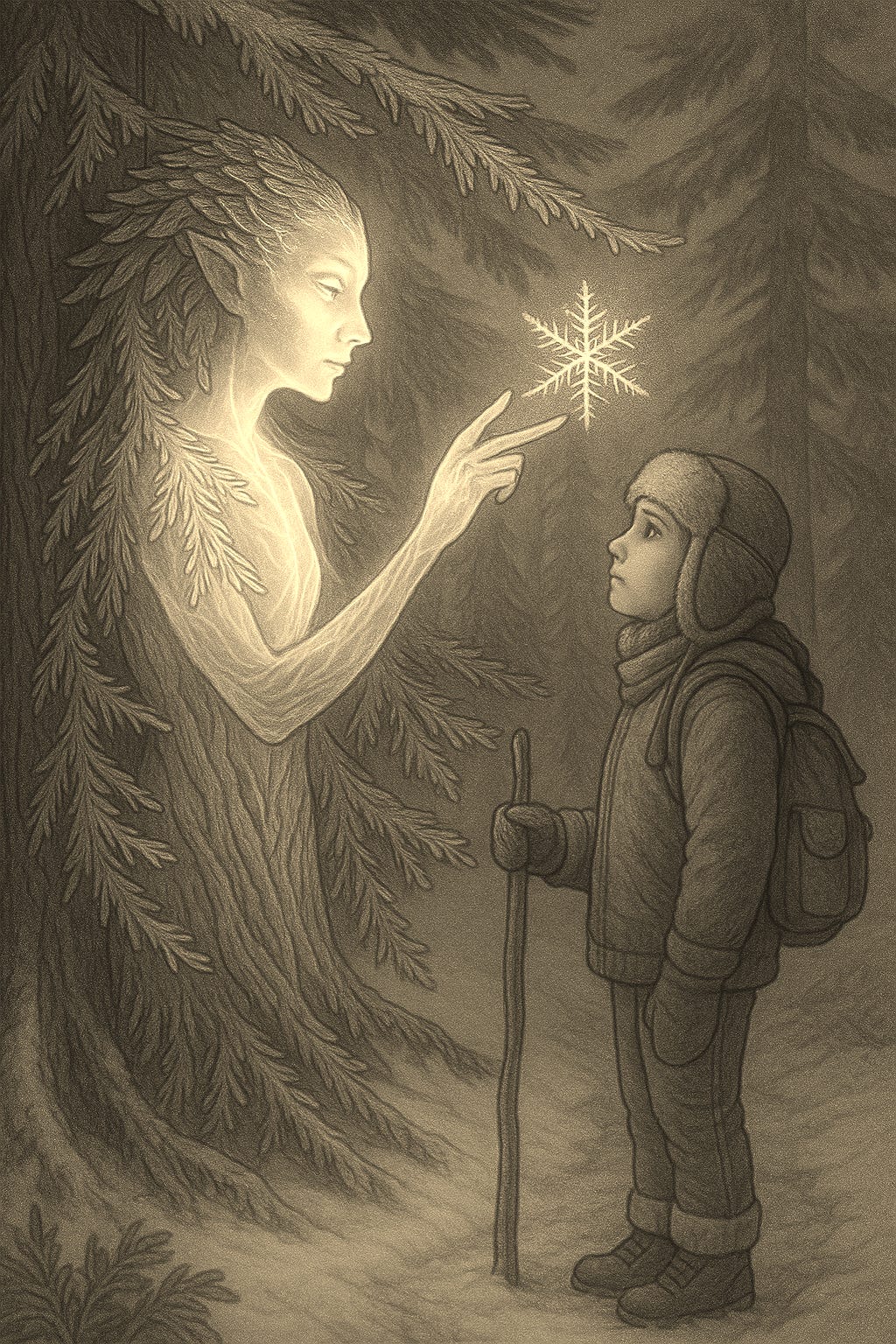
Sarah brewed tea from The Garden’s inner circles when my abilities felt overwhelming; her choices guided by Elizabeth’s wisdom, even if she couldn’t yet share that knowledge directly. We were a family learning to accommodate magic in our everyday life, with homework, garden chores, botanical research, and fairy sight.
Mine was an ordinary childhood punctuated by extraordinary moments when the boundaries between worlds grew thin. Looking back, this was the last period of pure wonder before questions of identity and belonging began to complicate the magic. The last time being different felt like a gift rather than a burden.
Reverie
My questions would change and evolve with the seasons, and I sensed that answers waited just beyond my reach:
Why did certain plants respond to my touch? Why did reflective surfaces sometimes show more than they should? Why did I feel drawn to the cedar forest when others found it forbidding?
As summer waned, I worked beside Sarah in The Garden. We cut back and divided perennials, trimmed herbs for drying. Charlie’s crew did heavy work, like stone replenishment, wall repair, mulching, and fall pruning.
The Estate was like an extension of the campus, as close as it was to the college, an educational environment itself. Sarah, Helen, James, Margaret, and Charles each had their special talents and education. I learned Science, History, Research, Math, Horticulture, and Ecology. My questions flourished. Sarah couldn’t keep my story hidden forever.
Sapphire Morning Glories opened one glorious fall day, weeks before my thirteenth birthday. From being outgoing and chatty in childhood, I’d grown introspective as an adolescent. What I’d accepted as a younger child, like why certain plants responded to my touch, why reflective surfaces showed more than they should, and why I felt drawn to The Cedar Grove and Cedra’s advice, now demanded deeper consideration. Questions that had sprouted in childhood, growing beneath others like roots deep in the soil, had surfaced and become urgent:
What is her name? Names are important. When you’re adopted, you lose your name. When Sarah calls my name, I go to her. But she is not my first mother. Who else knows my name? I should find out who they are. What is my first mother’s name?
The Morning Glory vine sprawled along the top of the Iron Bench where I sat mulling over these questions. I was meeting Sarah for breakfast before starting in The Garden. We enjoyed those relaxed moments, our backs to the Yew Hedge. Sarah had given me the name Stella, Star, a beautiful name that felt like me. But somewhere, someone gave me my first name. What made me think that?
The Blue Book
My Fox Terrier, Winston, came bounding toward the Yew Hedge. Sarah carried down a market basket that held a flask of tea, two mugs, Helen’s freshly baked scones, and a jam jar. It was such a cheery sight that I didn’t mind that my reverie was interrupted.
Only, where would my answers come from?
As we finished breakfast, Winston, who had been nosing around at the roots of one of the hedge yews, stood stock still and stared at me for a signal. “What is it, Boy? What have you got there?” Winston clasped his find between his teeth and trotted toward us. Instead of dropping his discovery at my feet, like he usually did, he turned to Sarah, wagged his tail, and placed the object in her open hands.
The compact book had a gold-stitched binding and an ancient-looking blue cloth cover with gold lettering that glowed. “Thank you, Winston.”
Sarah said. “What is this?” I pressed against her arm. My impulse was to touch it—both warm and cool, and damp.
“I wonder how long it’s been under the hedge in all weather,” Sarah asked. “We should treat it carefully. It could be valuable.” Her archaeological mind had gotten to work. “We should show it to Helen and James.”
Sarah opened the book on her lap, and we both read:
From The Fae Who Know You Well
For the daughter of Ellen,
Named for her grandmother,
Ruth, who saw the truth,
and for her Aunt Ann
whose garden healed.
Ruth Ann, first in love,
Stella, Starlight, and Seeker,
Thirdly, she is named
by those who watch her.
“It’s me! It’s my book!”
What followed was just as surprising:
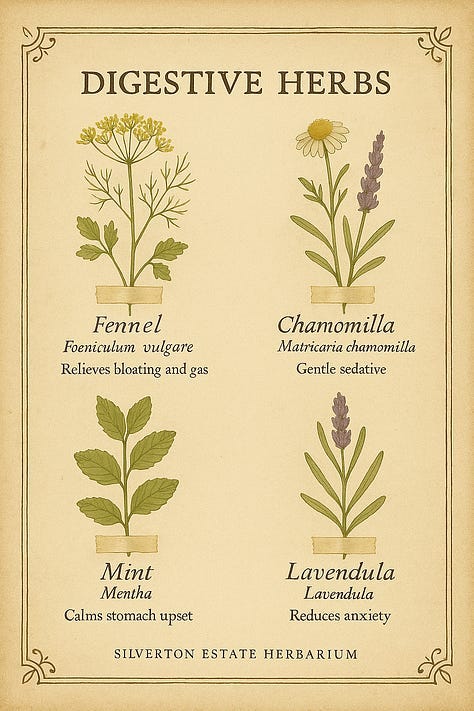
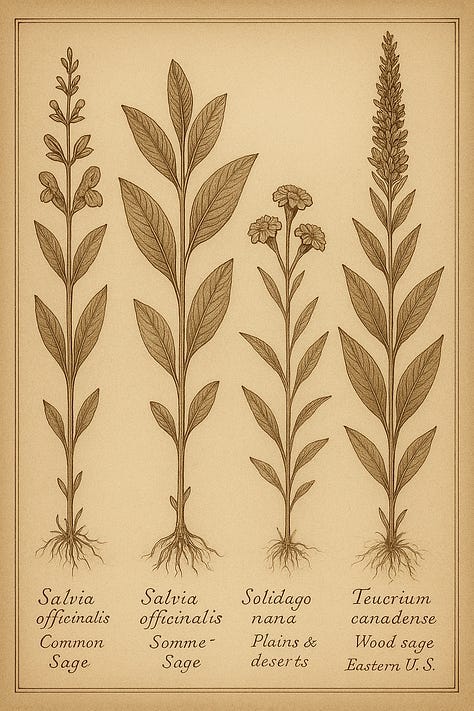
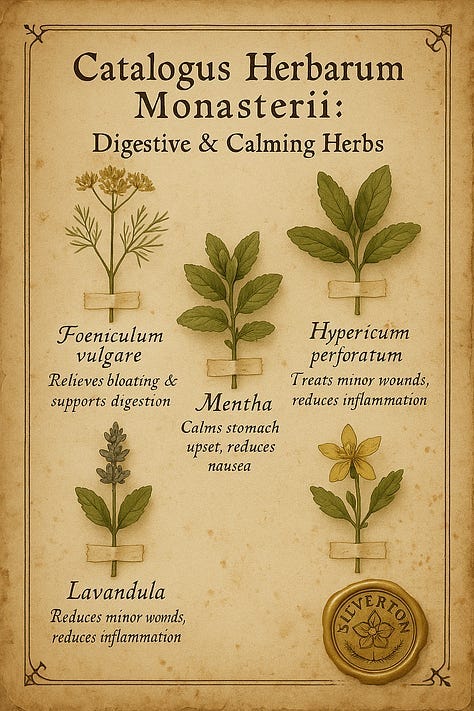
“It’s a list of medieval physic garden herbs, with antispasmodic properties,” noted Sarah. The old names whispered through the ages as she read aloud from the elegant handwriting:
Ann’s garden remedies for those whose sight is too difficult
Valerian root, for easing the sight. Its tiny white flowers glow like starlight, reaching deeply into long-remembered soil.
Lobelia, for peaceful thoughts, the blue-flowered Indian Tobacco.
Skullcap stems bend in graceful acceptance, growing in quiet corners.
Sweet Melissa, the Lemon Balm, releases an air of breezy calm.
Passiflora, Passionflower vines weave patterns of protection.
Chamomile, its blooming tiny suns, ground and calm.And on the following page:
Between two worlds,
I stand divided,
Half in shadow, half in light.
In gardens fair, my heart is guided,
Through dark mirrors,
I claim my sight.
Blood of Earth and blood of Star
With three names, I am complete.
Near yet far, known yet hidden,
Morning sun and moonlight meet.

“This is fascinating from a botanical history perspective,” Sarah said. “These are folkloric medicinal herbal properties. Helen and Margaret will be fascinated by this find.”
Sarah did not comment on the name embedded in gold, Ellen, the name I had longed to learn. Ellen must be my birth mother, and Sarah did not say her name. Has she known all along?
Sarah praised Winston for his discovery, and he settled at my feet; his eyes were fixed on the book as if he understood its significance—and my heavy heart.
“I’d like to hold it. To keep looking through it.”
Sarah didn’t look up from the page; her curiosity was engaged. “Of course,” she said absently. “This could provide valuable insights into The Estate’s herbal history. I wonder how old it is...”
My heart sank. Sarah was examining the book as a botanical artifact, rather than my first major clue: my birth mother’s name in gold lettering, only herbal history, and academic value. It was a chance finding she needed to protect and would take the Blue Fairy Book to her study. I carried the market basket to Helen in the kitchen, Winston at my side.
That night, Sarah was engrossed in her references to medieval herbal remedies. The mysterious book on her desk cross-checked the herbal list against her garden notes and didn’t notice me in the doorway.
“Vervain for stabilizing sight,” she murmured. “Morning Glory seeds to induce controllable visions. Cedar bark to anchor wandering perception.”
Her fingers traced the page to “Ellen.” Sarah had been recording anomalies that someone named “Aunt Ann” had treated.
She hadn’t seen me in the doorway. When she looked up, her expression held both revelation and regret. “Stella,” she said softly, “I want to tell you more about the morning I found you—soon.”
My nod had a weight of disappointment as we said goodnight.
But would it be a true story?
I opened my bedroom window, breathing the cedar-scented night air.
Sarah’s willingness was meaningful, but was I ready to hear her truth?
I was more confused than ever about my identity and the paths that were opening between separate worlds.
My dresser mirror ripples my reflection and possibilities, caught between something and something I can’t name. Between whom I have been and who I am becoming. I close my eyes and dream of a copper-haired woman tending a garden, of mirrors that are new doorways, of morning glories that bloom in every season, and the paths they mark. Ruth Ann. Stella. Seeker. Past. Present. Future.
End of Part Two
Next week: Part Three begins, in which Stella turns thirteen, the First Council ceremony is held, and the training and true tests begin.
Coming Soon: ‘Behind the Hedge,’ an every-so-often piece about the novella. I’d love to hear from you! Have you enjoyed the series? New here? We welcome you! Begin at the Prologue. I post a new episode just about every Wednesday. Please be sure to subscribe below. It’s a great show of support to independent authors.
Thank you! Have a wonderful week!
Mel & Islay
© All rights reserved
Mary Ellen Gambutti
I love the way the garden is such a magical place and your description of it really brings it to life. A perfect setting for the story to unfold. Very well done pet!