


This second installment brings us to the Tudor Manor, the pathways, and the raised herb beds that waited for Sarah. We step from myth into enchantment and the long memory of Elizabeth Silverton's Medieval Garden.

Introduction
Silverton Foundations
The green valleys, rolling hills, and silvery morning haze reminded travelers of their beloved homeland glens. On this rich landscape in their adopted new land, they built a pretty village and set it like a Celtic knot in a deep curve of the northern bank of a fork in the Primrose River. In time, English ivy would clamber over the white stucco walls of their timber-framed houses, and horse hooves and wagon wheels would smooth the meandering cobblestone streets.
Elizabeth Silverton was born in 1832 to the daughter of a German publisher and a British industrialist. After a Fine Arts and Botany education in Britain, she chose academia over marriage and emigrated from England to North America. In 1867, her dream to create a botanical sanctuary became possible, and she purchased a partially deforested property on the Primrose River in New England. In partnership with her brother, she founded Silverton University, and they incorporated the Village of Silverton.
At the Silverton Estate, recent history overlaid ancient traditions, as exemplified in the School of Landscape Architecture and the Department of Medieval Studies. Across the red arched footbridge from the campus, the conservation-minded and creative visionary, Elizabeth, merged botanical science and a deep study of European medieval monasteries. She brought to bear her fine arts education, extensive travel in Celtic regions, and a penchant for landscape and garden design in consultation with artisan builders and professional landscape gardeners. The sprawling Tudor-style manor house, medieval-style monastery garden, the cottages, expansive lawns, ponds, waterways, and remaining cedar groves would thrive. In turn, the Estate would come under the protection and care of the Department of Medieval Studies.
Sarah
Sarah Caldwell’s Bachelor of Science in Botany and Master’s in Medieval Studies from Silverton University shaped her distinctive scholarly approach. Her PhD dissertation, “Healing and Holiness: The Medicinal Codex of Medieval Monastery Gardens,” investigated how medieval healers embedded comprehensive medical knowledge within garden layouts, using systems that unified body and spirit.
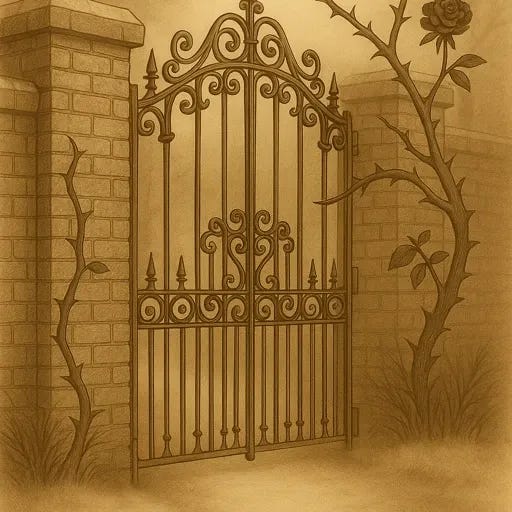
Across the front of the property on Cedar Lane, a brick wall ended in piers that supported a heavy Iron Gate. On the icy mid-winter morning that Dr. Sarah J. Caldwell approached the Silverton Estate for an eleven o’clock appointment, her scholarly aspirations intertwined with enchantment. The gate latch stuck, and a thorny whip of a rebellious rose clambering over the brick piers lashed out in gentle fury, snagging her jacket.
Undeterred, Sarah shouldered into the gate, its hinges groaning as it gave way onto the shoveled path. As she crossed the threshold, the rose, though dormant, bloomed black.
James
“Careful of the thorns,” James Hawthorn, the Estate’s archivist, warned a bit late, but he was on time for his meeting with Sarah, and extended a wool-clad hand.
“Great to meet you, James,” Sarah said, accepting his handshake. He was dressed in corduroy slacks, a down parka, and sturdy snow boots. At thirty, he was five years younger than Sarah.
“I see you’re prepared for the tour,” James said, noting Sarah’s knee high footwear. “You’ll get a look at the Garden’s bones, if not their blooms. I think the designers call it ‘structure.’”
Sarah replied, “Indeed!”
James was not a designer, nor a horticulturist, but he was somewhat familiar with the Garden’s layout and features, having grown up on the Estate; the son of the groundskeeper. “I understand you’re in the thick of your book research. I’m at your service,” James said with a slight bow.
Early in her academic career, Sarah had held the Elizabeth Silverton Fellowship, and continued research into the Medicinal Codex of Gardens: A Medieval Monastic Pharmacopeia.
Sarah replied, “Thank you, James. I’ve studied the drawings, and I’m familiar with the garden’s evolution.”
A giant yew hedge, having first obscured her view, she squints against the morning glare down to the glistening gardens, her breath a frosty vapor against the vista. She discerns the Garden’s geometry, the tight, low boxwood edge forming neat quadrants, now dark green, and frost-glazed, the sandstone paths bisecting the quadrants with warm earth tones.
Amidst the wide winter landscape, she visualizes the herbary in its season of color, its shapes, and textures, purple and lavender spikes contrasting with lemon balm’s green, tall stalks of Echinacea, the Coneflower’s violet purple, and vibrant pink petals against the darker hues. Beds dedicated for types of herbs and flowers, their healing properties are marked with wooden signs, meticulously organized. A Germander border contains rollicking herbs, and again, more architecture, texture, structure, and purpose in Elizabeth Silverton’s garden.
She asks, “What is that aura, or aroma---like pine---like Rosemary?”
“Oh! You’ve picked up the scent of the ancient Cedars at the far reaches of the Estate, the remnants of a storied, vast primeval forest that emerged after the Ice Age. We’ve done our best to protect the fragment that Elizabeth Silverton willed to the University. Much wilderness was lost to speculators before she acquired and preserved the meadows, ponds, creeks, and trees, and built the Tudor Mansion.”
James continued as they walked, “The University contracts with a small squad of conservationists. ‘Old Cedra,’ as she is known, guides their choices and ways of protection. She’s been here forever in her primitive hut back in one of the Cedar Groves. Elizabeth was a master herbalist, and Cedra was an intellectual protégé of hers, I guess you could say ...”
Sarah’s mind wanders to a melodic murmur, like whispered secrets across snowy tranquility, a gentle buzzing and whirring of wings, both near and echoed. She visualizes ancient healing powers of apothecary herbs, the concentrically circular beds, from the outermost layer of Rosemary, to the medicinal herbs, and at its heart, the Inner Sanctum. Along the parterre paths, she encounters a bare-stemmed Black Rose in bloom, protected by the stone wall on which it climbs. She lifts a blossom to her face, the heady perfume of its deeply hued, reflective petals...
Sarah strolled like it was summer back to the Cedar Gate where James stood swinging his arms and shuffling to keep warm. She said dreamily, “This is the perfect place for me to work on my book.”
As they crossed the Cedar Gate threshold under the Yew Hedge, James said, “The Estate has quite a history. But you’re familiar...”
Her somewhat detached reply was, “I see that the herbal Fairy Ring is thriving!”
James smiled at Sarah’s enthusiasm. “Elizabeth prized roses as symbols of love and devotion. A stone wall encloses her Rose Garden, over a hundred varieties. It’s way at the back of the property, next to what was once Elizabeth’s private cottage. It’s now in disrepair, no funding for upkeep. My father, Charles, does keep the roses pruned, though. He’s the groundskeeper.”
Sarah again escapes the frozen landscape to revel in early alpine spring bulbs: crocuses, fritillaria, species tulips, jonquilla hybrids. As they pass the wide double borders, it’s summer, and the long, wide, Gertrude Jekyll-style borders are in bloom, tangled with old-fashioned hollyhocks, delphiniums, and foxgloves, edged in lady’s mantle, Dianthus, and Aquilegia...
“It’s wonderful the Estate keeps up these traditional plantings. Tell me all you know, James.”
James continued, “Dad has a small crew to help with weeding and deadheading in the perennial borders, and with upkeep around the Estate. There’s plenty to explore when the weather warms.”
Charles
Wearing a green flannel jacket and brown overalls with thickly padded knees, he emerged with an aluminum snow shovel from behind the sprawling bare twigs of a bridal wreath Spirea. A fringe of snow sprouted from the back edge of his plaid wool cap, and his frame was a bit bent.
James’s father introduced himself: “I’m Charles Hawthorn, and you’re a medievalist.”
Not a question ... Sarah accepted his bare handshake, rough with age and from tending the earth. “Hello, yes, I’m Sarah Caldwell. Pleased to meet you, Charles.”
“The garden’s been waiting for you,” he said by way of welcome.
Sarah raised an eyebrow as the Groundskeeper continued, “We’re in the Keeper’s Cottage. Margaret and I have been here all our married life.
And you’ve met James, so you know he works for the University, too.
You’re always welcome to stop by our home if you need anything. You do know the Manor House is empty ...”
Again, not a question. Somewhat bemused, Sarah answered, “I’ve heard that.”
“The administration wants it occupied,” Charles said. “This old Estate needs a resident curator again.”
Although her interest was piqued, Sarah preferred nonchalance in response to Charles’s amiable but forward approach.
James piped up, “Most residents have been scholars, and many were connected to the Silverton family, though Miss Silverton ... well, you must know ...”
Sensing Sarah’s unease, James redirected, “Well, thank you for coming, Sarah. We’ll speak again soon.”
“Thanks for the lovely tour, James. And thank you, Charles.”
Charles saluted his reply.
“Well, I’m looking forward to making a start,” Sarah said privately to James, as he assisted her in clearing the gate and its unruly Black Rose.
“Bye!” She smiled as she pivoted right, toward the Red Arched footbridge over the Primrose to the campus. Born and raised in Silverton, Sarah had lived in a Village apartment for the past four years.
That afternoon she would stop at her childhood home, several blocks from the campus, to visit her mother, Helen Caldwell, to weigh the benefits against the difficulties of living in a grand old Tudor-style home. She thought she heard The Estate call to her.
“Residency would enhance my position as curator. Living amidst the gardens and history of the Silverton Estate while I’m on sabbatical to write my book, I’d have access to the Silverton archives.”
Sarah was captivated by the cultural symbols in the Medieval Monastic Gardens, the early texts, and mystical and pragmatic medieval botany. Another project was “Translating and Annotating a 13th-century Herbal Manuscript.” The Silverton gardens would be a living laboratory for Sarah.
“Indeed, what a great opportunity!” Helen supported her daughter’s decision. The two were at a turning point. Helen’s husband, Robert Caldwell, a local architect, had passed away a year earlier. She and Sarah grappled with grief. Sarah, too, was faced both with decisions about her career advancement and her mother’s well-being. Helen was thinking about selling their family home, possibly renting an apartment near the campus. Suddenly, Sarah’s career path was clearer, and she could be persuasive.
“Mom, would you consider moving to the manor with me? I’d apply to the realtor who handles the estate, and maybe we can move in March. We both could find healing there.” The Estate on Cedar Lane presented the possibility of mutual renewal. “When Professor Winters suggested me for the curator position, I didn’t realize the house was unoccupied. It feels like the ideal arrangement for both of us.”
Helen agreed with Sarah, that she’d been spending too much time alone in their 1930s white Colonial home behind the picket fence, and was excited for an enlivening adventure.
The Move
The inconvenience of packing and boxing was overshadowed by the excitement of moving across the Primrose River into the Silverton Manor.
“What great timing!” Helen said, arranging her folkloric research volumes. “My house sold three weeks after you were offered the curatorship.”
Charles Hawthorn voiced his approval of their move to the Estate, The house has a special draw to artists and scholars. Elizabeth had certain stones shipped from a Welsh quarry to build one of the walls,” he told Helen, who, as a folklorist, was keenly interested.
Charmed by the Tudor’s quirky blend of elegance and eccentricity, Helen and Sarah planned to gently edge the grand main floor rooms of the spinster’s residence into an eclectic modern style by adding their furnishings to Elizabeth’s remaining Victoriana.
As Sarah planned, they were in at the start of spring, and took to the rhythms of the estate. Even the house seemed to unfold around them, its spaces inviting new purposes.
One morning, Sarah paused in the doorway of an upstairs room that had a long view out to the gardens. “I considered placing our reference books here, but ...” She trailed off, and Helen, observing her daughter’s dreamy expression, asked, “What do you think it should be used for?”
Sarah surprised herself with the words: “Maybe a child’s room ...”
Over breakfast, Sarah’s thoughts crystallized. “The local adoption agency has a waiting list for foster parents,” she said, admitting she’d inquired. “I could be eligible to care for a child aged six to nine. Fostering an older child or two, I could continue researching and writing. They’d thrive in the open spaces, learning about plants and gardens. And you’d have a ready audience for your stories, Mom.”
Possibilities flew back and forth across the breakfast table. Helen said, “You’ve always enjoyed taking on challenges.” She easily embraced the idea of a child in her life again.
Sarah replied, “I think I’m ready.” She contacted the agency, taking the first steps in the process of becoming a foster parent. There were forms and hard questions for the single, middle-aged prospective parent who expressed her earnest desire to provide a loving and caring home for a child. She was added to a waiting list.
Sarah’s new routine balanced her plant curator duties with her book research into Elizabeth Silverton’s garden design and practical uses.
Years ago, as Elizabeth had stipulated, the University transferred what remained of Elizabeth’s archives back to the Estate. As its current archivist, James handled materials few others had: her herbarium, garden plans in watercolor and ink, personal correspondence, receipts, and architectural drawings. Now he welcomed Sarah’s botanical knowledge, and Helen’s expertise. While Sarah traced the garden’s evolution into the present, Helen pursued folkloric parallels, and James stitched their findings to the Estate’s historical record.
“Elizabeth’s bequest required that her papers stay with the gardens,” James said, unlocking and opening a wood and glass case on a conference room wall. He lifted out a framed letter. “Here it is, the document establishing the Estate as University property, and Elizabeth’s intentions for the gardens. Her vision.”
Sarah leaned closer and began to read aloud:
From the Bequest of Elizabeth Silverton
Spring Equinox, 1892To the Board of Trustees
Silverton University
Department of Medieval StudiesDear Colleagues,
It is with careful thought that I bequeath my Estate and Gardens to Silverton University, with the charge that they be maintained as a faithful recreation of Medieval Monastery Gardens. I intend these grounds to be a place of peace and contemplation, as the monks of old designed them, while preserving the rare botanical specimens I have gathered throughout my life.The Garden’s design follows historical precedent in its quadrant structure, drawing from manuscripts of European Monastic Gardens. I ask that its integrity be preserved in perpetuity: the Concentric Herb Beds arranged according to apothecary principle, propagating the collection of uncommon plants.
My hope is that the Gardens continue to serve both scholarship and solace, as a living document for students of history and botany, and a contemplative refuge for future generations.
I further request that all plans, drawings, and catalogues remain housed in the Manor’s Archives, for proximity to the Gardens, so that future curators may have recourse to the original records.
The accompanying endowment shall provide for the ongoing care, study, and preservation of this rare work.
With scholarly devotion,
Elizabeth Silverton
Sarah’s voice faded to a whisper, and James, respecting the moment’s stillness, said, “The Silverton Legacy. Sarah, with your background in Medieval Botany and Garden Design, you were well placed to continue Elizabeth’s work as Curator.”
“It’s an honor to be part of this Garden family,” Sarah replied, acknowledging her weighty commission.
Summer Walk
On a hot, bright afternoon, Sarah and Helen meandered down the brick pathway that bordered the perennial beds. “I’ve been looking over Elizabeth’s notes on medicinal properties,” Sarah explained. “I want to bring some of her approaches into my own methodology. Previous curators respected most of Elizabeth’s original plantings. I want to do more; to restore her botanical legacy.”
The towering ancient Yew Hedge marked the boundary between formal and informal spaces. Its topmost feathery foliage, where pruning shears seldom ventured, captured the midsummer’s sparkle. Helen ran her hand along the hedge’s tightly sheared profile, stopping at the rough-sawn cedar board gate with a high arch set snugly within the hedge.
At the start of his career as groundskeeper, Charles had replicated Elizabeth’s Celtic gate, replacing the original by request of the University. It was kept safe in the archive’s storeroom with the aviary, also long out of commission.
“Perfectly maintained,” said Helen of the Yew Hedge, “yet Charles said it requires minimal trimming, as if ...”
“As if it maintains itself?” Sarah completed her mother’s thought with a hint of skepticism. Yet, Sarah admitted she’d observed a few botanical oddities, “ ...plants blooming out of season, unusual growth patterns ...”
Helen smiled at her daughter’s cautious phrasing. “It seems that Elizabeth had an unconventional approach to horticulture. In her private social gatherings in the Manor House, she was quoted (off the record) that the Garden responded to more than soil chemistry and light conditions.”
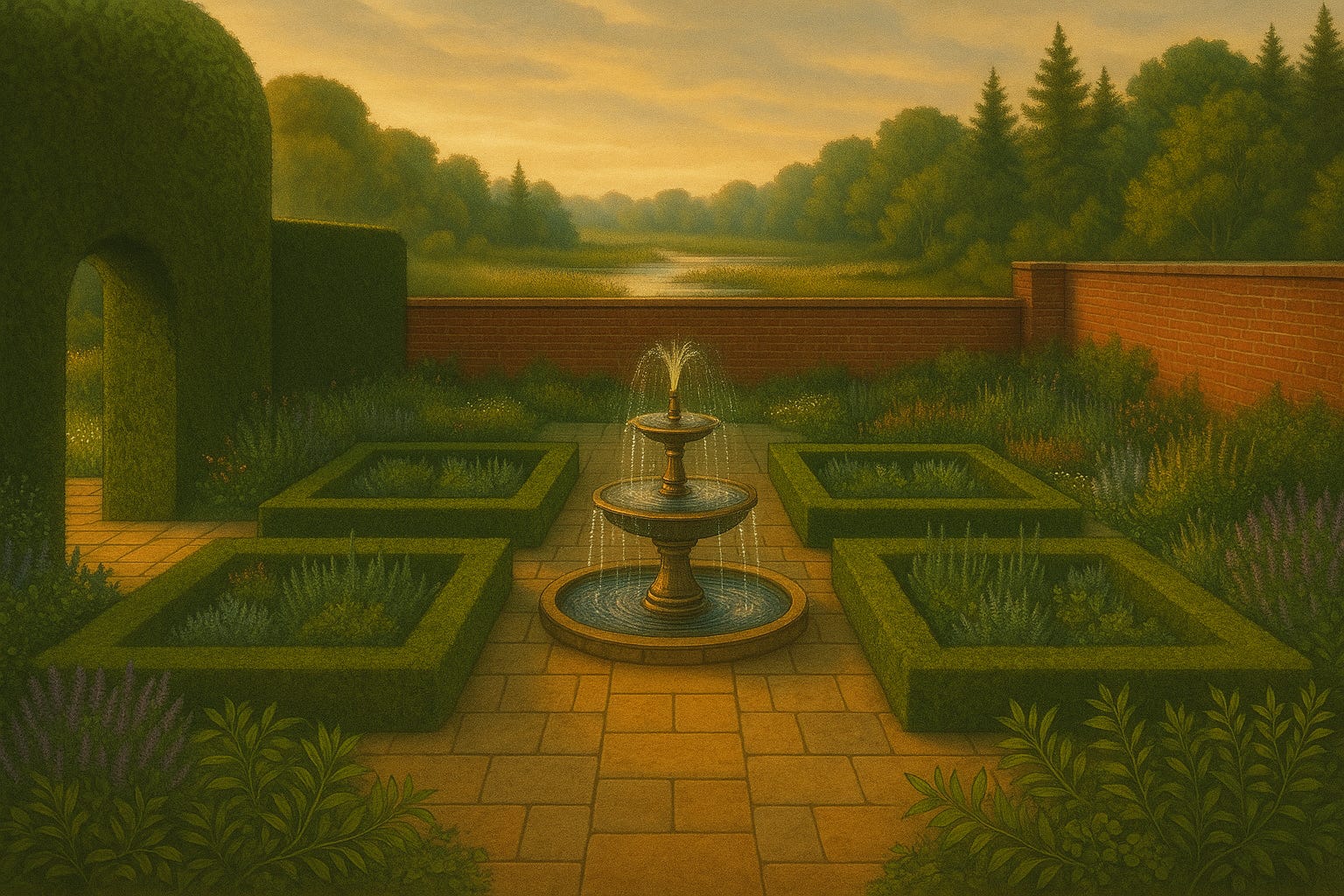
Through the portal and onto the terrace, both women felt a shift in ambient temperature. The hedge, the brick wall on three sides, the warm sandstone paving, and the murmur of cooling water made a pleasant microclimate. The sheltered, cloister-style raised beds in quadrants that held precisely planted herbs, was a highly structured yet aesthetically satisfying botanical display. It contrasted with the naturalistic perennial borders, wide meadow, marshes, ponds, streams, and forest. At the Garden’s central axis, the three-tiered iron fountain heightened the afternoon’s dazzle with its arched spray, and reflecting pool’s ripples and rainbows.
Helen and Sarah were relaxed, steeped in the magic of the afternoon, and pleased with their decision to accept the Estate’s challenges and enjoy its comforts. Heading back toward the House, Sarah mused, “Tomorrow I’ll revisit Elizabeth’s planting schemes and cycles, the living rhythms of the garden, what stirs beneath the soil. To explore, even embrace her intentions and her purposes, beyond her official documentation.” Helen smiled in reply.
The last of the boxes could wait; Elizabeth Silverton’s Garden legacy had taken precedence. By the end of their first summer on the Estate, Helen and Sarah were well settled. Sarah was immersed in research and discovery in the garden. Helen had taken up baking bread and cooking in the once-forbidding AGA cooker, at first enlisting the aid of affable Margaret Hawthorn to demonstrate the fundamentals of the imposing combination gas and wood oven. Helen enjoyed walks in green and paved spaces. She thought about her husband, Robert, who had some acquaintance with the Silverton history, though not a Medievalist. Helen felt sure he would have been pleased that she and Sarah were living in an aesthetic environment with plenty of opportunites to research.
The Estate’s Arteries
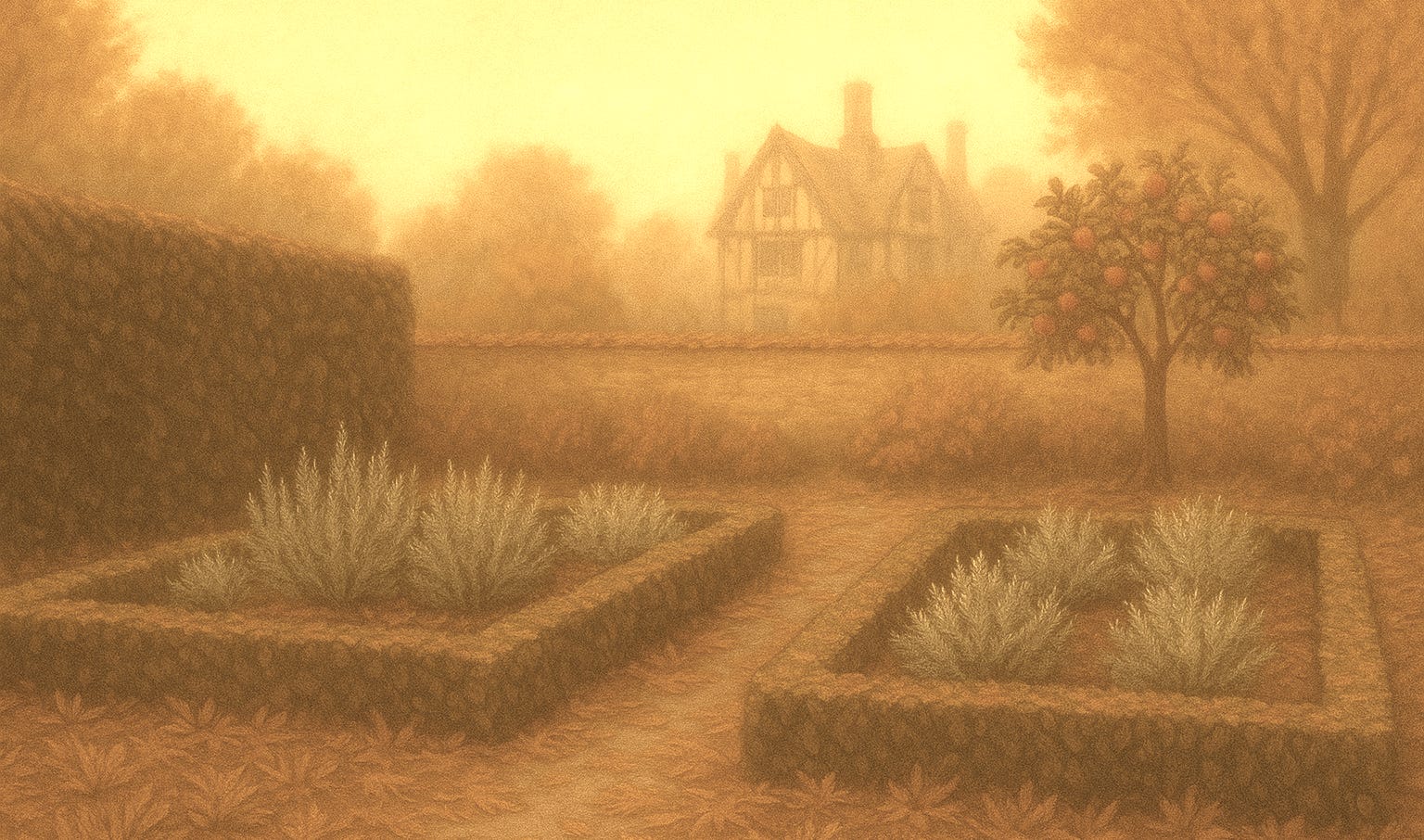
The first heavy rains revealed aspects of Elizabeth’s design not apparent in the summer, so Sarah, James, and Helen donned ponchos and wellies, ventured onto the sodden lawns and gardens to witness the Estate’s water workings; the irrigation network extending from the Primrose River underground and out through the property.
At the windy northwest corner of the Medieval Garden, a series of carved stone gargoyles, the size of five-gallon jugs had come to life, spouting rainwater from garish open mouths into a communal trough, draining discreetly into an intricate system of rills.
“This is a unified water management system,” Sarah explained, leaning where the stone channel disappeared under the greenhouse.
James produced a sketch of the original blueprints from his pocket to show Sarah and Helen. The trio eyed the damp paper, their umbrellas joined against the drizzle.
“According to these plans, there are seven main waterways running beneath the medieval garden, with thirty-two secondary veins branching off through the quadrants and perennial beds.”
Sarah’s blonde bangs clung damp to her forehead, and she separated the fringe, saying, “Perfect moisture balance, mostly gravity-fed.”
Helen examined the stone edge of the rill that trickled liquid life to the perennials. She traced the smooth, carved symbols: spirals, knots, and stylized eyes with her index finger. “They are similar to those in monastic water systems throughout medieval Europe in Celtic regions. Water, a threshold element, connects the visible and invisible worlds.”
Sarah noted, “Elizabeth documented certain plant species thriving regardless of conditions. She classified plants not only by sunlight and soil preferences, but by their relationship to the water flow here, some, marked as threshold, positioned where water emerges or disappears.”
The three colleagues followed the main rill to the central fountain, where water burbled up through stone basins before flowing outward along four channels aligned with the cardinal directions. The fountain featured carved Celtic knots intertwined with Elizabeth’s herbarium motifs.
Sarah noted that the fountain water level stayed even despite rainfall accumulation. “It’s a regulating system. Overflow is channeled and redirected to drought-sensitive areas or out to the lawns.”
From the lip of the bottom basin, water spilled into four discrete channels. Helen said they represent the four rivers of paradise.
“Remarkable precision,” Sarah’s voice held a trace of awe, “when you observe Iris and water mint arranging themselves in the channels, adjusting their growth patterns to seasonal water flow.”
As the rain intensified, James said, “Dad mentioned his predecessor instructed him against tampering with the water channels, even if they seemed to malfunction. ‘The garden corrects itself.’”
“I’d have dismissed such a statement, except for what I’ve seen. Elizabeth seems to have designed a responsive arterial system where the garden’s structure reacts to subtle changes in environment with organic intelligence.” With her next breath, Sarah murmured, “Water as medium between worlds.”
Helen replied, “Elizabeth surely knew that the monks made use of water as the life of their gardens, and that if properly channeled, it is more than hydration for plants. It is communication.”
Sarah’s journal entry that evening was a nod to new awareness”
Water system functioning with remarkable efficiency during heavy rainfall. Plant response continues to defy conventional explanation.
Notable: morning glories appearing at junctures where water emerges from underground channels. Helen’s interpretation of symbolic carvings suggests deliberate integration of water as threshold element. Consider: Elizabeth’s water system may serve functions beyond irrigation---possibly creating conditions for what she termed in her notes “permeability between states.”
Sarah’s botanical expertise could not have prepared her for events three months later at midwinter.

Thanks for reading!
Next Wednesday, we continue with Part One: Ruth Ann, through the days and weeks after The Finding.
Your writing really provides a vivid, detailed description of the estate, while hinting at the magic yet to come. Very well done Pet!