
An Invitation
My personal essays and this novella series are influenced by adoption, and my belief that all the occurrences around my adoption profoundly affected my physical and emotional make-up. I’m not a therapist or an expert. Except for my work in Allied Health and Horticulture, I am largely self-educated. Since a brain hemorrhage at age fifty-eight, I have focused on reading and writing. My speech and cognition was impaired, and I was determined to return to language skills.
At seventy-four, I’ve grown content with my progress in that regard. And there’s the continual displacement of self. The damaging guilt which is the legacy of my natural mother. So, ethics comes up, as does severance, secrecy, silence.
And words.
Hiraeth
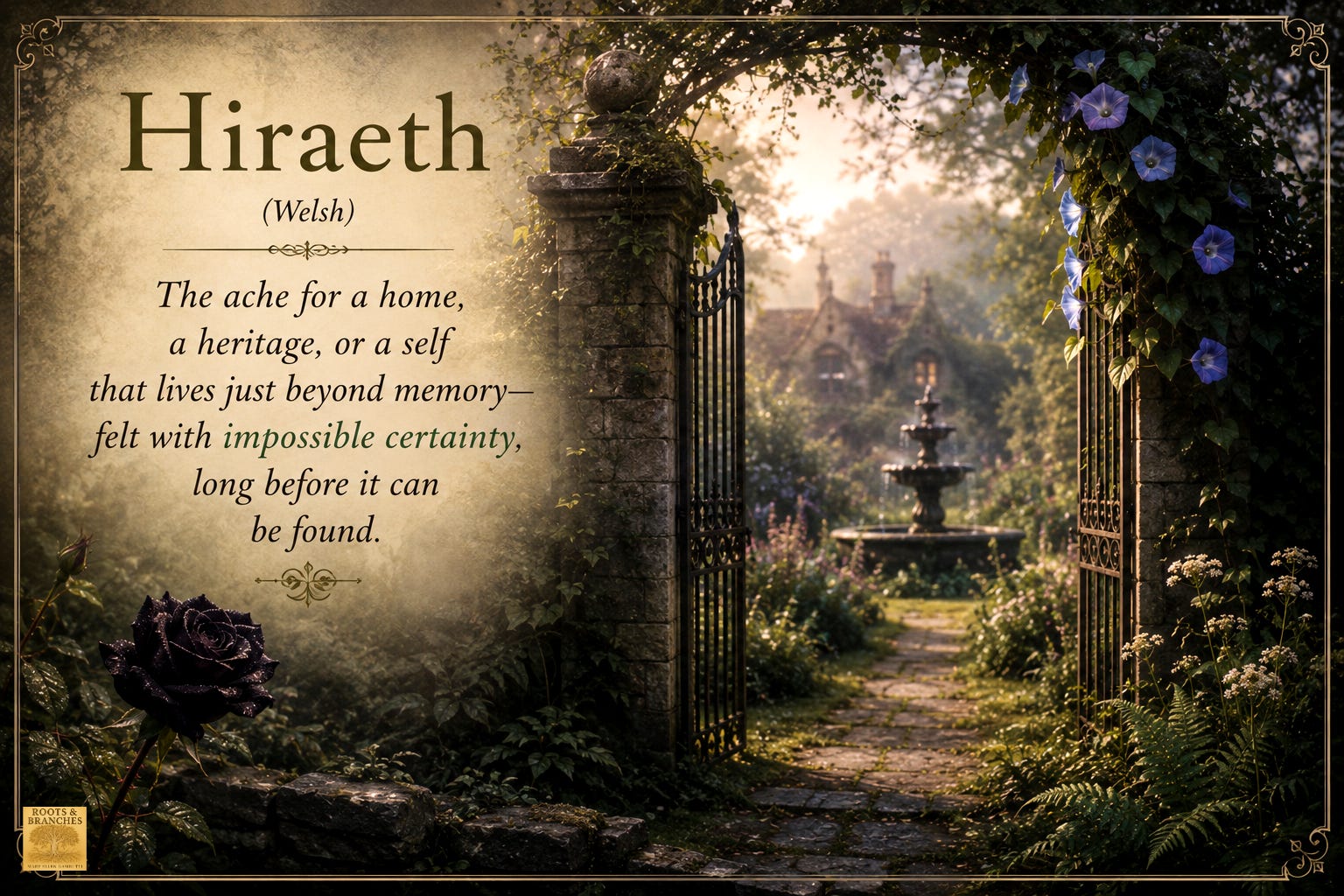
This beautiful word, borrowed from across an ocean counts toward recovery. A Welsh word with no precise English equivalent; not quite homesickness, not quite longing, and not quite grief. And it is all of these at once, and something more.
It is the sense of a home you cannot return to: a home that lives in a dim memory of what once belonged to you, or was part of your very being. That is it, I think, it is the feeling of what is in your essence. Except, there is no “there.” And where I belonged, I cannot say.
Homesickness implies a home you know and have left. Longing is too gentle. It suggests something sweet at its center, a wish that could be satisfied if the wished-for thing arrived. But hiraeth offers only non-fulfillment.
For the adopted, the displaced, this home is a place in the heart that existed before the rupture, or because of it. It is not the “no place like home” feeling. Not a fond memory. An adoptee separated at birth was removed, or abandoned, before a home, and after the comfort of the womb. That loss precedes memory, precedes language; it lives in the nervous system. It is atmospheric. Present but unsourced. Real but unlocatable.
English is a language of precision and accumulation. It borrows freely, builds compounds, invents technical terms. But for certain interior experiences, the ones that live beneath articulation, in the body’s oldest knowing it reaches its limits. Hiraeth holds all of this without resolving it. It recedes when we reach toward it, the way we humans, insatiable as we are, recede from ourselves.
The feeling is not tranquility or serenity. It’s anxious. Uncertain.
Home That Preceded Memory
I didn’t know my origin story until I was in mid-life. What I grew up with was not a memory of loss but something more like its shadow: a persistent sense of incompleteness, of being apart from others, of standing in a room where most of the furniture was present but something essential was missing. No one would or could tell me more than what I had now was my adoptive parents’ protection, with all its forms, conditions, and restrictions. The one who left me behind would stay nameless, formless, a non-entity. Any others who might have been were gone with the furniture.
This is what hiraeth names for me and for the adoptees I’ve spoken with. Not grief for a specific person or place we remember, but disenfranchised grief . Grief for the mother’s body, her scent, the voice I heard from her womb. It’s not all in my imagination. It’s in my body. Researchers of early attachment have slowly caught up to what adoptees know in the body: separation in infancy leaves traces. The infant does not remember, but the infant has imprinted. Hiraeth names that foundation. That inheritance.
Preservation and Loss
The Welsh relationship to hiraeth is inseparable from a history of dispersal. Of communities scattered by economic necessity and political force, of a language that had to fight for its survival against centuries of pressure to disappear.
A culture that names hiraeth is a culture that knows what it means to lose something that cannot be fully recovered, and to carry that loss as part of identity, and still, a wound to be treated.
Preservation. Keeping faith with what was lost. Naming it. Holding it. Refusing to let it be erased a second time. That is the work. While it may seem like a blessing to some, to insist that adoption is uncomplicated, that confidentiality is best for all involved, that the records are better sealed, and that the wound is healed, is not helpful. The story is never over.
Why a Welsh Word Works
I write fiction rooted in the Welsh healing tradition, and the mythology of the Physicians of Myddfai, in the landscape of the borderlands where Welsh and Irish currents have mingled for fifteen hundred years. This is not accidental.
The Welsh tradition understands something about what endures. About what the land remembers when the records are lost. About what the body carries when the documents are sealed. About the relationship between healing and knowing, between recovery and what cannot be recovered.
The water remembers what you give it to carry.
This line appears in my second novella, attributed to the Physicians of Myddfai. It is my attempt to say, in fictional form, what hiraeth says in a single word: that what is lost does not disappear. It is held in the land, the water, and in the body. In the nervous system’s wordless archive. In the ache that is without source, but ancient and real.
Hiraeth. Maybe you know the feeling.
Mary Ellen Gambutti writes memoir and personal essays as herself, and lyrical fiction as Islay Corwin, author of the Silverton Estate duology You can purchase in e-book format here. Print coming soon.
Thank you!
https://books2read.com/ThroughtheYewHedge
https://books2read.com/IronGate