
In which Sarah, Helen and James confer in the Archives, and
together, read Elizabeth’s bequest.
The Archives
While Sarah waited over the long winter, she immersed herself in research and writing. The giant oil-burning furnace that lived near the cellar door where coal deliveries were once made could keep the workroom at a tolerable temperature if she wore a sweater, except on the coldest days.
From the manor’s upper floor bedrooms and her office, Sarah had easy access to The Estate’s labyrinthian Archives, two flights down the back staircase in the basement of the Tudor Manor.
From mid-morning until noon, Sarah worked by natural light at the massive oak table, its surface worn smooth by the elbows of academics in woolen blazers. She might be found reading in the afternoon or evening in the overstuffed Victorian armchair under one of several wall sconces that Charles had converted from gas to electric fixtures in the fifties.
As might be expected of an antique home, it lacked sufficient insulation and weather stripping, although the University had made attempts to control temperature and humidity in The Archives to preserve its treasures. Newer windows in the conference room, though not state-of-the-art, were a step up from former drafty casements.
A complex fragrance of aged paper, leather bindings, cedar wood cabinetry, and dried botanical specimens was present in the network of storage halls, lab, reading, and conference rooms, like a perfume of preserved knowledge.
A tall oak, glass-fronted cabinet displayed a curious collection of Elizabeth’s found objects, natural artifacts, and archaic finds unearthed during excavation, showing that The Estate was not the original habitat.
A stack of flat drawers held part of an extensive collection of pressed botanicals, the Herbarium. Sarah photographed the specimens, while James assisted by adjusting the lighting and holding the acid-free supports to protect the fragile archaic pages.
“The Latin is standard taxonomy for the period,” Sarah said, “but these marginal notations are in another...”
Helen, working on the far end of the table, raised her head and asked, “May I see?”
She put aside cataloguing folklore texts to stand next to her daughter, and Sarah accommodated Helen by adjusting the lighting. Helen eyed the notation for a moment, then turned to a set of shelves opposite the table, and took down a slender bound volume, opening it on the table to a medieval manuscript facsimile.
“I thought so!” Helen said, returning her reading glasses to her forehead. Sarah and James joined her, and she said, “These aren’t botanical classifications. They’re references to the Physicians of Myddfai.”
“Who?” James asked.
“They were Welsh herbal healers from the 13th century, James. Their manuscripts contained one of the earliest systems of plant medicine in Britain, combining empirical observation with folk practices that recognized plant properties.”
Sarah leaned closer to compare the notations. “You’re right. Elizabeth wasn’t only using plant taxonomy to identify these plants, she was cross-referencing their traditional medicinal applications.”
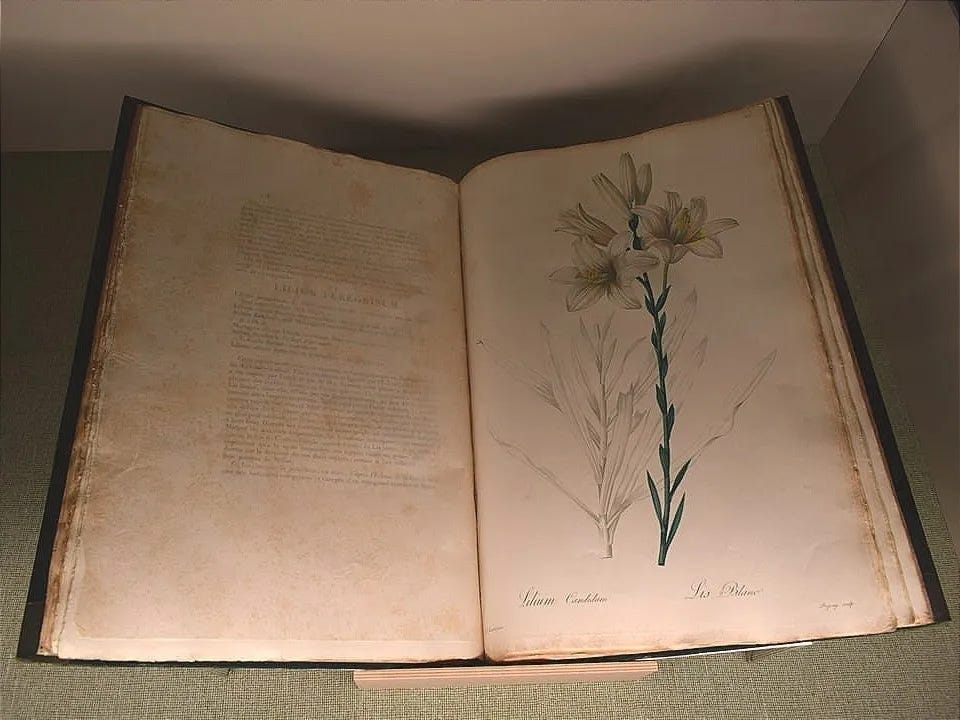
“Not just medicinal,” Helen said, as she motioned to James to bring the volume over to the herbarium pages. “The Physicians of Myddfai classified plants according to their relationships to states of being: physical health, emotional conditions, spiritual transitions, and human relationships.”
Sarah’s skepticism surfaced. “That seems rather esoteric for someone creating a historically accurate monastery garden.”
“Not if you consider the whole purpose of monastery gardens,” Helen said. “Medieval monks grew herbs to treat physical ailments, yes. And they believed in the interconnection of body, mind, and soul.”
“Yes, that’s right, Mom.” Sarah referred to another open volume beside her on the table, a folio of monastery garden layouts. “See how herbs were grouped in physic gardens? Plants were by their therapeutic purposes. Those treating melancholy would be placed where they received morning light. Those for fever reduction would be near water features.”
James seemed intensely interested, and the three fell into their collegial rhythm: Sarah identified herbarium specimens, pointing to their on-site locations, which James then documented. Helen translated marginal notations that she said revealed Elizabeth’s interpretations of plant properties.
Elizabeth’s formal Bequest stipulated the care and preservation of The Garden as a botanical contemplative space, a refuge for world-weary academics. As Sarah and Helen cataloged herbarium specimens, they came across a note tucked among pressed samples:
To Future Guardians of the Garden
Spring Equinox, 1892The whole of my garden serves purposes beyond what is stated in the official Bequest document. While presenting my work publicly as an historical recreation of a contemplative garden, here, I’d like to disclose the deeper intentions behind my design.
The concentric herb beds follow principles found in manuscripts from the Physicians of Myddfai and other medieval healing traditions. I have arranged the plants not merely by botanical family, but according to their documented therapeutic properties for those seeking peace, clarity, and restoration of spirit.
The innermost circle contains herbs traditionally used for calming anxiety and promoting restful sleep: chamomile, lavender, and lemon balm. The middle ring holds herbs that medieval monks used to sharpen mental clarity during contemplation: rosemary, sage, and mint. The outer ring provides herbs known to strengthen the constitution and support general wellness: echinacea, calendula, and thyme.
I have yet to mention my intentional placement of the Medieval Garden between the Cedar Forest and lesser cultivated, wilder grounds; the meadow and pond, for the optimal benefits of wildflowers and the Cedars’ aroma.
I humbly trust that your enlightened care will preserve this contemplative and therapeutic purpose for scholars and visitors to benefit this place as a sanctuary for the mind to rest, the spirit to heal, and for the body, as for those who tend it, a vital medicine, that it may continue to offer solace and restoration.
With Devotion to the Arts and to Science
Elizabeth Silverton
No specific conditions were mentioned, but the harvest times, preparation methods, and observed effects showed a systematic approach to something beyond mere historical recreation. “She developed an alternative healing system,” said Helen.
Sarah was intrigued despite her skepticism, but was content for the moment with her own speculation.
The Structure
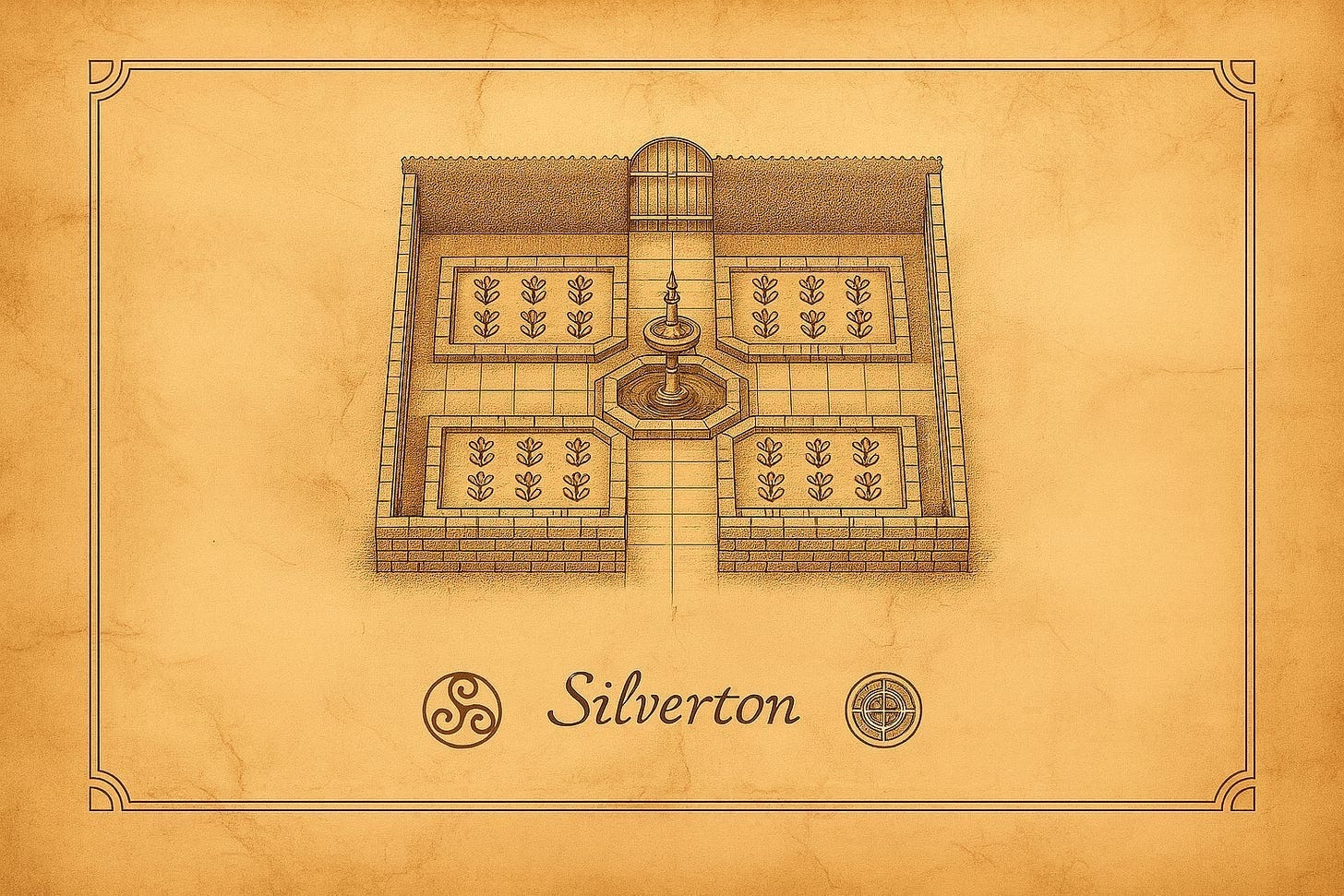
This discovery led Sarah to look deeper. Before long, her neat annotations marked plant species and growth patterns on a transfer copy of the detailed architectural drawing. This was a bird’s-eye view of the medieval monastery garden that showed the formal quadrant structure with the central fountain, arbor, terrace, aviary, and obelisk.
The next time they were together, Sarah traced the quadrant structure and said, “The layout incorporates elements of traditional monastery gardens. What do the positions of the obelisk, fountain, and arbor tell us?”
James nodded, his expression thoughtful as he examined the plans. “The proportions must be intentional.”
“May I?” Asked Helen, her eyes widening. “These aren’t just aesthetic choices,” she said. “They’re astronomical alignments. See how the path from the fountain to the obelisk aligns with the winter solstice sunrise when viewed from the terrace arbor?” Could it be that the positions of these Garden features ensure visitors derive the Apothecary’s benefits at optimal times? For example, morning light warms herbs, bringing clarity so the mind is fresh for study. Perhaps, the moist evening shadows release calming scents when rest is needed.”
James leaned closer. “And this line from the arbor to the aviary...”
“Summer solstice sunset!” Helen was enthusiastic. “Elizabeth embedded calendrical markers into The Garden’s structure! Her precise astronomical alignments suggest she tested specific variables. She wasn’t just following precedent.”
Sarah looked intrigued, but said, “That seems... speculative.”
Helen smiled, recognizing her daughter’s skepticism. “Give me a moment.” She recalled a reference book and returned with her well-worn volume. “This is a study of sacred geometry across Britain. The geometric relationships between standing stones at places like Callanish and Avebury follow similar patterns to Elizabeth’s, except they used megaliths, and she uses garden features.”
Sarah was adapting to her mother’s unconventional perspective: “So, are you suggesting that Elizabeth was not only recreating a medieval aesthetic, but that she also aimed to synthesize multiple traditions?”
“Yes, precisely. The terrace arbor provides the viewing point for these alignments. The quadrant beds correspond to the four elements in alchemical tradition.”
And so, the conversation around the colleagues’ research and discovery would continue for months and years.
The Silverton Estate Duology is widely available in E-book format.
Thank you!