

PART TWO: Stella
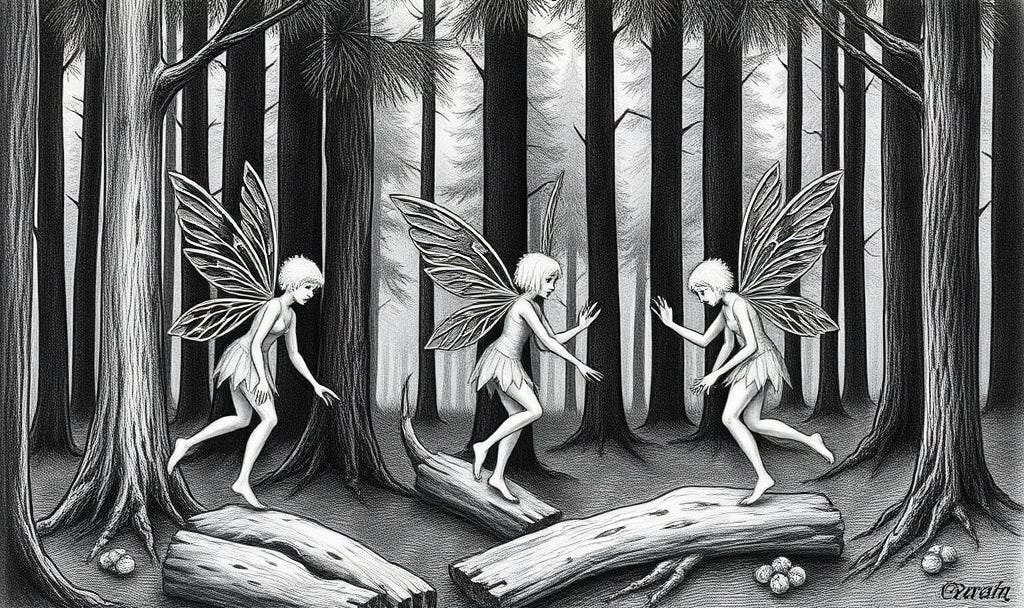
“Where the wave of moonlight glosses/The dim gray sands with light,/Far off by furthest Rosses/We foot it all the night,/Weaving olden dances/Mingling hands and mingling glances/Till the moon has taken flight;/To and fro we leap/And chase the frothy bubbles,/While the world is full of troubles/And anxious in its sleep.” — W.B. Yeats, “The Stolen Child”
GROWING SEASONS
Garden Observations
Sarah recorded:
Morning glories climb the trellises as naturally as Stella’s growth spirals and blossoms.
Mom balanced scholarly discipline with a growing sense of the Garden’s mysteries. One journal recorded botanical observations, while the other chronicled unusual phenomena like flowers blooming out of season, paths shifting under the moonlight, and how the Garden responded to human sensation and emotions. She was awakening our awareness that diverse views can be true.
Sarah’s personal entries gave way to astonishment:
Stella’s first clear responses to the Garden came with the crocuses. Her laughter matched the rhythm of the opening blooms.
Her professional notes strayed into poetry rich with wonder:
Ebony rose petals harbor visions from three epochs. From my study windows, the garden changes centuries like light caught in glass. The nursery is filled with moments between moments: morning fog rising from the herb beds in dancing shapes.
Moon Terror
Sarah’s compassion for a motherless infant gave me a stable home and family, albeit an unconventional one. I have no doubt I was loved. But was I a curiosity? Enjoyed because of my feral nature? Or adored in spite of it?
The misunderstanding of my assumed, uncertain origin was wrapped inside my adoptive mother’s sensitivity; her insecurities. Thus, the seeds of secrecy were sown in protection.
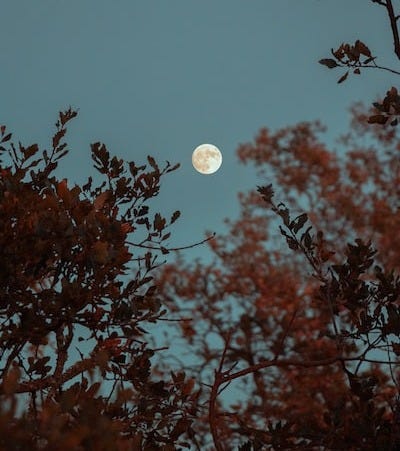
I recall one strange bedtime when I was three. After my bath, when I was in my warm pajamas, Sarah carried me down to the front porch and held me to see the full moon, and she sang my “twinkling” song. My “Stella song.”
A punctuation of stars was hanging in the pin oak, but what should be lovely, I rejected. I couldn’t bear the immediacy, terrified to tumble up into space, into unfathomable, vast emptiness.
“No! I don’t want to see it!” I twisted away to flee her arms, to turn from the black depth and distance.
Mom chided me gently and carried me back upstairs to my safe bed. Two luminaries, the streetlight on Cedar Road and the moon, rested between the tilted window blinds. I drifted, floating fearlessly among the yellow wallpaper flowers, chasing a repetition of dreams.
Sarah wrote:
S.’s extreme fear reaction to the open night sky…
Mom planted Morning Glories that climbed toward my bedroom window. Was it her maternal instinct to link my human need to be grounded with my halfling heritage that pulled me toward infinity?
I knew nothing of gravity. My terror of the night sky would stay with me for a few years. Sarah’s arms had been safe, until they exposed me to an endless void. I was both afraid of falling up, and capable of floating dreamlike in my bed.
Years later, Cedra would explain to me that these were reactions to Sarah’s close protection: confinement versus my inherent limitlessness. I was too young to form questions about my dual identity. I wasn’t broken, Cedra would tell me, but as a Half-Fae healing from maternal severance, I inhabited two worlds.
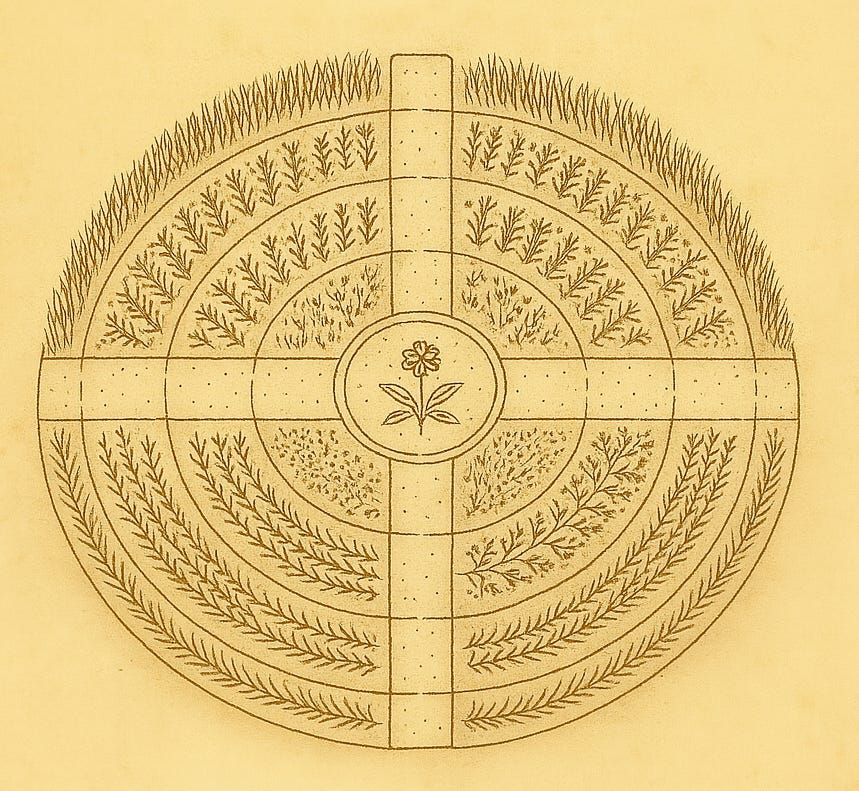
Enclosures were all around me. The Medieval Garden’s raised beds, and brick and stone walls, the Yew Hedge, Iron Gate, Fairy Ring, the Perennial Borders, and our warm, quirky home all provided safe boundaries. The Cedar Forest was a liminal space, and in time, there would be new thresholds and portals to negotiate.
The Garden’s mysteries intensified when I noticed unsettling glimpses in reflective surfaces. At first, mere tricks of light and shadow, these visions grew more vivid, revealing fragments of faces I didn’t recognize.
June 28: Reflective phenomena increasing. S. spoke to someone in the parlor mirror this morning. When questioned, she described “the lady with flowers in her hair” who “lives on the other side.” Temperature dropped 5 degrees in the immediate vicinity.
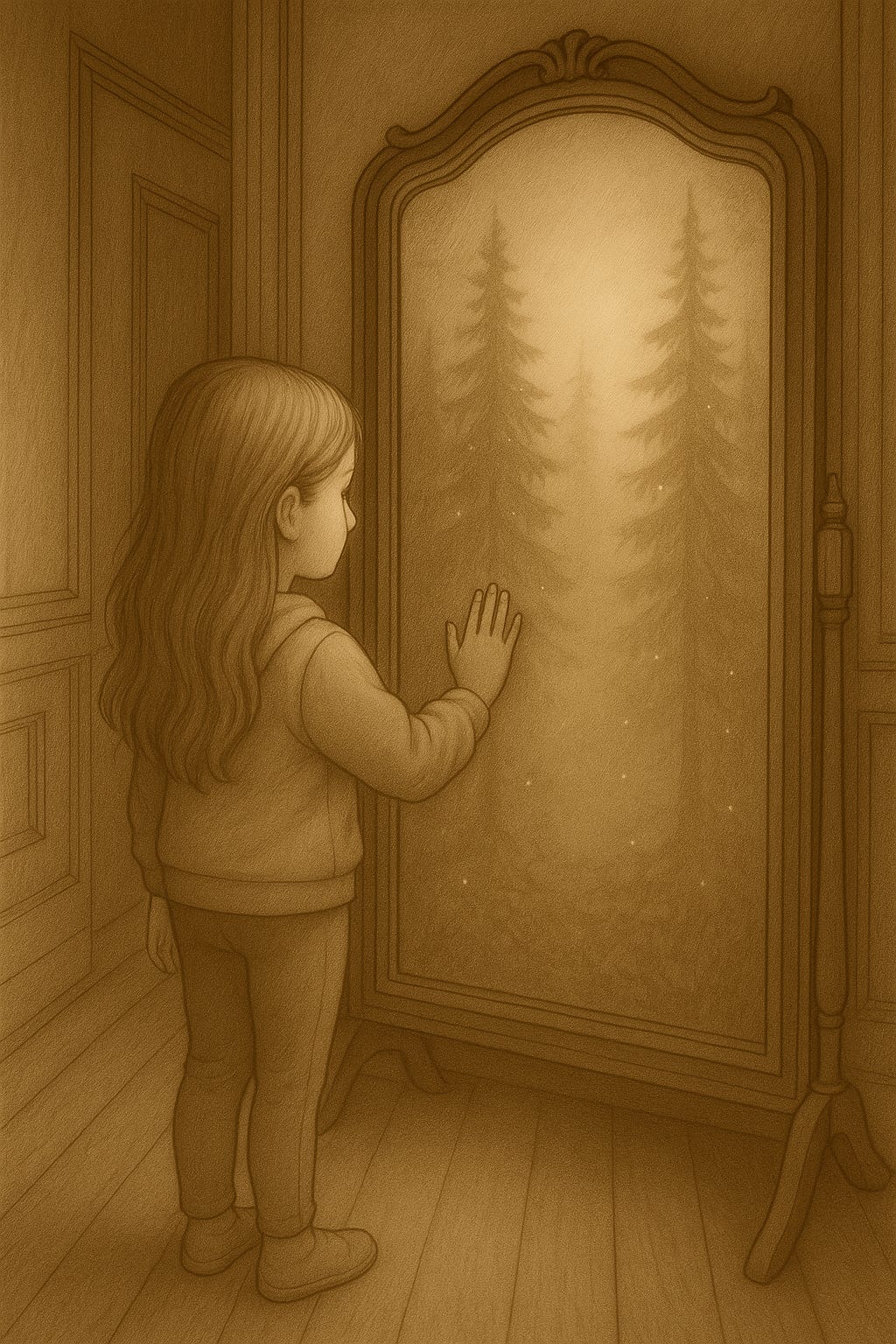
These observations might have remained academic curiosities if not for what happened on fourth Summer Solstice. Sarah found me standing before the tall mirror in the upstairs hallway, my little palm pressed against the glass. The surface showed not the hallway behind Mom, but the cedar grove at the estate’s edge.
I turned to Mom, my eyes filled with wonder, not fear.
“The trees are singing, Mommy. Can you hear them?”
“Honey, the trees don’t actually sing, they...”
“These do, Mom!”
Spinning
I was four, in a glorious summer of exploration and natural freedom bordering on ecstasy.
Sarah noted as she watched me on the lawn outside the Yew Hedge:
“S.’s spontaneous spinning mirrors the Garden’s spiral patterns.”
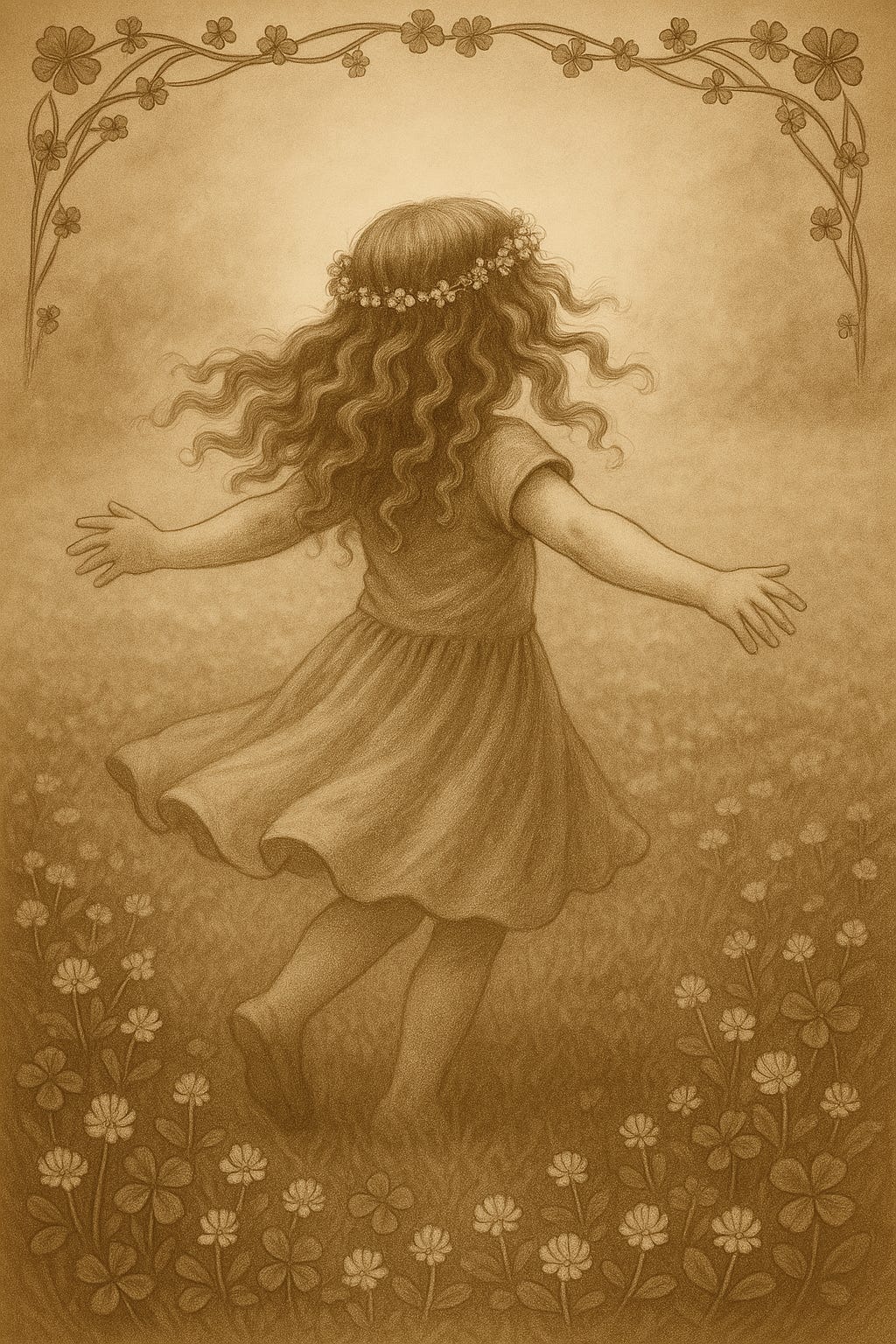
Momma shows me how to pierce the succulent stems of sweet white and rose clover into chains, to twist and twine them into necklaces with wild grass, white field daisies, shaggy golden dandelions. A soft carpet of chamomile under my bare feet. I have no cares, only pick flowers, and sing and twirl. My song comes to me in pieces, a tune of time, love, and a happy heart, a song no one knows but me. Spinning my story, my story spins me. My copper hair is pinned back in barrettes, falls on my shoulders in waves, ringlets, curls, spirals, corkscrews. Spiraling on the sunny grass, I stumble, and drop, dizzy I jump up giddy, whirling round and around in the breeze. Under the sapphire blue sky. a whisper, a song that no one knows.
It would be years before I realized that the song I sang that seemed to come from nowhere was an old fae lullaby. That day, I knew the joy of chamomile beneath my feet and clover chains around my neck. I knew I was part of the Garden, as much a part as the sunshine.
Sarah watched over me, while my fae guardians watched from thresholds---the spaces between waking and dreaming, between the Garden and the forest, between one world and another, although I wasn’t directly aware of their presence. I would later learn to recognize their patterns. In their own ways, in my early childhood, they protected boundaries I would someday have to cross. The faes’ vigilance never wavered. Sarah’s journal was a catalog of observations that straddled science and maternal anxiety.
Cedar Grove
Sarah walked with me to the Cedar Grove for the first time on my fifth birthday, the Autumnal Equinox,
“I’m curious to find Cedra’s sod roofed hut. James once said he thinks it’s in the second grove,” Sarah said.
“She works in the greenhouse and garden most days. You’d like to see her home, too, wouldn’t you, Stella?” I nodded, because I knew Cedra as a quiet, constant presence, and I hadn’t yet been to the interior of the woodland.
“Yes, I want to see the gardener’s home.”
We strolled down the first soft-needled path, but there was no sign of a hut.
Sarah said, “Oh, well. Someone will guide us to Cedra’s home another day,” and we returned to a clearing at the edge of the woods.
Sarah called as though from a distance, “Please stay where I can see you, Stella.”
I was mesmerized by branch shadows, or maybe by the shapes, or textures on the forest floor.
“I’m here, Momma.”
I’m far smaller than the sentinel cedar above me, as I sit cross-legged on the forest floor, selecting soft, young twigs to twist into spirals. I whisper secrets to the tree that protects me. My guardian between moments of the Equinox twilight. The trees trust me with their secrets, as I trust them with mine.
I said louder, “I’m here playing with cones and twigs, Mom!”
Sarah leaned against an ancient tree to sketch, satisfied I was safe.
The patterns around me could have been copied from Mom’s notebook… A flash of silver, a shifting in the grove. I hear a soft voice above a whisper, not Sarah’s. Is it Cedra’s voice? Does Cedra know my story?
Suddenly, Sarah was there. She took my hand and we turned back toward the Garden. We didn’t speak of shadows or about my speaking to trees, or how the whispers in the cedars were like goodbyes.
Mom’s research journal entry that evening was brief and precise:
First exploration of remnant cedar grove with S. Notable specimens est. 500+ years. Traditional medicinal uses: bark infusions for fever, needle tea for vitamin C. Further investigation is needed regarding folklore connections to ancient protection rites.
Sarah’s personal note:
S. stood perfectly still for 15 minutes, watching something I couldn’t see in the cedar shadows. When I asked what she was looking at, she said, ‘The trees Momma. They remember everything.’
The air felt different. More research is needed.
Helen’s Stories
Grandma Helen’s stories were a warm hug on rainy afternoons. She would take me into the main floor library, and gather me onto the velvet, plush sofa.
“Long ago,” she would begin in a rhythm and expression that captured my attention, “when the world was younger and the boundaries between realms were thinner, there lived people who could see what others could not.”
I remember her tale, about a girl who discovered a fairy ring in her garden, where morning glories bloomed in winter to mark safe paths, and how black roses appeared to warn of dangers. The tale sounded familiar; resonating in a way I couldn’t articulate.
“Did the girl talk to the flowers?” I asked.
“Some say she did,” Helen replied, her eyes twinkling. “The old stories tell us that certain children are born with the ability to see beyond ordinary sight.”
These afternoon story sessions continued through my early years. Helen nurtured my growth through tales of Celtic seers, monastery gardens, and ancient protections against unseen forces, while Sarah documented my physical development with clinical precision.
Adoption Whispers
When I was six, Sarah told me I was adopted, and gently punctured my world view. The great pin oak pressed against the window to hear the story that I was not only Sarah’s, but someone else’s, too.
We were in her study, but she wasn’t at her desk. She patted the settee for me to sit. “Do you know you’re adopted, Honey? Do you know that I adopted you? Do you know what that means?” I remember her words were tender, urgent, pleading.
I ask, “Am I lost?”
“No, you’re not lost, you’re just where you need to be. You’re here with me and Grandma. And no one is going away.”
The furniture shifts like puzzle pieces in a tilted box. “Adopted” is a whisper. A make-believe. Something in Stella’s heart is a song, something that makes her wonder about ones she never thought of before. Missing ones. Sarah protects me. Keeps me safe. “I chose you out of all the children.” I’m her girl, no one else’s. I don’t know how to ask her who they are, the lost ones. Who took me? Did the lost ones leave me? I must keep the questions inside me.
Mythmaking
I was helping Sarah with flower pictures at the table in the archives, when I was seven. I asked, “Where are my baby pictures, like Margaret has of James when he was tiny?”
Sarah’s hands stilled. “You have baby pictures, Sweetheart. Just not from when you were brand new.”
My questions were inevitable. More and more precise. I was old enough to notice patterns and innocent enough to be direct.
“Why aren’t there pictures of when you first got me?”
Sarah put aside her work and turned to face me fully. It was a threshold moment. “Babies come to their families in different ways. You came to me on a very special morning. You were a surprise to me, but the whole world was waiting for you.”
Sarah told me nothing about where I came from. “Why doesn’t anyone look like me?”
“You’re not like other children. You’re only like you, my only child. I chose you to be with me and Grandma.”
I don’t like to be different. I want to be like someone. I want to see my lost ones and know they are safe. In the fairytale, the mirror talks to the evil queen. Hansel and Gretel wander from their home, or maybe their mother left them in a dark forest. They went to a witch’s house. Must stay away from the forest where the witch lives! Sarah would never hurt me. She would never hide anything from me.
“Babies come to their families in different ways. You came to me on a very special morning.”
“Did the Garden choose me?” I thought the Garden had a life like we did.
She replied, “We must have chosen each other, don’t you think so, Stella?”
The morning glories at the windowsill turned to listen for an answer to her sweet story.
I said, “Yes,” because I didn’t know what else to say. I didn’t yet know about Myth.
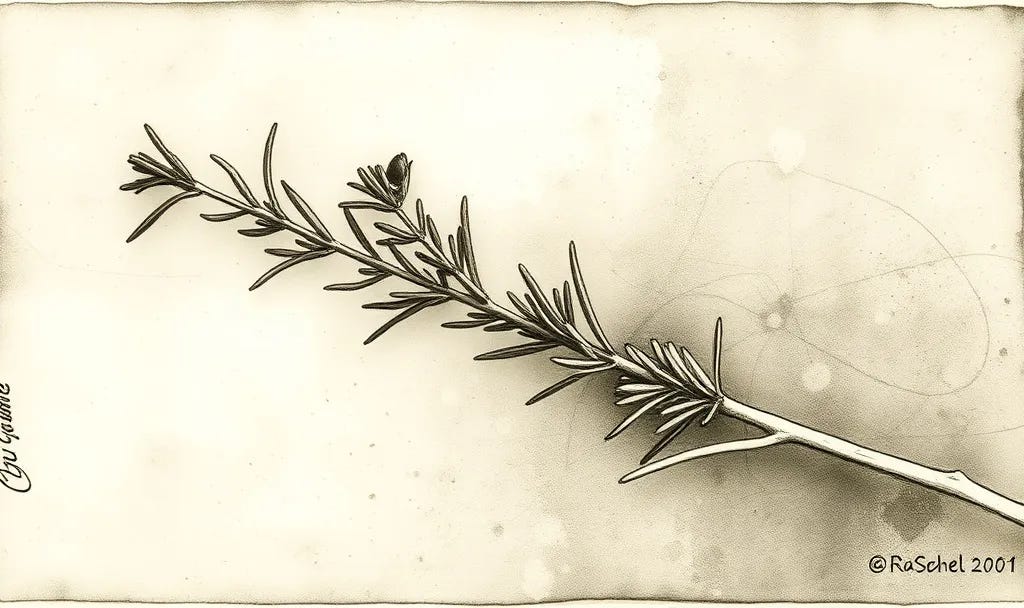
With adoption on my mind, I was drawn to the Garden in the morning light. The story of myself was unclear. Only the dew on the Rosemary remained constant, tiny, reflecting fragments of sky, earth, and my uncertain face.
Am I changed? I wondered to myself.
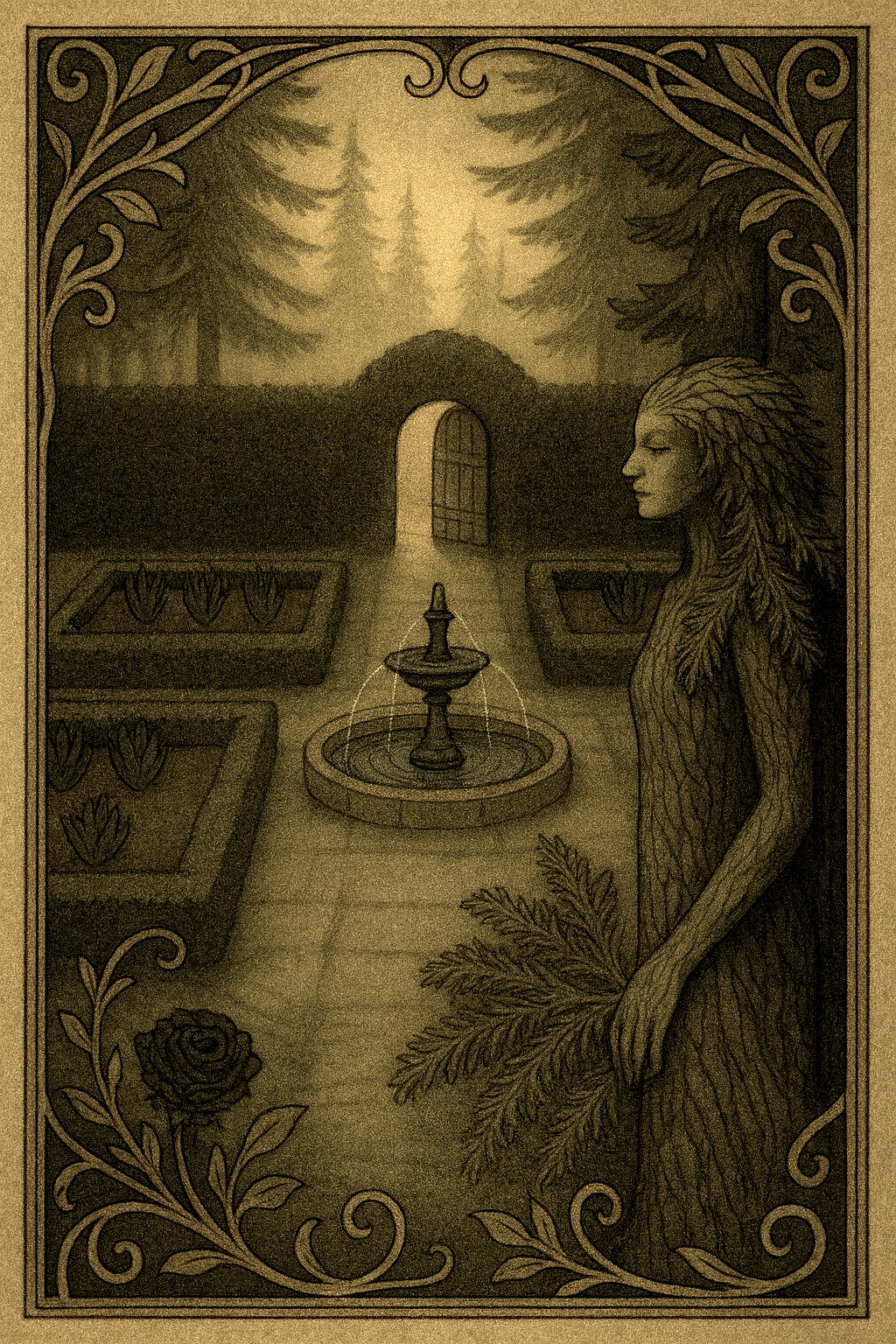
Cedra, the herbalist and rose grower, appeared beside me like I’d never seen her before; cedarbark patterns like scales beneath her skin.
All reflections hold truth, she answered my unspoken question.
Even broken truths? Broken reflections? I didn’t know how to ask her, so stayed quiet.
Cedra twirls the Rosemary sprig, showing me dewdrops in mirrored patterns. Especially those. Wholeness isn’t found in a single reflection, but in understanding how the fragments connect.
Part Two of Stella’s Story Continues Next Wednesday with No. 5 in series.
Thanks so much for following!
Mel and Islay
Thanks for reading Roots & Branches! Subscribe for free to receive new posts and support my work.
You have caught the voice of your childhood beautifully. Thank you so very much.
Magical, mystical! A loving belonging in the garden and woods. 🙏💞