
Protection, Recovery, Restoration, and Preservation
Friends,
When I found my biological family, I realized that things had happened to me before I had words or memories for them. Intrinsic moments were unrecorded or forgotten.
Did those things even happen? How real or meaningful were those occurrences to me? What is the truth of one’s origin when there is no original story to tell?
Many people are troubled by these questions. Adoptees live with them in a particular way, because of how our origins are recorded, sealed, and rewritten by law. Because the story of where we came from was taken from us before we were old enough to ask for it.
The Record
I never questioned the circumstances or location of my birth. What I knew of my origins came from my adoptive parents, the Catholic agency, and the state of South Carolina. Everything else was thin. A thinness that speaks volumes in myth, mystery, and magic.
My baptismal certificate had served as valid identification until I attempted to obtain a new passport at age forty. I was astonished to learn that South Carolina law denied me access to my original birth certificate; the document I needed, as a married adult, to prove who I was. Until then, I had accepted the legal suppositions handed to me: the vocabulary of a church document that doubled as a state record, and the myths it carried.
The amended birth certificate displayed the names of the parents who raised me. Not my origins. My adoptive mother mailed me the adoption papers when I asked for them. “I don’t know why you would want these,” she wrote. I did not know, then, how to explain to her why I wanted them. I didn’t have the language, even at age forty, to affirm my ownership. Because the record of my own beginning belonged to me, regardless of who the law said could hold it.
What I did want to know was: Would she be alive? Two years of calls and letters before my first mother and I reunited.
At the age of seventy, I finally held an uncertified copy of my original birth certificate. South Carolina still has restrictions.
The Doubleness
Many adoptees’ lives are shaped by a strange duality: belonging and not belonging; being someone’s daughter while also outside the familial circle. A kind of illegitimacy.
One mother is lost. Another offers the silver platter of adoption, with its uneasy privileges and obligations.
Adoptee’s Riddle of Belonging
A formula of lies obliterated my origins
and gave me a chance for a better life.
What life might I have had?
Removed from the powerless,
given to those who had
what I needed to live,
but who weren’t mine.
Where were mine, the lost ones?
All are left behind in a riddle of unbelonging.
— Mary Ellen Gambutti
This sense of duality is not a disorder. It is not ingratitude. It is the accurate perception of a reality that most adoption language doesn’t name directly: that you can be genuinely loved and genuinely severed at the same time. That belonging and loss are not opposites. That the record of your origin can be rewritten by law without the origin itself being changed.
Before Words
Life writing honors what can be documented. Yet beneath the evidence lies an earlier layer of experience that precedes the record.
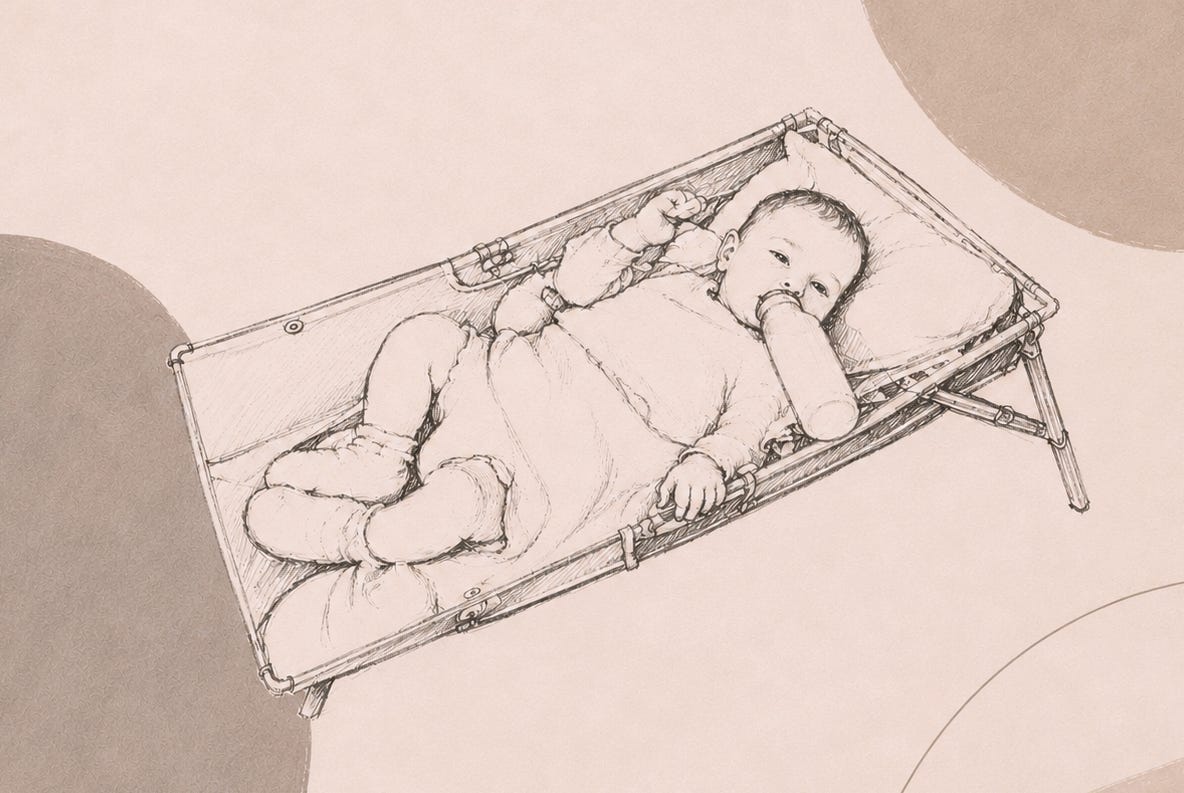
When an infant is separated from her mother in the first hours of life, the event does not live in time but in the newborn’s nervous system’s wordless archive. The body remembers the displacement. The dissociation. The earliest impressions are formed in the womb, and in the first moments after birth. Before language. Not in memory. And they may last a lifetime, as trauma clinicians have long observed.
Many adoptees recognize a heightened sensitivity: a quick response to emotional undercurrents, an ability to read the room, a hypervigilance that began before they had words for what they were watching for. Survival adaptations? Primal wounding, intuition, extra-sensory awareness. A kind of deja vu, perhaps? The separated, abandoned newborn waits and watches, adjusting to loss before she understands it.
Recovery becomes complicated if you cannot remember what happened. You cannot document what precedes the record. You cannot grieve, in the ordinary sense, a loss that occurred before you knew. But this is the grief of the disenfranchised. There is no reason to grieve, or to be ungrateful, you are told. Preservation becomes all the more urgent.
If the record was sealed, and the body’s knowledge precedes language, what can be recovered? What must be preserved if not in document, nor in testimony? What can hold what the archive cannot?
The story can change.
The Language
I did not set out to write magical realism, though I was intrigued by the form. I would be approaching fiction for the first time, which was daunting given the relative ease I had cultivated in writing personal narrative. The process of memoir, the stir of memory and emotion, the discipline of evidence, had brought me closer to understanding my own truth than I had expected.
Memoir allows the evidence to stand: the military family transfers, the bases and separations, the impermanence, the tensions and transitions, the discipline. The baptismal certificate. The amended birth certificate. The adoption papers in their envelope from the Rock Hill law firm.
But something essential lay beyond literal description.
I needed a language strong enough to hold the contradictions of adoption. A language in which both love and harm are real simultaneously. A language that doesn’t resolve the tension between severance and belonging but instead allows both to exist, intact and true, without requiring a verdict.
Magical realism gave me the language. It offered an escape from the difficulty of adoption’s realities. But it works because it widens the frame. It allows truths to exist that resist the narrow limits of literal description. Because it can hold what the nervous system holds; the pre-verbal, the pre-memory, the knowledge that preceded language, and render it visible while honoring its validity.
In my fiction, written under the pen name Islay Corwin, the central character carries mirror-sight: the ability to see through reflections and across thresholds. The inherited trait opens a conversation about adoptee heritage and reflects the effects of newborn separation. The child senses the world, perceives ruptured identity, and without choice, moves between worlds.
The adoptee at the center of the story carries three names. One was taken from her. One was given to her. One she ultimately claims for herself. Adoptees require little explanation of this. Severance disrupts the self. Only patching the wound of loss, the meeting between Stella and her first mother is tender, yet awkward. After all, they have become strangers. Their bond was broken by the first mother, whose circumstances shaped an impossible decision.
Recovery and Preservation
There are no simple answers, although adoption discourse often presses for them.
Was it a rescue, or was it a rupture?
Are you grateful? Angry?
Do you belong to this family, or to another?
Of course, the answer is yes.
The work of recovery, if possible, is not to choose between these truths. It is learning to hold them simultaneously: grateful and grieving, belonging and having been severed, to love the family that raised you and to mourn the family you lost. This is to be Ruth Ann and Stella and Questa all at once, without resolving the contradiction, but instead finding integration in acceptance, without transforming the dilemma into something tidy.
Preservation insists that the full record exists, not just the amended birth certificate, not just the baptismal card with its official vocabulary, but the body’s knowledge, the pre-verbal experience. Insisting that these things happened. That they mattered. That their absence from the adoption records does not erase those early experiences.
In the end, the language that came closest was the one that allowed for finding magic in the mundane. Some truths are too large for the literal.

This essay grew from an earlier piece published in Roots & Branches. It has been substantially expanded to include the Recovery and Preservation framework that organizes
The Garden and the Gate.
Thank you for reading. I appreciate comments and re-stacks in support of my work.
Mary Ellen Gambutti writes memoir and personal essays as herself, and lyrical fiction as Islay Corwin, author of the Silverton Estate duology. Protection, Recovery, Restoration, and Preservation is the organizing principle of The Garden and the Gate.
The Duology is widely available in e-book:
Through the Yew Hedge: A Tale of Identity Magic
Through the Iron Gate: The Rosemere Records
Amazon
A note to readers: The Garden and the Gate is now open. Several essays, including this one, are free to all subscribers. In Behind the Hedge, you’ll find a number of excerpts from Book One of the Duology. Future essays in this section, exploring the botanical traditions, Celtic mythology, Welsh healing practices, and adoption themes that ground the Silverton Estate duology, will be available to paid subscribers.
If you’d like to support this work and access all features of Roots & Branches, including the full Recovery and Preservation essay series, you can upgrade your subscription here:
Thank you for being here!
Mary Ellen Gambutti