Expressing the Inexpressible
Adoption Tales in the Language of Magical Realism

“The task of the writer is to make the invisible visible.” — Toni Morrison
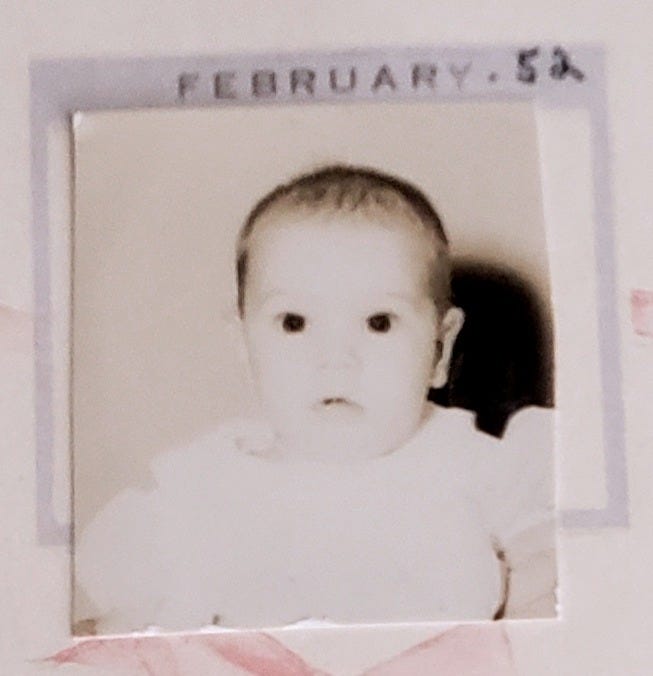
About the time I was discovering my biological kin, I began to understand that things had happened to me before I had words for them. Before I had language at all. Things no one recorded, of which I have no memory, and perhaps no one remembered.
Did they happen, then? What is the truth of one’s origin when there is no story to tell?
A severance. A transfer. A name sealed away and another given. The law calls it settled. But the body does not settle so easily — if at all. The body keeps its own record.
For many years I relied on the language of law and the suppositions handed to me. The vocabulary of my baptismal certificate, sealed records, and amended birth certificate, of relinquishment and placement. I accepted the words as accurate, since I gleaned them from my adoptive parents, the Catholic Agency, and South Carolina. “Born in September 1951” seems valid. The tone of my adoptive mother’s nurse-clinical notes, which begin from my arrival in their apartment until about age two, ring true with the spectre of Dr. Spock. Her evidence points to fact. All else is thin, yet speaks volumes in myth, mystery, and magic.
Accuracy, however, is not the same as understanding. Such language cannot quite reach the strange doubleness that shapes many adoptee lives: the feeling of belonging and not belonging at the same time. Of being someone’s daughter, while being no one’s. Of carrying a self that exists just beyond the edges. One mother was intent on abandonment. Another presented me with the silver platter of adoption and undeserved privilege. A deeper self was never formally introduced to either.
Memoir brought me closer. Memoir allows the evidence to stand: the Air Force bases, the school transfers, the mealtime silences. The day, at age seventy, I held my birth certificate. Memoir is honest and attentive to what can be documented.
But beneath the evidence there remains another layer of experience, one that precedes documentation.
When an infant is separated from her mother in the first hours of life, the event does not live in time. It lives in the body. In the nervous system. In the strange ways a room feels wrong, or a silence carries weight. In mirrors that seem to hold more than reflection.
This was the place where story began to change.
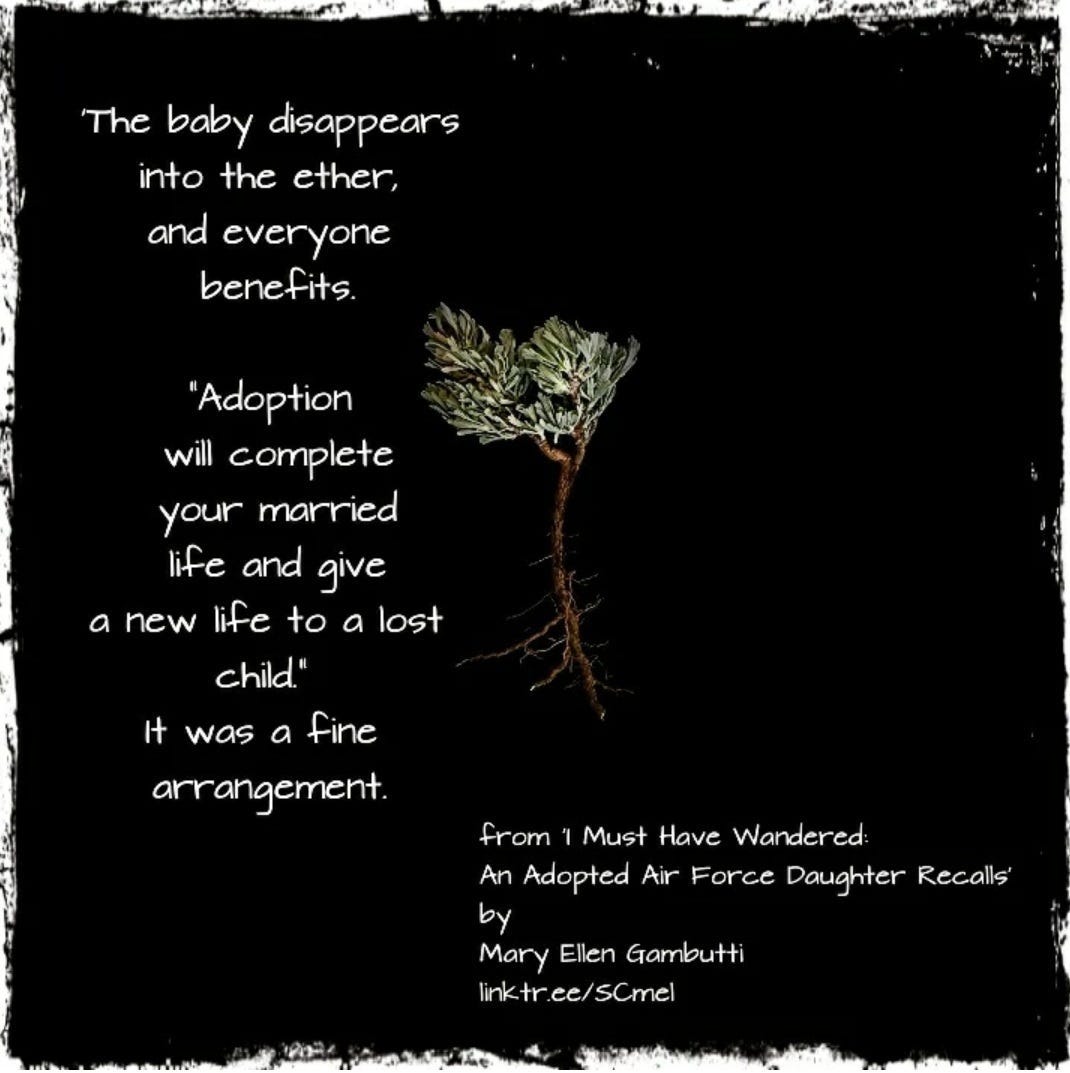
I did not set out to write magical realism, although I was intrigued by the form. I intended to write another memoir. Yet the story I needed to tell resisted the tools I brought to it. The facts held, but something essential remained beyond the reach of literal description. A language that could hold the contradictions of adoption: the love that was real and the harm that was also real. Magical realism permits my images and words to keep such contradictions intact.
In the novella, the central character develops mirror-sight: the ability to see through reflections, across thresholds, into spaces others walk past without noticing. It appears as a magical inheritance within the story. Yet it is also the closest metaphor I know for the adoptee experience. The heightened perception. The attunement to what remains unspoken.
Research has begun to describe what many adoptees already recognize in themselves: patterns of heightened sensitivity, acute responsiveness to emotional undercurrents, a capacity to read the room long before language arrives. These are survival adaptations. The infant calibrates to loss before she has words for what has happened. The body reads atmosphere before the mind learns to speak. Pre-verbal experience that resides in the nervous system before it can live in narrative.
Many adoptees recognize it long before they encounter the terminology. The body remembers what the record cannot. In the world outside story, such sensitivity is managed as pathology. In the novella, I chose to give it another name: inheritance.
I placed that inheritance within a garden designed by a woman who understood that some people experience the world with a permeability ordinary life cannot easily accommodate. Gardens are well suited to such work. They hold contradictions without argument: dead wood beside new growth, beauty beside decay, buried records beside the stories that rise quietly above them.
The adoptee at the center of the story carries three names. One was taken from her. One was given to her. One she ultimately claims for herself. Most adoptees require little explanation of this.
The reunion the story allows is not repair in any simple sense. It is tender, awkward, necessary. A first mother whose own gifts shaped an impossible decision. An adoptive mother who loves fiercely and imperfectly, concealing documents because she believes she is protecting her child, unaware that concealment itself becomes part of the wound.
Adoption discourse often presses toward simpler answers.
Was it rescue, or was it rupture? Are you grateful, or are you angry? Do you belong to this family, or to another?
The honest answer, of course, is yes.
Ordinary language struggles to hold such contradictions. Magical realism widens the frame, allowing us to acknowledge truths that resist the narrow limits of literal description.
The mirror remembers what the record sealed away.
For many years I searched for the right language for something that happened before I could speak. In the end, the language that came closest was the one that allowed for magic. Not because magic is untrue. Because some truths are simply too large for the literal.
© Mary Ellen Gambutti