
Dear Readers,
In the Archives, Sarah uncovers secrets that Elizabeth Silverton left for future guardians. But knowledge and acceptance don’t always arrive in the same moment...
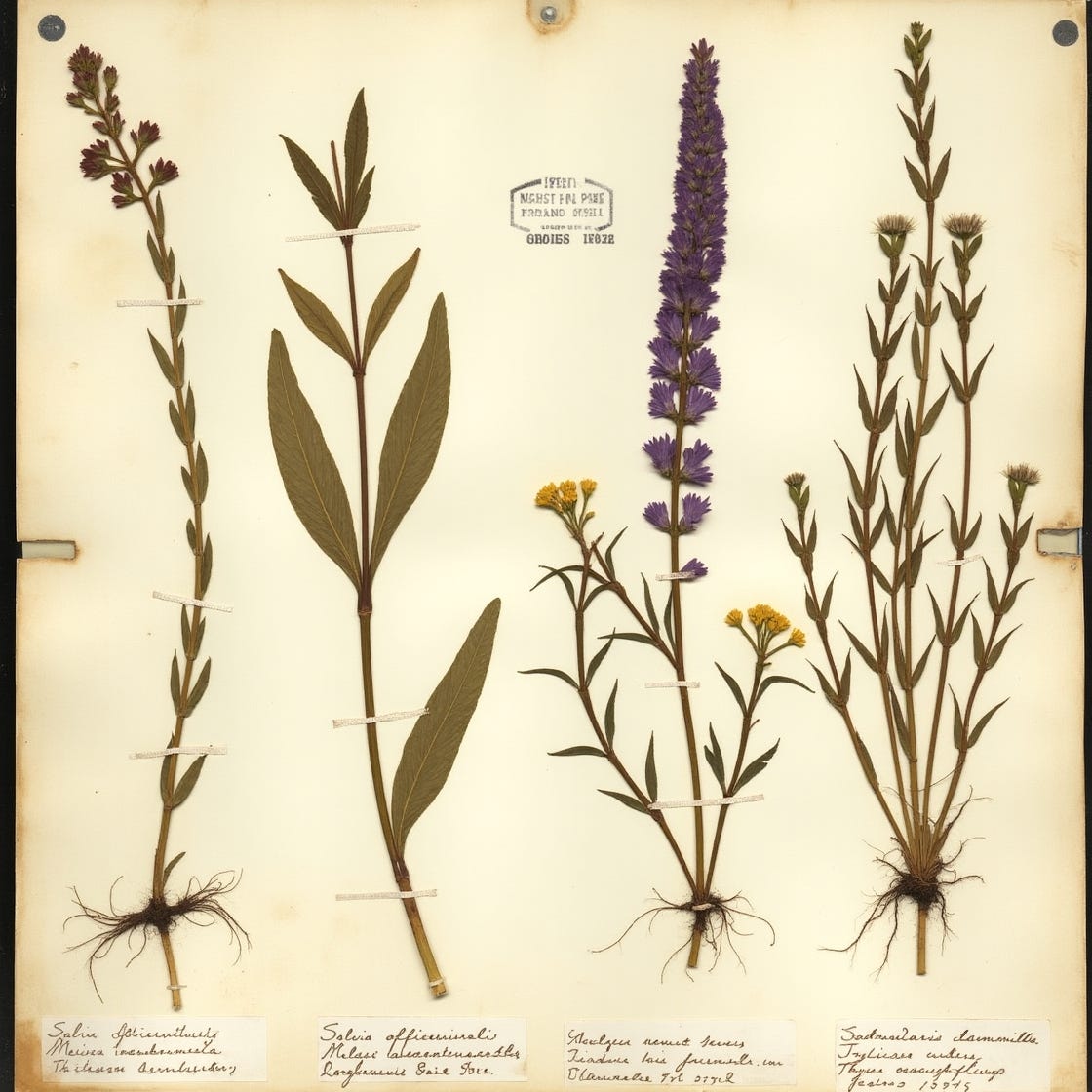
Sarah’s Research
Mom seemed distracted from her routine tasks. I noticed her furrowed brow. She didn’t smile as she used to. I wanted to make her feel better, but she was less playful, spending more time in her office.
Sarah was authorized to access the full Archives, yet had misgivings about unlocking the “specialty” cabinet that held the most perishable and fragile documents and specimens when James wasn’t working there.
Late one evening, she decided to open that particular cabinet to review Elizabeth’s original Garden plans. Their watercolors and drawn details, preserved for a century, now benefited from up-to-date climate control and acid-free storage paper and boxes.
Sarah smoothed the first architectural drawing on the viewing table, and her eyes went right to the features she’d looked at time and again. But had she seen them? There was, of course, the concentricity of circles—the Fairy Ring. She mused: In the Fairy Ring, start with gentle constitutional strengtheners in the outer ring, progress to the focusing herbs in the middle circle, and retreat to the calming plants in the inner sanctuary when needed...
She now conceded that the herbs might have been arranged in a therapeutic progression. Moreover, she now could concur with Helen that the astronomical alignments that honored medieval tradition might optimize aromatic release in daily and seasonal cycles. Then why, she wondered, had she not internalized Elizabeth’s intentions after years of following her work?
Elizabeth’s Annotations
Matricaria chamomilla: Thought to benefit visitors who suffer from nervous overstimulation. Particularly effective when positioned to catch morning sun, releasing therapeutic compounds during hours when such distress appears most acute.
Lavandula angustifolia: Remarkable calming properties observed in individuals whose perceptions seem to exceed ordinary ranges. Garden placement allows evening fragrance release to coincide with periods of heightened sensitivity.
Valeriana officinalis: Root preparations show promise in treating episodes of overwhelming awareness. Medieval manuscripts suggest similar applications for what they termed ‘seeing sickness.’
Sarah’s breath caught. These weren’t general horticultural observations. Elizabeth seems to have been treating visitors who were troubled by uncomfortable or unusual perceptions, or intense reactions to environmental stimuli. On page after page, she read entries that could have described me:
Individuals who perceive patterns others cannot detect often benefit from grounding aromatics. Rosmarinus officinalis, when properly positioned, appears to stabilize excessive perceptual activity. Those prone to episodes of heightened visual phenomena respond well to carefully regulated exposure to Melissa officinalis. Observed reduction in distressing episodes when subjects spend extended periods within the herb’s natural fragrance range.
Sarah’s Journal Entry: Margaret brews chamomile tea when Stella has difficult episodes. She encourages Stella to linger in the Rosemary beds when mirrors overwhelm her. The scent of Lavender calms her on restless nights. Are Margaret’s choices intuitive? Herbal lore? Or are they guided by Elizabeth’s planting design; had she positioned herbs for optimal potency? For their remedial effects? Does Margaret understand this about Elizabeth’s Garden?
Startled, Sarah straightened. Has The Garden been teaching me how to help Stella right from the start?
Below, like a postscript, or a disclaimer, undated, and penned in a different ink by Elizabeth:
Ongoing study is recommended. The design is a framework and proper use and treatment requires the guidance of one more knowledgeable than I. I entrust this Garden with all its challenges and opportunities, and benefits to future caretakers who may be more enlightened than those of my generation. E.S.
And there was more; another lead, a clue, a breadcrumb, perhaps: A folded sheet of stationery monogrammed with “E.S.”
To Future Curators Spring Equinox, 1892
Dear Friends,You have known me for some time, so you understand that this Garden is more than a strict arrangement of plants. It is a sanctuary.
I have chosen these herbs as one might choose companions; by nature, each may offer a degree of kindness and comfort. I’ve kept careful records. The lists, plants, and The Garden as a whole shall be in your safekeeping, for your gentle, guided use.
Fondly,
Elizabeth S.
Sarah sank into Elizabeth’s Victorian armchair, suddenly exhausted.
How could I, Elizabeth’s intellectual protégée, not have grasped that The Garden wasn’t designed to impress donors or simply to echo the past, but to fill the human need to comfort and be comforted in return? It was designed to research, treat, and heal, to support the special abilities she might not have fully understood. I must have known this! Why haven’t I made the relevant connection to my child?
Sarah pondered until her head grew heavy, and her bed called. Had Elizabeth known? Had she somehow foreseen that a child with unusual sight would one day require sanctuary here? Impossible! She gathered Elizabeth’s materials and locked them away. Like a spell, waiting to be released, was a promise of help, the potential for good. But could it harm? Have I reached beyond convention to something taboo?
Before she slept, Sarah wrote:
Where have I seen these words? “What seems like mere historical curiosity today may prove essential understanding tomorrow.” Perhaps it’s time to stop hiding knowledge and start sharing it. To trust, as Elizabeth trusted, that some truths are worth preserving even when they challenge what we believe, what we understand about the world.
Sarah now felt sure that the key to Elizabeth’s legacy was her courageous message to future curators. She had trusted them to validate her work.
Sarah’s Soil Analysis, Silverton Estate—September
As curator, Sarah collected soil samples periodically to test the acid and alkaline balance and determine the availability of critical nutrients. Following her research in the Archives the night before, she felt the need to confirm the soil condition, especially in the apothecary beds, and in locations where Black Roses sprouted. Morning Glories grew virtually everywhere, so she decided it was less critical to trace their requirements.
Samples collected from perennial borders and quadrant beds.
*Mineral composition consistent; trace elements not typical of regional geology.
*Moisture retention good despite recent drought.
*Mycorrhizal networks denser than control plots.
*Recommend long-term storage and comparison.
“The Garden has wisdom,” she murmured as she capped and labelled the vials. She would do the pH tests and send the rest to the University Horticulture lab. She wrote the next morning: I dreamed of roots twining underground, carrying memory like blood.
The Mirrors Misbehave (Age 10)
Sarah’s recent foray into the Archives shifted her feelings about my mirror episodes. She wasn’t covering the hall mirror. She seemed to think about my reactions to reflections as harmless hereditary traits. She seemed less controlling and more understanding, and objective. She had been redirecting my attention from mirrors that “misbehaved,” and now was documenting mirror “incidents” in detail.
“The bathroom mirror clouded again this morning,” I reported over breakfast, no longer hiding these occurrences but not yet understanding their significance.
“For how long?” Sarah asked, her tone curious rather than concerned.
“Just a few seconds. It showed the Garden, but it was covered in snow.” I paused, considering. “It felt like a memory, but not mine.”
Sarah made margin notes like she was witnessing something important.
Elizabeth’s letter had come as a warning to her to pay attention to patterns rather than dismissing them or worse, raising alarm.
“The house has a long history,” she said thoughtfully. “Perhaps you’re seeing glimpses of its past.”
Her acceptance permitted me to report other incidents without fear: reflections that showed different seasons, glimpses of people in period clothing, waters that rippled without wind. Each occurrence became a small exploration rather than a worry, building my confidence while teaching me to observe rather than merely react. How Sarah responded helped me to accept that being different wasn’t wrong.
Memory Tricks
I tried to explain memories to Cedra, like fragments of light through leaves, or sounds like singing when no one was around, and she would say, Memory plays tricks.
One early morning, around my tenth birthday, I sat upright in bed, awakened from a vivid dream. Bluebells and morning glories surrounded a familiar-looking woman who sat humming softly while she wove a bracelet of blue Forget-me-nots.
In my mirror—it might be a trick of the light—lifting my right hand; my reflection lifts its left. When I blink, it smiles. Is the slight point to my ears my imagination? And the woman’s Forget-me-not bracelet is on my wrist!
Below my bedroom window I saw Sarah walking out to The Garden, wearing her favorite cardigan and the cargo pants with large pockets for seeds and plant snips. She had left her garden notebook on my dresser. I grabbed it and ran downstairs in my bare feet, Winston my fox terrier, right behind me, his tail wagging all the way. We caught up with her.
“Mom, you left your notebook...” Breathless, I held it up.
She thanked me; her brow furrowed to see me in pajamas and bare feet on a chilly fall morning.
“Sleep well?”
My reply wasn’t what I expected:
“The mirrors are getting clearer!”
She paused. The Garden leaned in, and the breeze stirred through the Yew Hedge. I saw Mom the way the fae must have: a scholar open to wonder, a gardener who understood the nature of plants; that they sometimes grew unexpectedly.
“Clearer? How?” She asked with only slight concern in her voice. I sat on the Iron Bench, and she sat, too, giving me her full attention.
The Black Roses brightened; their late-season blooms catching the morning light like dark garnets. Winston panted, pressing against my legs.
“I saw my face as a baby, my usual face, and my face...a little different," I explained. “And this pretty flower bracelet was on my wrist...” But the bracelet was gone, leaving only a trace of perfume. Winston moaned. I sighed.
Sarah studied my face, weighing my words against what she was learning from The Garden’s mysteries. Like me, she was trying to put puzzle pieces in their right places.
She stood up and placed her hands on my shoulders, gently, but firmly, directing me, “Come. I want to show you something.” I stood with her and we entered the Monastery Garden through the open gate in the Yew Hedge. Winston trotted cheerfully alongside us.
“These herbs don’t just grow randomly,” she said, gesturing to the rows in the raised beds. “They were planted with intention. They protect, they strengthen, they remember.” She pointed to the rosemary, thyme, and lavender, the plants I’d helped tend since I could walk. “Elizabeth Silverton chose each one for specific properties.”
“And The Ring,” I whispered, the words rising unbidden from a deep place of certainty.
“Yes, and The Fairy Ring, too,” Sarah nodded. “This Garden has been waiting for us both to recognize it properly. To see what it is.” I remembered how, as a toddler, I liked to curl up in the center of the concentric circular Fairy Ring for comfort.

“Momma, why don’t my eyes see things the same as other people?” I asked in a small voice.
“Because you’re learning to see all that truly is—what could become,” Sarah said, reaching into one of her many pockets. It was a tender way of telling me that I was sorting facts from fiction, using discretion, and powers of reason. She withdrew a small iron key pendant on a silver chain. “I’ve been saving this for when you are ready. I found it in a drawer in my study when we first moved in. We can call it a talisman for protection and clarity.”
She fastened the chain around my neck, and the pendant was both cool and warm against my skin. I knew it was important, but not why.
“What do you know about me, Mom? How did I get here?”
Sarah said what she thought she could. “I know that this Garden recognized you the moment I found you. I know that Morning Glories bloomed in the snow to welcome you, and that Black Roses appeared to announce that you are someone special. And I know that you belong here, with us, growing into whatever you’re meant to become.” It was a kind, motherly, albeit myth-laden response, and it satisfied me in that moment.
We saw the herbs lean toward us, and the rising golden sunlight spilled across the quadrants as she spoke, “The Garden isn’t ordinary, Stella. And neither are you. But that’s not something to fear; it’s something to celebrate.”
I felt a deep sense of rightness, of being exactly where I belonged.
“We’ll figure it out together,” Sarah promised. “You, me, Grandma Helen, and everyone who cares about you. That’s what families do; they help each other grow.”
On the way back to the house for breakfast with Helen, I was buoyant and bouncy, like Winston. I noticed I was still in my pajamas.
Heart-to-Heart
In the weeks that followed, I was drawn to reflective surfaces rather than avoiding them. The mirrors were showing me something about myself that explained so much: why certain plants responded to my touch, why I could hear whispers in the Cedar Grove that others couldn’t, why I sometimes glimpsed movements at the corners of my vision that disappeared when I turned to look directly.
I wasn’t broken or strange. I was something else; something the mirrors recognized even when I didn’t fully understand it myself.
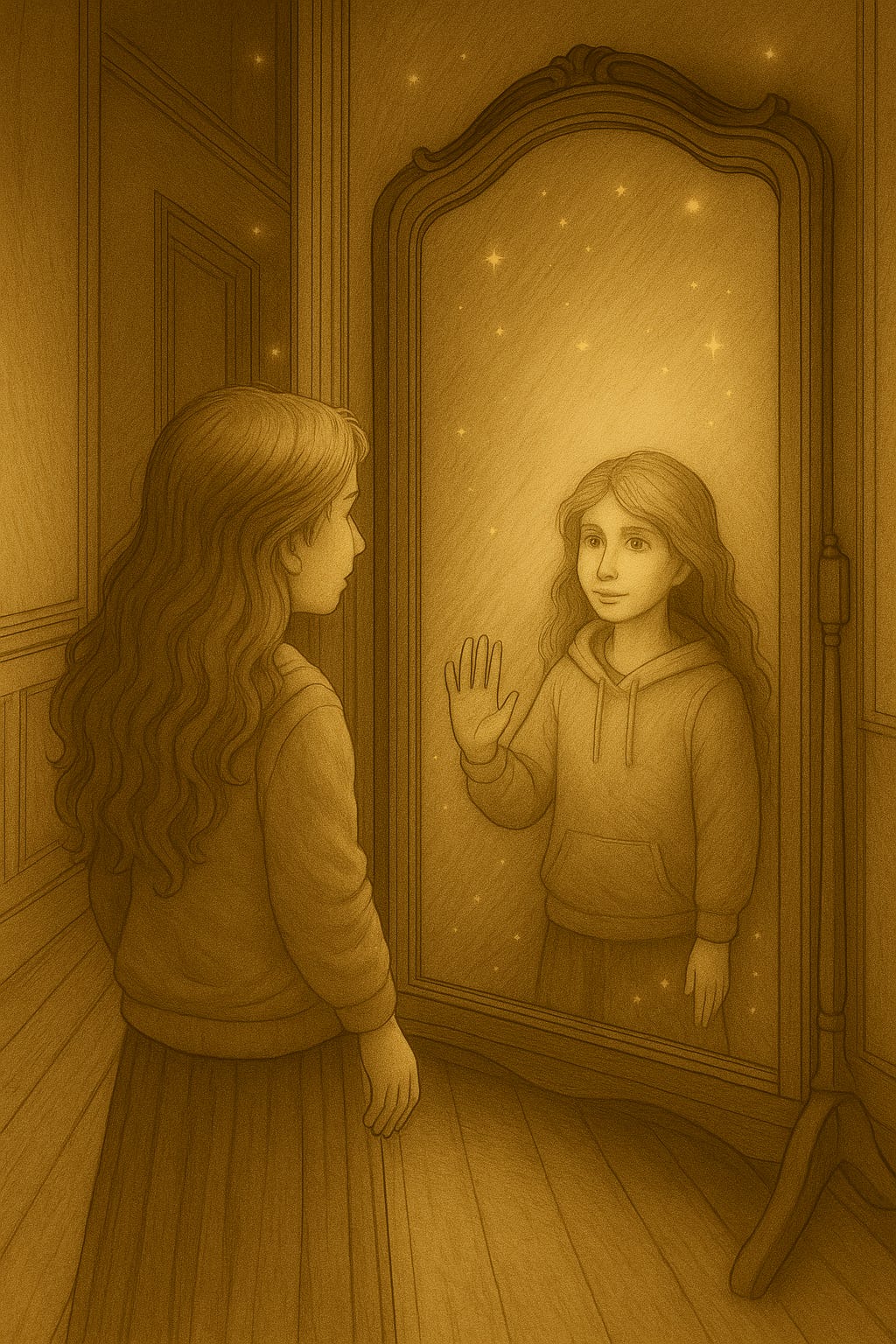
One afternoon, I sat cross-legged on the floor in front of the antique mirror in the upstairs hallway, the one Sarah had nearly removed several times because of my complicated relationship with reflective surfaces.
Today felt different, though. Not a moment of fear but one deliberate connection.
“Everything all right?” Sarah asked, pausing in the doorway.
I didn’t turn immediately. “I was asking it questions.”
“The mirror?” Her tone remained neutral, but I recognized the scientific skepticism she was trying to hide.
I turned to reply, “Mirrors remember things ordinary glass forgets.”
Sarah sat beside me on the hall runner, careful not to position herself within the mirror’s reflection. “What sort of things do they remember?”
“People who stood where we were sitting. Words were spoken in this house before we came. Sometimes...” I hesitated, studying Sarah’s face for signs of disbelief, “Sometimes places that exist somewhere else.”
The conversation had entered territory where Sarah would likely redirect toward more rational explanations. Perhaps it was her collection of documented anomalies in her research journals that caused her to pause instead of dismissing my perspective and listen to what resisted conventional explanation. Perhaps it was Helen’s gentle reminder that the world contained more knowledge systems than those recognized by Western science.
“That must be... challenging,” Sarah said tactfully, “seeing things others don’t.”
Her words, though unexpected, relaxed me, and I replied, “It’s not always scary. Sometimes it’s like having extra windows in a room where other people only see walls.”
My words surprised me and Mom. “And these windows—they show you different places?”
“Or the same place differently,” I said, “like how you see The Garden as plants and weather patterns, and growth cycles. I see that too, but... more.”
Sarah felt a familiar tension between science and her instinct to validate my experience. “Does it bother you that I don’t see what you see?”
“Not really,” I said, with a child’s innocence and forthrightness.
“People see things in different ways. Charles sees which plants need attention before they wilt. Margaret knows when it will rain without checking the forecasts. James finds patterns in old books that tell stories other people miss.”
Sarah was struck by the wisdom of my observation. Each person I named, indeed, did approach the world through separate ways of understanding; frameworks no less valid for being different from her method.
“Besides,” I continued, “you’re starting to see more than you used to.”
“Am I?” Sarah asked, surprised.
“You didn’t pull me away from the mirror this time, like you have been doing. When the black rose popped up in the herb garden yesterday, you watched it instead of writing in your notebook.”
Sarah laughed, “You noticed that did you?”
“The roses noticed, too. That’s why more of them are blooming now.”
In a matter-of-fact tone, I had made an ordinary observation, the way Charles often did.
Sarah sighed. She realized she was up against a reality she’d been gradually accepting in her research journals but had hesitated to fully articulate: that The Garden was unpredictable, and her training hadn’t equipped her to fully comprehend how that could be true.
“I don’t always understand what happens in this Garden,” Sarah admitted, the confession both difficult and freeing for her, and possibly for me, as well. “Or why certain things happen around you.”
“That’s okay.” I placed my hand over Mom’s. “Understanding isn’t the same as accepting. You can accept things first and understand them later. That’s what Charles says about difficult plants—you nurture them before you fully understand their needs.”
“When did you get so wise?” Sarah asked with a smile that contained both pride and wistfulness.
“Maybe I remember things from before, like the mirrors do,” I said.
Once again, I surprised myself with my growing awareness of the mystery around my origins. The statement wasn’t meant to challenge Sarah’s role, but to acknowledge what neither of us understood. Sarah, once again, didn’t feel the need to redirect toward more rational explanations.
“Perhaps you do,” she said. “And perhaps those memories are as much a part of you as the ones we’ve made together.”
I leaned against Sarah’s shoulder, and my gaze returned to the mirror, where both our reflections, mother and daughter with different genetic heritages, but an undeniable connection, shared a loving silence.
“The Garden helped you find me,” I said after a moment. “That’s what the morning glories told me.”
Sarah considered the unlikely sequence of events that had led her to The Ring that winter solstice morning—her uncharacteristic decision to walk The Garden before sunrise, the impossible blooms that had caught her attention, the path that seemed to open before her.
“Perhaps it did,” she acknowledged, putting her arm around my shoulders. “In which case, I owe it a debt I can never fully repay.”
Looking back on that moment, a door had been opened to possibilities with Sarah’s acknowledgment that some bonds were formed through unlikely and impossible circumstances. When we’re lucky, it is a bond formed by love.
Thanks for being here! Next Wednesday, when we continue Part Two: Stella,
Sarah witnesses something impossible in the Garden, and Stella asks the question that’s been waiting since the beginning: “Where are the papers?”