
Welcome back to Through the Yew Hedge: A Tale of Identity Magic.
After Midsummer, the story turns from ceremony to evidence. DNA results surface, a long-forgotten soil sample is recovered, and the Garden responds as though it has been waiting for the right questions to be asked.

Family Patterns
Sarah’s academic world had expanded to embrace the changes. Her study transformed from her academic sanctuary into a liminal space where truths coexisted. Medieval herbals and ancient texts about family magic lived with Botany textbooks. Embellishing the margins of her notebooks and folios with symbols and florals wasn’t unusual, but now she recorded what she once considered peculiar phenomena as mundane occurrences. Most importantly, Sarah showed her acceptance of my reunion with my natural mother after our long, unnatural separation, and my inherited fairy sight.
The Garden’s Essence
Sarah and James, taking a slow Saturday afternoon out of the heat, were chatting in the Archives lab. James set aside the file of genetic reports. “Do you remember that soil sample you collected several years ago? It’s been in the back of the specimen refrigerator all this time.”
Sarah blinked, “What? You kept it? It’s got to be covered in Rhizopus!”
“Yes. I did. It seemed... important. And I’ve compared a sample against Stella’s DNA results. I thought you should know, the fungal DNA fragments show patterns just as unusual as her markers.”
“Don’t try to tell me Stella’s genetic makeup is akin to bread mold...”
Sarah’s chuckle and facetious tone didn’t surprise James. Lately, she seemed freer, more accepting of the magic around her. Still, James rolled his eyes.
The Garden’s blood, bottled in a beaker, had waited for the right moment to speak. “Even the soil remembers,” James said.
Extraordinary Results
On a bright July afternoon, James visited The Guest Cottage with the DNA test kit he’d ordered for Ellen. She’d agreed to provide a saliva sample, as I had the previous fall. The combined results of our genetic tests could help me understand my heritage and bridge ancient lore to modern science.
“What we have learned from Stella’s test is that your family’s genetic pattern is extraordinary,” James said. “There are markers that appear in less than 0.01% of the general population...”
“My grandmother called it ‘the old blood,’” Ellen replied. “She said it came from beyond the mirrors, but I always thought that was her way of explaining what she didn’t understand.”
James said, “Science and folklore may describe the same phenomenon in different languages. What matters is accurate translation between systems of knowledge.”
Shimmering Sequences
Ellen needed more rest on the hottest days, preferring the cedar breezes through the cottage windows. I’d retreat to the cool, quiet of our high-ceilinged first-floor library, and the comfort of Elizabeth’s antique sofa, as I had on hot and rainy days with Helen since childhood.
One stifling late July afternoon, James set Ellen’s results with mine on the reading table. I noticed a silver presence from the library looking glass – Eleris, overseeing us with her spectral gaze.
James said. “There are records, if you know where to look,” a pet expression of his. “It seems that the mirror-sight manifests differently through generations,” James continued, perhaps sensing something beyond ordinary perception. From my point of view, the results glowed; the markers highlighted colors that seemed to shift. Perhaps it was scientific truth reacting to fairy sight—the genetic markers revealing the magic of heredity.
“The markers remain remarkably consistent: what your mother called ‘the old blood’ shows up here—” he pointed to a specific sequence, “—and here. Both locations are associated with neurological structures involved in visual processing and perception filtering.”
While James spoke, the ancient Sansevieria, “Snake Plant,” that rested on the mahogany side table, perhaps since Elizabeth’s day, but never bloomed in my memory, sprouted a long stalk and produced tiny lily-like buds that burst open within ten seconds. It was Selwyn’s presence manifest in the language of flowers.
“The most fascinating aspect is the correlation between these genetic markers and historical records of the Silverton Estate,” James added, gesturing to ancient family trees and property documents where certain names appeared with special notations—symbols I now recognized as private language indicating mirror-walkers in previous generations.
Had James seen the plant bloom? A faint cedar scent filled the room. It was Cedra to acknowledge the connection between bloodlines and land, inheritance and place. The three fae converged as witnesses to the scientific confirmation of magical lineage.
The afternoon light filtered through the sheer library curtains, across the papers, and I leaned forward when I saw something unusual in the printed sequences.
“These markers here,” James pointed to a section of the results, “show maternal lineage from regions with the highest concentration of documented ‘sight’ accounts: Northern Scotland, Western Ireland, and the Isle of Man. It’s the Celtic triangulation where accounts of fairy sight remained strongest into the modern era.”
I wasn’t listening to the geographic explanation, but I was transfixed by what I saw on the page. The silver-blue highlighted sequences now shimmered and pulsed like morning glories outside the library window; that now seemed to beckon in response.
“Stella?” Sarah had entered the library and noticed my fixed gaze.
“The sequences,” I whispered. “They’re moving.”
James saw nothing more unusual in the test results than what he’d noted earlier. “What do you mean?”
“These particular markers,” I repeated, pointing to the sections he had identified, “they shimmer like they’re written in moonlight.”
Sarah exchanged a glance with James. “What do they look like to you?”
“Like Celtic spirals,” I said. “Triple spirals, similar to the ones in the Garden, but alive.”
James took notes, documenting the locations of shimmer to markers. We mapped a pattern that, when traced onto paper later, formed an intricate Celtic knot, like one repeated in the stones of the Monastery Garden.
“Your DNA must carry a signature invisible to standard testing,” said James, holding up his hands, shaking his head, “evidence of your dual fae and mortal heritage, that only mirror-sight reveals.”
Blood Remembers
After James’s analysis, I thought about the silvery patterns that pulsed with life beneath the printed results. That evening, the sweet pea vines in the Keeper’s Cottage Garden drew my attention. Their tendrils curled not only in response to their support but also in double-helix patterns. Like they were telling me something. The Estate had inhaled the day’s discussion and now exhaled in stillness.
I rested on the cedar bench under Margaret’s arbor. In the fading light, I saw the luminescent silvery-blue pattern that James identified as unique to mirror-seers from the Celtic triangulation.
Your mother had this same marker...
The voice came from behind the arbor. I didn’t startle when Cedra stepped from behind a column of sweet peas, her form like moonlight.
...as did her mother before her, and back through your line to when our worlds were one.
A rustling in Margaret’s cut flower beds was Selwyn and Eleris, coming to join us. They flowed toward the arbor, translucent in the deepening twilight. It was rare to see all three fae together outside a formal council, but since the trio had been present in the library earlier, I wasn’t surprised to see them. Their presence made the air feel thinner.
The Garden responds to blood knowledge. Plants recognize what flows in your veins. The sweet pea vines trembled in their spiral patterns.
“Is that why the plants always reacted to me? Because of my blood?” I asked.
Blood remembers, said Eleris, bending to look at the charts beside me on the bench. Silvery trails connected markers. What science has only recently discovered, the ancient ones always knew. She circled the arbor, and in her breezy voice, continued: Your blood carries memories older than human words. Memories of when boundaries between worlds were permeable.
The three spoke in turn, in a rhythm that resonated through Margaret’s garden:
Ancient patterns in your veins
Mirror-sight in silver rain.
Spiral code in twilight
Now visible by mirror-sight.
Morning glories bloomed impossibly in the twilight, their blue-purple flowers opening in sequence to form a garden path. I gathered my charts—it was time to go home. Margaret stepped out of the Keeper’s Cottage, smiling and waving.
The three fae departed for their moss-roofed hut in The Cedar Grove, singing in unison:
Blood remembers, soil echoes.
Strands entwined
through time and space
Three worlds meeting
Three names binding
Questa’s gift
your rightful place.
The nearest window of The Manor House gleamed, although not from light within. In its reflection, I could see the pattern of my Celtic heritage connecting me to both mortal and fairy lineages. The quiet fire of Brigid’s forge and hearth braided with older currents of the Tuatha Dé Danann. I discovered my inheritance was a weaving of song and flame, soil and story, blessing and burden. I stood between worlds; not accident, but memory. My Guardians dissolved into the forest, merging with the shadows.
August Storms
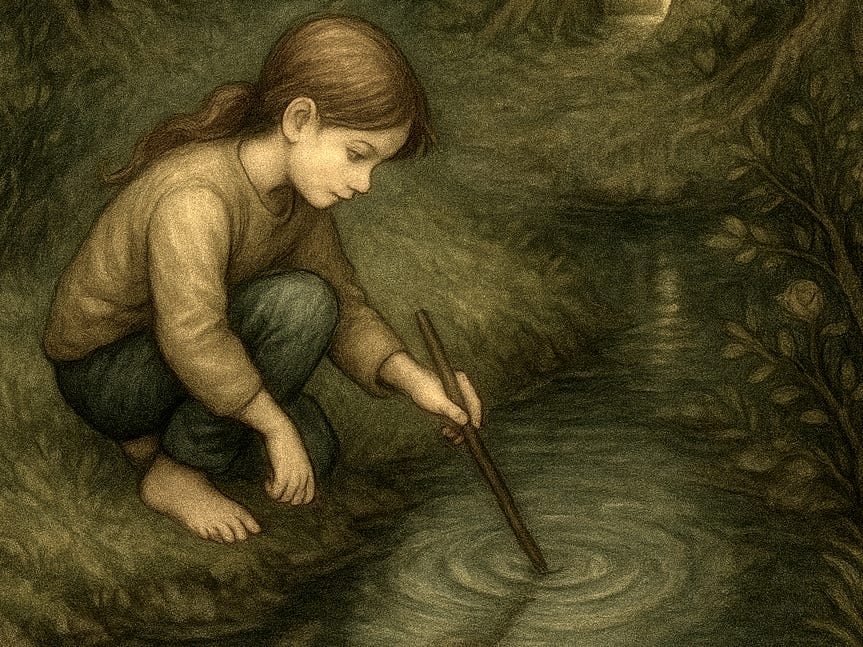
Thunder rattled windows, and pools lay all over The Estate, in reflective surfaces that Ellen warned me to approach with caution:
“Water reflections are the most dangerous,” she admonished, shaking her head, her face shadowed with old grief, lines deepening around eyes that had seen too much across too many reflective surfaces. “They’re less stable than glass or metal, more likely to create false passages to places from which return becomes impossible. Emily found a passage but lacked the training to maintain her connection to this side.
“Without an anchor, she couldn’t find her way back. I was too young to help her then, barely understanding my abilities. By the time I realized what was happening, she had already released her tether to this world.”
I grieved my half-sister and heeded Ellen’s warning. I was learning to anchor.
Season’s Change
At the Autumn Equinox, I turned fourteen. This thin time of seasonal change brought its magic to The Estate. Margaret and Charles hosted a party at their Keeper’s Cottage, saying, “This threshold day needs a celebration among all who have become family through choice, and by blood.” My birthday party would be a blended family reunion, and Charles extended the weathered oak table with its extra leaf. I arrived early to help Margaret with the preparations. Comfortable in her kitchen, their family home was my second home, and as next-door neighbors, Margaret and Helen exchanged recipes and household tips. Margaret shared herbal remedies advice with Sarah and served me tea on many occasions when my mirror-sight troubled me.
The Equinox yielded mixed late summer and early autumn blooms in blue jars on the stone mantlepiece and for a table centerpiece in a white stoneware jug. Margaret’s home-crafted beeswax candles cast golden light from her heirloom pewter holders that stood beside the chunky, brown crock of sunflowers glowing on the sideboard. Garlands of rosemary, thyme, and lavender wound between the place settings, herbs that seemed to respond to the Equinox energy with extra fragrance. “Protection and happiness, according to tradition. They know it’s a threshold day,” Margaret said. We all knew that the Hawthorns wove protective elements into their everyday life with the shared wisdom of those who live close to the land.
James set aside his work to escort Ellen to the party. “No work tonight,” he promised as the two walked through the door of the keeper’s cottage, his home since birth. I could sense his enthusiasm about the genetic genealogy that had revealed so much about mine and Ellen’s ancestral heritage. Ellen was getting around less, taking tentative steps that demanded a bit more of her by the week. She had enjoyed a boost in health and energy when we began training with Cedra in April, but her stamina waned after Midsummer. It hurt my heart to see her limitations, apparent in her every gesture.
“Birthday traditions matter in our family,” Ellen said, her spirits brighter than I’d yet seen them, as she placed a gift on the sideboard.
Our family. It was so good to hear that I was included in another family, my first.
Sarah and Helen arrived together, Helen carrying a layer cake decorated with sugared violets, blue icing, and fresh morning glories encircling the plate. “Mom’s idea,” Sarah said, her smile holding both affection and the scientific curiosity that had led her to research traditional birthday symbolism in Elizabeth’s journals.
As Charles ladled Margaret’s hearty autumn vegetable stew into our bowls and she served warm brown bread with butter and cheese, conversation flowed among this constellation of people who had become family through choice rather than blood. Sarah offered her botanical observations; Helen shared folkloric insights; Charles provided practical gardening wisdom, and Margaret’s gentle household knowledge anchored it all.
Ellen put forth a few Fairchild family anecdotes in a surprisingly strong voice. “My grandmother taught my mother to read folklore and frost patterns.” And “My mother tried to teach me mirror-stabilization...” I sensed there was much more to my birth mother’s family history that she guarded; memories of trauma or shame, knowledge that might be essential to me.
“Stella has already mastered basic stabilization.” Sarah sat a bit taller.
She shows an unusual aptitude for cedar resonance.
The voice caused us all to turn to the kitchen door, where Cedra stood at the threshold, her appearance causing no alarm. We were accustomed to Faes’ visits, both announced and not, especially from Cedra. On this birthday, Cedra’s inclusion might have been expected, and I felt sure Margaret and Charles had invited her: my Mentor, Ellen’s Guide.
I was pleased to see her, dressed in garments far brighter than her usual earth tones: a chartreuse vest, a tartan kilt over heavy black leggings, a white balloon-sleeved shirt with laces, and canvas knee boots. The Dryad stepped toward me, holding a simple circlet woven from cedar twigs and morning glory vines.
The Council acknowledges your progress. You stand now between childhood and completion, knowing all three of your names. Soon you’ll be ready for integration.
I didn’t feel ready to accept more accolades, having only recently passed Second Council. But I bowed my head graciously as Cedra placed the circlet like a crown.
“Ruth Ann, by birth. Stella, by choice. Questa, by destiny.” I echoed the mantra established at the Summer Solstice to gentle applause.
“Names carry power in traditional cultures,” Helen observed, as she had many times in my memory, “both given names and chosen names.” Her expression grew nostalgic. “I have such fond memories of your Naming Ceremony, Stella.”
Sarah smiled at the recollection, though I noticed her glance toward Ellen with a hint of uncertainty. “I cherish the memory; the way you handled the ceremony, Mom.”
Ellen’s eyes darted around the table and focused on Sarah. “A naming ceremony? I wasn’t aware...” She knew that Sarah had changed my name, but must not have been told about the ceremony.
Sarah blushed. Her eyes met Ellen’s. It was awkward to talk about the singular event that Ellen hadn’t attended in my infancy.
“I wanted to celebrate Stella joining our family; I wanted to add more meaning to the moment besides paperwork.” Sarah looked down: The paperwork. Was my tone a bit harsh? Did I sound defensive?
I felt the familiar sting of resentment at the mention of the paperwork; the documents Sarah had hidden from me.
Ellen speared a carrot chunk in her bowl of stew, and raising the fork to her lips, she chewed as she processed Sarah’s words. She then spoke with restraint: “A celebration for your natural child, Ruth Ann. You welcomed her into her new extended family.”
Sarah recovered, “It was a joyful, cool, sunny day,” but her description felt rigid.
Charles leaned back in his chair and sipped his cordial, settling any tension with the peaceful creak of wood. “I remember when Sarah chose your name. We set up the white canopy on the terrace by the Iron Fountain, as we did at Midsummer.”
All shared their memories while Ellen listened. Margaret served more bread. Helen poured elderflower cordial into small glasses, and the candles flickered gently as the story unfolded.
Sarah began: “The adoption had just been finalized. I look back now on the excitement and happiness, as much as the anxiety and fear of failure. Raising a child is a tremendous responsibility.”
Ellen’s face was composed, but I imagined her pain and regret as she heard details about my new beginnings.
“I suggested we do something special,” Helen continued. “The legal aspect felt so clinical. I’d been researching naming traditions, and they all emphasized community acknowledgment.”
“Margaret made a special cake with star patterns,” Charles added warmly, and Margaret smiled.
Sarah continued. “I’d been calling you Stella while I waited for you, and it felt good to make your new name official.”
“The morning glories were blooming early that year,” Charles recalled. “All around the fairy ring, though it was barely spring.”
“I’d written something to say,” Sarah admitted, “but when we gathered with Helen and Charles and Margaret and James, different words came out. I held you up and said, ‘This child came to me as Ruth Ann. I name you Stella, my star, found in darkness, bringing light. May you grow knowing you are both born of one family and chosen by another.’”
“And the Garden responded,” Helen added softly. “The morning glories opened wider, and a black rose bloomed at the edge of the fairy ring.”
“Black roses mark significant transitions in our family line,” ventured Ellen.
Helen was tactful. “What I loved most about it was how complete it felt to affirm Ruth Ann’s origins and Stella’s new beginning. Not erasing her birth name but adding to it.”
I squeezed my eyes shut, willing Ellen to remain composed.
Each birthday present was personalized and unique. Sarah gave me a journal decorated with tiny crystals and sapphires. It had sections for recording mirrorwork, plant histories, and personal observations.
Helen’s beautifully wrapped gift was a collection of her annotated folktales.
The Hawthorns presented a cedar box carved by Charles and lined with velvet embroidered by Margaret.
James’s gift was a silver locket, which, he said, held “an etched representation of your genetic markers,” science transformed into a personal talisman.
Ellen’s gift was a pewter hand mirror engraved with a triple spiral pattern. “This belonged to my grandmother,” she said, as I unwrapped it. “The design creates boundaries that stabilize what you see.” Its weightiness and warmth suggested my responsibility ; a tangible connection to my newly found lineage of women who had carried mirror-sight.
Margaret lifted the cake server to cut the first slice, but she paused and looked around the table at all of us. “Wait,” she said with her warm practicality. “We’ve done and said all but the most important part. Happy Birthday, Stella!”
“Happy Birthday!” came the chorus from around the table. The words were a reprieve from the weighty significance of the evening, bringing us back to the center. My cheeks were warm as I thanked them, returning their smiles. Cedra accepted another glass of blackberry cordial from Charles’s decanter.
Margaret served the cake, and the evening wound toward its close, the cottage having expanded with warmth and love. Ellen took James’s arm, and he followed her painfully slow pace home to the Guest Cottage.
Charles escorted us three Manor-dwellers home along the well-worn path to our kitchen door. His swinging lantern cast dancing shadows at our feet and through the rose edging. “Your birthday matters to all of us,” he said in his straightforward way. “Not just because we care for you, but because each year brings you closer to understanding who you are meant to be.”
I nodded, and the cedar circlet bobbed on my head. That night, placing Ellen’s mirror on my bedside table, I reflected on the layers of meaning that had emerged during the evening:
Ruth Ann, the name connecting me to Ellen, to bloodlines that carried mirror-sight through generations, often without understanding its nature. Stella, the name given by Sarah, recognizing the light she saw in me even as an infant, claiming me as daughter through both a legal certificate and a garden ceremony. Questa, the name revealed by The Council, represents integration rather than division, both/and rather than either/or. Three names. Three aspects. Three truths forming a single whole.
The Garden understood this completeness before any of us could. The morning glories had bloomed for my naming ceremony, as they bloomed through snow when I was first discovered. The Black Roses marked transitions that legal documents missed. The mirrors showed reflections that existed between worlds.
Legacy
In the weeks following my fourteenth birthday, as autumn deepened, Ellen focused on sharing the Fairchild family inheritance. There was little in the way of material possessions, but my first mother wanted to ensure that their history, and the mirror-sight legacy of the half-fae, would be imparted to me. So, she approached our lessons with renewed urgency.
The Guest Cottage had become a sanctuary of quiet rituals. Ellen rarely ventured beyond her immediate surroundings now, her strength conserved for essential activities and, most importantly to her, my continued training.
Ellen’s doctors had given her a poor prognosis: weeks, perhaps months. Her spirit and body, weakened by years of grief and suppressing her abilities, were failing, even in the Garden’s protective embrace, surrounded by the magic she had once fled. But her awakening magic proved too powerful against the long denial of her true nature, and channels had been dug too deeply for her power to flow safely.
Under a raw, pale late autumn sky, The Garden became an eerily silent stage for a spontaneous lesson in controlling feral magic. Ellen, despite her frailty, and I, determined and precise, ventured into the labyrinth of manicured boxwood and rogue blossoms. Ellen’s magic flared, and a blooming black rose cutting undulated into our path, stirred by an unseen current. I moved among the trembling flora and softly instructed my birth mother, “Hold steady! Let nature and magic become one,” as my fingertips brushed against dewy leaves that pulsed with an uncanny warmth; the untrained power wrestling with disciplined guidance; a wild blend of inherited wonder and impending loss.
The exercise was urgent and exhausting. Ellen had limited strength and felt pressure to learn and to teach, in what would likely be little time, what Cedra had been training me as a life skill. Working together among the plants, though, our roles had shifted. No longer student and teacher, we had become partners, navigating dangers, and this lessened our anxiety.
“Evergreen is a constant,” she pointed to the boxwoods. “Some things remain unchanged across seasons. Remember that when reflections try to disorient you.”
Cedra insisted on supervising all mirror-work since the September feral event. Ellen’s moments of instruction on ordinary skills that required no reflective surfaces were precious to us both.
October’s frosts caused the morning glories to retreat, all except those surrounding Ellen’s cottage. They still bloomed defiantly against the chill. Ellen arranged her cozy quarters with intention: An afghan she knit in a blend of warm colors, a patchwork quilt sewn by her sister, Ann.
The spicy scent of cedar bundles cut by Charles and crafted by Margaret hung from the ceiling beams. Charles kept the woodpile stacked for the brick fireplace. Ellen lined up her collection of blue Mason jars filled with dried herbs on the kitchen windowsill.
“Today we’ll discuss anchoring without tools,” Ellen explained to me, as I arranged dried meadow wildflowers on her kitchen table, “for the times you can’t access cedar or iron.” She moved her fingers with the precision honed by habit, stripping the ferny dried yarrow leaves from brittle stems with dedication and care.
Ellen labelled her herbs, botanical bunches, and dried flowers with their names, properties, and uses for mirror-work. “Rosemary strengthens memory anchors,” she told me, placing a sprig in my open palm. “Rub it between your fingers and inhale deeply.”
I obeyed my first mother, and the resinous scent filled my senses. “Now close your eyes and recall The Cedar Grove—the Sentinel Tree where you first trained with Cedra. Hold that image while keeping the rosemary scent in your awareness.”
My visualization was vivid: the Ancient Cedar’s rough bark, the pattern of frost, and the quality of light filtering through its branches.
“The memory itself becomes your anchor,” Ellen continued. “Rosemary creates a sensory bridge when physical contact isn’t possible.”
We worked through the herbs: lavender for emotional stabilization during difficult visions, thyme for awareness of time and reflecting different eras, and the bracing scent and taste of mint to steady us in the present.
“My grandmother taught these to my mother,” Ellen said softly. “Who taught me... but knowledge can fragment over generations if training isn’t consistent.”
As the afternoon light softened, Ellen shared her lore. “I want to show you something important,” she said. “I need the box...” she pointed to it under the iron bedstead. I jumped to assist and knelt on the floral hooked rug, lifting the light maple box onto the table. It was lovely, inlaid with mother-of-pearl. “It will soon be yours.” It was about the size of a legal-sized tablet and opened on silent hinges to reveal objects nestled in tissue paper: a silver thimble, a lock of bronze hair tied in a slender blue ribbon, “my mother’s,” and a thumb-sized stone of obsidian, “a worry stone.”
On the bottom were several sheets of parchment folded in half, “our family’s grimoire,” with rows of handwritten notes. The oldest legible entry was from over a century ago. “You’ll see our family history of mirror-sight...”
The changes in writing styles and inks over time: these were my ancestors, too, by blood, if not by bond.
Our ancestors recounted morning glories’ response to emotions; Black Roses appearing at significant transitions, mirrors most active near thin times, and anecdotes the likes of which Cedra had been warning, and teaching safety—trials and tragic errors.
Ellen’s windows grew dark, but she wanted to show me more family tradition, like how to create protective sachets with the right herbal combinations, how certain crystals could stabilize erratic reflections, how morning glory seeds could be prepared to enhance dream clarity without endangering mirror walking.
Her legends empowered me as Helen’s stories did, and I was grateful for my four mother figures: Sarah, Helen, Ellen, and Margaret. We were all family, each fostered learning and imparted their individual personality strengths.
Ellen’s determination seemed to sustain her as her body weakened. I noticed how she occasionally lost focus, her gaze drawn to reflective surfaces as if seeing or hearing something not in the room.
“Is it getting stronger?” I asked, recalling the signs from our frightful September experience. With a half-smile of sadness and acceptance, she answered, “The call? Yes, as Samhain approaches, the boundaries are growing thinner.”
“Do you hear them? Emily, Ann, your mother...?”
“More clearly now.” Ellen closed the grimoire box on silent hinges. “But I won’t answer until I’ve finished what I came to do.”
I understood that Ellen’s teaching sessions were meant to prepare us for both my growth and her absence.
“There’s one more thing,” she said as I put on my sweatshirt, ready for my walk home. She lifted the silver chain with the iron pendant she always wore, a simple disk engraved with a triple spiral. “I’ve had it most of my life for protection. I want you to have it—it’s yours now.”
“But you need it,” I protested, “for stability near reflective surfaces.”
“I’ve made other arrangements,” Ellen assured me, fastening the chain at the back of my neck, under my braids. “And you’ll use it more effectively; you’ve already shown that. You have a long life ahead of you.”
The triskele pendant felt both cool and warm against my skin. It came with responsibility, not only for my safety in mirror-work, but for the continuity of Ellen’s family legacy, now part of mine.
I hugged her with the care I would give to a fragile doll. We were still about the same height, and I was more athletic from my life in the Garden. I noticed that my mother’s frame seemed less substantial than it had even a week before. Yet her green and amber eyes were clearer than I remember.
“Tomorrow we’ll discuss the specific differences between water reflections and glass,” Ellen said as I stood on the front porch. “Cedra has agreed to supervise a practical demonstration.”
I was aware that each meeting might be our last, and Ellen was planning our next lesson despite her fatigue. Still prioritizing. I blew her a kiss and took the path past the Keeper’s Cottage to our kitchen door. Whatever happened in the coming weeks, Ellen had ensured that the broken chain of heritage was restored.
The Crisis
The Celtic wheel turned toward Samhain. Ellen was determined to pass her family’s heritage and half-fae knowledge. I was getting ready to leave her one evening, and she embraced me with unusual intensity. “The triple spiral protects,” she said with an ominous whisper. “Remember that, when reflections begin to pull.”
“I will, Mom,” I said, and left her in the cottage doorway, silhouetted against the warm light. Walking home, I sensed Ellen’s balance was disrupted by the weight of memories, and her cryptic warning called to mind her times of restlessness and instability, and her tendency to stare into reflective surfaces. The edges of her purposefully controlled demeanor seemed to be fraying. As her daughter, not long reunited, I felt the strain of her demeanor. Did Sarah have second thoughts about offering my birth mother respite?
“You’re certain Cedra knows you’re practicing tonight?” Sarah asked me after tea the next evening. I put on my sweatshirt to walk to the Guest Cottage. “The council is meeting, but we’ll only be reviewing stabilization. Ellen worked with me months ago on the techniques.”
“Okay,” Sarah said, but her face said, I’m worried.
“Just simple reflective anchoring,” I said, to reassure her, as I opened the kitchen door.
The tremor in Ellen’s hands while she positioned a small silver-backed mirror at the center of the kitchen table alerted me to a potential problem. Ellen, seeing my concern, said, “Nothing that requires Cedra’s direct supervision,” and continued to prepare the space, showing unusual attention to detail. She checked that iron nails hung at compass points around the room, and cedar bundles hung over each doorway and window.
“Extra precautions never hurt,” she said. “Especially during thin times.”
Twilight settled over the cottage, and Ellen lit beeswax candles infused with herbs from Margaret’s kitchen: rosemary for memory, lavender for clarity. Their flickering glow comforted me.
“We’ll start with simple reflection anchoring,” Ellen said in the formal cadence she used during lessons. “Remember: one point of contact with cedar at all times, eyes never leaving the mirror’s surface once engagement begins.”
I positioned myself as she directed, my right hand on her cedar block and my left hand free to adjust the mirror. Ellen sat opposite, mirroring my posture. Between us, the small silver-backed mirror reflected the candlelight in kaleidoscopic patterns.
“Begin breath alignment. Inhaling and exhaling. Our breaths synchronize. The mirror deepens, becomes dimensional.”
“Anchor visualization now!”
Ellen’s voice is steady, though her hands trembled. I picture the grove’s ancient trees, feel their roots extend beneath the soil. Shadows shift like cedar branches past the edge of the mirror...
This was as expected, until Ellen departed from the formula. “Tonight we’ll try something slightly different.”
Her eyes never left the mirror. “My mother once showed me this technique.” Her voice trailed while adjusting the mirror’s angle. She sprinkled a glistening powder on the mirror.
“Ellen?” I reacted with sudden uncertainty.
“Just a refinement.” Her voice became resonant, both younger and older. “Watch the silver surface now, not the glass. The backing shows things the reflection hides.”
The mirror’s silver edging begins to glow with an inner light. I see a landscape, unfamiliar trees, twisting paths, and distant mountains beneath a twilit sky, but it’s not my sky.
“Where is that?” My eyes are wide with a wonder that borders on fear of the unknown.
“The otherworld,” she whispers, leaning closer to me and to the mirror. “My mother, Ruth, your aunt Ann, and your sister, Emily, are all there. See how beautiful it is? See how different the light is?”
Ellen’s hand slips from the cedar block as she reaches to touch the mirror with her index finger. A breeze through the cottage, and it becomes cold. The candle flames stretch in a sudden wind.
“Ellen, you’re not anchored!” Each gesture of Ellen’s brings me closer to panic. But Ellen doesn’t seem to hear, and her eyes reflect mirror-light with an intensity I’ve never witnessed.
“I hear my mother’s voice... Emily’s laughter... through reflection...” One touch of the mirror and it ripples like disturbed water for what seems like hours...
I held to my training despite my mounting alarm, keeping cedar contact while reaching with my free hand to touch Ellen’s shoulder. “Ellen, remember the anchoring. You taught me—always maintain a physical connection.”
But it was no use. Ellen’s awareness had shifted elsewhere. When she finally turned toward me, her eyes had changed, her pupils dilated, irises reflecting silver rather than amber. “The mirrors don’t just show, child, they offer passage—if you’re willing to follow.”
The cottage walls receded, and the space between worlds was thinning. I remembered and acted on Cedra’s emergency protocols. My iron pendant would have to do if I were to keep contact with Ellen and the cedar block. I lifted it over my head and pressed it against the mirror’s frame.
“By iron and cedar, by blood and breath, the passage is denied,” I recited, voice steady despite my fear. “Return to true reflection, shadow to substance, boundary restored.”
The mirror’s surface shuddered, then abruptly returned to normal reflection, showing only our faces and the cottage interior. Ellen collapsed backward in her chair, the unnatural light fading from her eyes. Exhausted and disoriented, she asked me what had happened.
“You lost anchoring,” I said, expressing no concern, as if it were a normal occurrence. I slid the mirror across the table, out of my range of vision. “The reflection started to... open.”
Ellen covered her face with her hands. “It happened again,” she whispered. “I thought I could control it this time.”
“You weren’t yourself,” I said gently, helping Ellen to a more comfortable position on the sofa. “You were calling people on the other side.”
Ellen’s eyes were tearing up. “The mirrors are stronger near the equinox. I should have known better than to attempt this without Cedra.”
Sarah’s intuition advised her to check on me. She could see from the Manor an uncanny silver light glowing in the Guest Cottage. She let herself in just as I was making Ellen comfortable. “What happened?” Sarah noted the disarray of ritual materials.
“The mirror-sight went feral,” I tried to seem calm, using Cedra’s term for uncontrolled reflection work. “The boundary started to dissolve.”
Sarah checked her tone before asking, “Are you both alright?”
“I stayed anchored,” I responded. “Ellen lost contact with the cedar block, and I had to use the emergency protocol.”
Ellen looked up at Sarah with haunted eyes, and in a barely audible voice, she said, “Now you understand why.”
Sarah and I both knew.
Satisfied she was alright, we left Ellen to rest. On the way home, I saw Cedra walking from the Cedar Grove toward the Cottage, and she acknowledged us with a nod.
The Balance Breaks
Three days after the mirror crisis, I found Ellen in the Moon Garden of The Guest Cottage, on her knees, her body rigid and dazed.
“Make it stop,” she gasped between spasms. “Too many, too fast!”
She was surrounded by spectral images swirling like visible thoughts. Morning glory vines grew rapidly across the Cottage exterior. Without full protective geometry, Ellen had lost control. The Cottage lacked the alignments that Elizabeth designed into the Medieval Garden.
I shouted for help.
Ellen’s pain and passion for life surged violently with fragments of memory, glimpses of places beyond normal perception, visions of what might have been. Her voice hitched between sobs and whispers,
“I must tether these wild winds!”
I employed Cedra’s emergency protocols, hearing her voice in my memory: To contain wild magic, first establish boundaries. I sketched the main garden’s protective geometry with a stick on the ground around Ellen.
Next, anchors. At cardinal points, I traced the elements: carrying cedar wood, black rose petals, morning glory seeds, and iron filings. Make a connection.
I knelt beside Ellen, taking her trembling hands in mine, and recited an ancient incantation of Cedra’s, the language of thresholds beyond ordinary speech, connecting those with the sight. Words to calm disturbed boundaries and stabilize passage between worlds.Not suppression but redirection, not denial but integration.
Ellen’s body relaxed, and the spectral images slowed their frantic motion. Morning glory vines retreated to normal size and position.
“I’m sorry,” Ellen’s breathing steadied. “I thought I was stronger.”
“You are strong, you’ve survived this alone for decades. I’ve had guidance from the beginning.”
Sarah and Cedra trotted toward my shout for help. I’d been able to help Ellen to her feet, steady her toward the door, and safely inside. Sarah stood aghast while Cedra surveyed the aftermath: the wall mirror covered with a pillowcase, its frame bulging, dried flowers flung on the wooden floorboards, the hearth fire left with only a few glowing cinders.
Sarah composed herself, noting details in her research journal while the kettle boiled for tea. “We need to incorporate the Cottage into the Garden’s full protection. I’m surprised Elizabeth hadn’t seen to extending the alignments from the main garden,”
Cedra tightened the boundaries I’d drawn outside. Yes, and the morning glories can help. They remember the patterns, Cedra said.
Ellen was in awe of the exchange between the scientist and Cedra, a phyto-dryad, who collaborated without argument. “I never saw this, always one extreme or the other, all or nothing,” she whispered.
“But you have it now and for as long as you’re here with us,” I responded, feeling mature and capable for a fourteen-year-old.
This was the complementary support Sarah studied and now practiced. She had grown into her profession. And I, too, was coming into my own.
I had hoped that, since Ellen had learned a modicum of control, her wild-sight episodes would become less frequent and less intense. That by midwinter, she’d be navigating mirrors without fear. And that a year after our first training together, by next Beltane, she’d flourish in a new spring of health, and safely walk the labyrinth alone.
But the years of uncontrolled sight had taken their toll. What Ellen gained in mastery, she lost in physical strength. The integration she attempted to achieve had come too late. Her crossing approached not as a tragedy but as a transformation. The final threshold she would teach me to understand.
Samhein
On the Celtic New Year, when the veil between worlds reaches its thinnest point, and ancestors are honored across the threshold, Ellen prepared for her crossing. Though she never explicitly stated it, she gauged my emotional readiness.
“You’ll continue working with Cedra,” she said matter-of-factly. “She understands the sight.”
The Council Fae manifested more often during this period. We might see them watching a private session from the edge of the Cedar Grove.
Cedra would step in if she saw that Ellen needed further guidance or deeper mythological grounding: The sight existed before mirrors. It began as the ability to see between worlds without reflective tools, to perceive what lies beyond ordinary reality. Your ancestors carried this gift when they crossed between realms during what humans call pre-history.
Ellen nodded in agreement; her thinning frame wrapped in shawls against the chill.
Mirrors make it easier for you to focus, Cedra continued, and like a telescope, enhance natural vision, but they don’t create stars. Mirrors are merely tools of perception.
Weak but determined, Ellen asked to meet with The Council in a setting with the people who had become critical to her well-being during her stay at the Silverton Estate. “I need to establish certain things before I cross.”
Ellen’s Farewell
On November’s Eve, the night of Samhain, Ellen prepared for her ritual of transition. I helped her step into her mother’s black wool dress; its Celtic knot-work, embroidered by her mother’s mother. I tenderly placed Ellen’s grandmother’s iron pendant over Ellen’s head for her protection. Although she’d stopped wearing her leather pouch to hold cedar bark and various herbs, Ellen wanted to honor Brigid, the Healer, so she asked me to draw her leather belt through the slide, positioning the pouch at her waist.
The anticipation I’d experienced before our reunion had been softened by hope. Helping Ellen prepare, I had a sense of dread, thinking about what a funeral must be like. Sarah and Helen would be there, but Ellen’s inevitable passing reminded me that our separation would again bring grief.
And I thought, I must not cry—I must help Ellen.
James met us outside with the wheelchair he kept in his car trunk for Ellen’s appointments. I wrapped her black wool shawl around her for the way down the brick path. Swathed, surrounding her like a shroud, her appearance was somewhat frightening, as it was Samhain. The sky took on the foreboding grey and black of the new November, darkening clouds spreading over the Estate. I’d rarely seen James wear his navy woolen dress coat. He turned up his collar and steered Ellen through the Yew Hedge gate, onto The Terrace. She had chosen the Iron Fountain for our gathering place. James set the brakes and took his leave.
When all were present, Ellen proclaimed:
“I come to establish continuity of knowledge, to formalize what has begun through blood and teaching.”
Though we had discussed this ceremony in advance, at the sound of her formal farewell, my eyes watered.
“To you, Sarah, who found my daughter in the Fairy Ring, who raised her with wisdom and protection, who opened your home and heart to her, I offer thanks beyond measure.” Sarah accepted with humility and grace.
Ellen took both of my hands. “To you, daughter born of my body, I affirm the gifts of our lineage; the sight that bridges worlds, the blood that connects generations, the knowledge hard-won through trial and loss.” I held back tears.
“Dear Helen, your research preserved knowledge that might otherwise have been lost. Stories are pathways no less real than those the sight reveals.”
Ellen addressed the Fae Council: “As my ancestors did before me, I recognize your guardianship of those with The Blood. I ask that you continue to guide my daughter as she develops her abilities and discovers her complete identity.”
Cedra, Eleris, and Selwyn respond, manifesting in myth and magic: The Garden knows its own. The Grove remembers its children. The boundaries will be maintained. The passages will be marked.
The Faes’ voices echoed water flowing through the Iron Fountain. The close connection between us all felt sacred. Ellen’s formal transition was established, responsibilities acknowledged, and continuity assured.
Ellen had further weakened, and we were concerned she would collapse. Cedra wheeled her home, Sarah accompanying them to help Ellen to bed. Sarah explained to Helen, “She asked to be alone to rest for a while.”
We respected Ellen’s request; I returned to the House with Helen.
At sundown, when Sarah went to the Guest Cottage to make tea for her, Ellen was gone. On her pillow lay a single Black Rose stem.
“She crossed,” Sarah told me when I arrived moments later.
Crossed—the word seemed right. My mother had crossed the portal, like from one room to another.
The Garden Grieves
Táim sínte ar do thuama / I will lie on your grave forever ...
—Traditional Irish Lament
Questa’s Rainstorm Dream
Clouds are gathering in The Garden
Bold beneath a thundering sky
Soaking rainfall grows the roses
Questa tends them; power flows.
Thunder echoes, warns of sorrow
Illumination from my Guardians comes:
Eleris speaks in lightning’s brilliance:
“Half-fae’s tears are falling dewdrops,
Morning Glories drinking raindrops,
Puddles making mirror portals.
Questa’s tears make boundaries thin.
She was lost but found new doors.
Healing magic heals her break.
When flesh is torn by loss, and thorn
Vines climb higher, growing vibrant
When they, from rain and wind, have bent.
Like a haze, grief hung over the Estate. Moments stretched or contracted without purpose, as time followed by no calendar. The Garden, first despondent, now responded with unexpected blooms despite the deepening chill. Black Roses and morning glories spiraled up Ellen’s cottage, lending a pathway for her anticipated return.
At breakfast, I took the chair opposite Sarah at the kitchen table. Steam rose from two mugs of tea as we sat with our mutual loss. “I only had her for eight months, so why does it hurt this much?”
Sarah reached across the table and covered my hand with hers. “Loss doesn’t measure itself by time. Ellen carried you for nine months, so her absence shaped both your lives.”
I couldn’t cry then, as I had most of the night, but the well stood ready without warning. Sarah came around to my chair and held me the way she had when I was small, and a dream frightened me.
In the days ahead, grief moved me between moments of piercing clarity and foggy disbelief. The Black Rose that had appeared on Ellen’s pillow now grew beside the Guest Cottage door. Charles found me there on the third morning, and his words consoled me.
“The Garden will hold your grief when you cannot,” he said, his weathered hand gesturing toward the beds where Morning Glories had appeared despite the season. “Plants remember differently than people.”
“What do you mean?” I asked, grateful for the conversation that pulled me from my circle of thoughts.
“We remember with stories, from beginnings through the endings. Plants remember through cycles.” He knelt to brush frost from the blooming Black Rose. “Nothing truly ends here,” he said. “It transforms.”
That afternoon, Cedra called me to Cedar Grove. Although the ancient trees stood silent in the early winter stillness, my palm against the rough bark felt a faint vibration. I murmured something between a heartbeat and a whisper, and my Fae Guardian stepped beside me in the shadows.
You seek her...
“I don’t know what I’m seeking. Ellen wanted to teach me so much more—about the mirrors, about my heritage. Who will guide me now?”
The teaching continues, child. Death is merely another reflective surface.
“I don’t understand.”
Ellen gave you something no one else could—the beginning of your story. But she hoped others would help you write the rest. Child, these trees were growing long before any of us walked here. They’ve witnessed countless losses. Yet they remain. Let the cedars comfort you.
At the end of the day, Helen stopped by my bedroom to offer comfort; Elizabeth’s wise words in her letter to a friend:
“The Garden taught me that grief is not linear but a spiral. We return to the same point, yet never quite the same way. Each cycle brings new growth alongside the remembrance.”
“Did she lose someone, too?”
“She had many losses, but found ways to keep them present in her life.”
It had been a week since Ellen left us when Sarah suggested we clean the Guest Cottage. I hadn’t gone inside since her passing, unable to face the emptiness.
“We don’t have to,” she said, “but sometimes handling the material things helps process the spiritual.”
Sarah and Helen understood grief. Robert Caldwell, my grandfather by adoption, whom I never knew, died about a year before I was born. I had learned bits and pieces about his neurological condition that caused his demise, but it never occurred to me until that moment that Sarah’s father could have had a form of the sight.
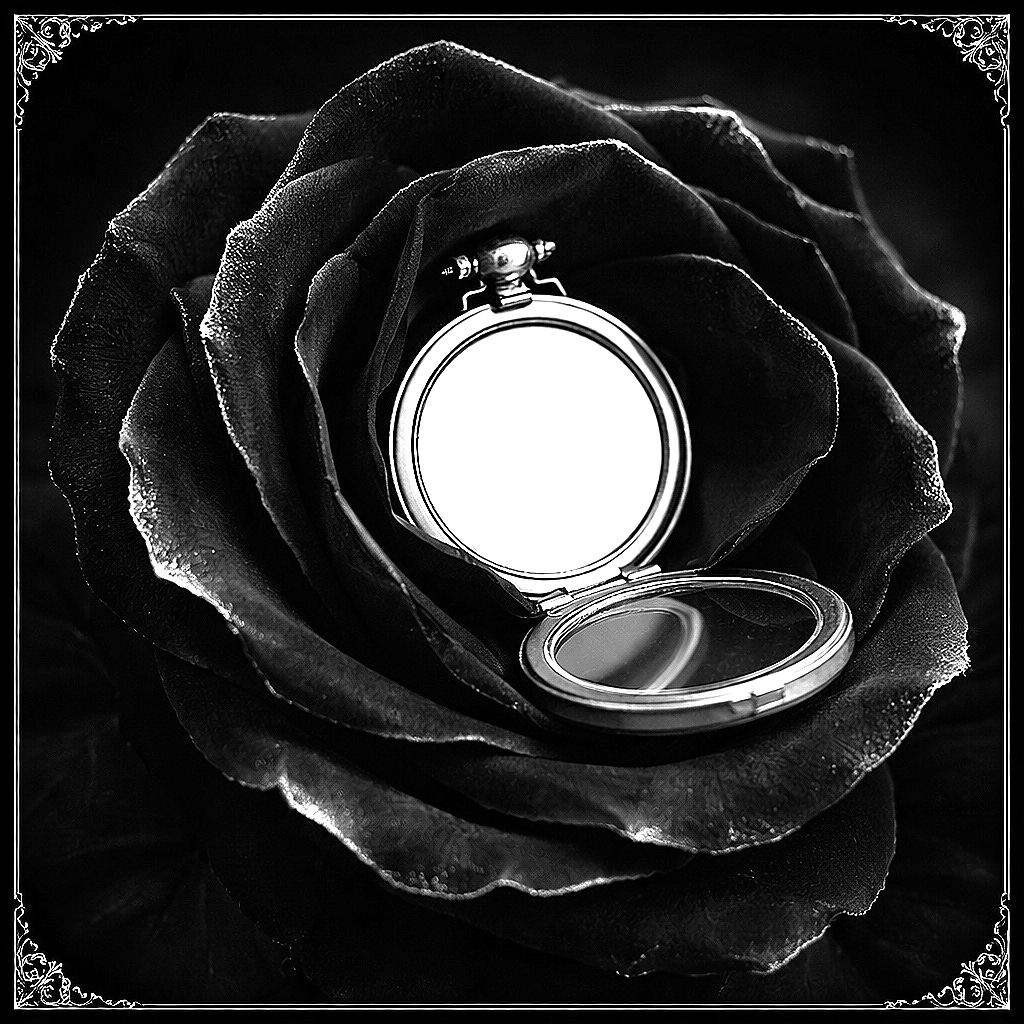
Sarah, Helen, and I spent the afternoon sorting Ellen’s few possessions. In a small tin box on her nightstand was a tiny silver pocket mirror with intricate engravings around its frame. “She kept this private, I guess. I’m surprised that Ellen kept anything hidden from me at the end of her life, after all she went through with reflections.”
“Perhaps she was saving it for you—for when you were ready.” Sarah’s words had a familiar ring.
I replied, “I think I’m ready for the Third Council.”
Sarah and Helen exchanged a knowing glance. Sarah said, “Yes, I’ve heard a few hints of your Winter Solstice Integration.”
I looked at these two women, my anchors: one who raised me with unfailing love, and one who continued to share her wisdom.
Behind them, I felt the presence of other guides: Charles, with his quiet understanding of the Garden’s language; James, with his scientific validation of magical heritage; and Margaret, with her practical knowledge of plant medicine. Ellen, too, not in the pain of recent loss, but in our shared genetic heritage, and the abilities awakened in me.
Alone in my room that night, I sat with Ellen’s mirror and attempted what Cedra had warned me against: seeking a person through reflection. It caught the moonlight, reflecting it in spirals. The surface clouded, then cleared, but showed only my face.
Disappointed but not surprised, I set it on the nightstand and closed my eyes. Sleep came quickly, and with it, dreams of walking with Ellen through a medieval garden I’d seen somewhere between memory and imagination.
I awoke to the first pale light. The mirror on my nightstand no longer reflected my room. It showed a black rose in full bloom against an image of our home, the Tudor Manor House. As I gazed, the image faded to mirror my room.
My thoughts turned to Ellen. I miss you. I think I always will.
I recalled Sarah’s words, “That’s what love does. It remains.”
I dressed in layers and went down to the Garden to find Sarah kneeling beside new growth emerging near the Fairy Ring.
“The Black Roses are spreading!”
“James thinks they’re responding to our emotions.”
I’d heard him express this theory in the past couple of years, and now I didn’t doubt it. “He’s been tracking magical plant responses,” Sarah added.
“And what do you think?” I asked.
She considered. “I think grief changes the landscape, both inside us and around us. Maybe the roses are mapping changes in our hearts and minds.”
I went directly to the Archives to see James. He was at the worktable with genetic charts and botanical drawings in front of him. Without looking up, he slid a notebook toward me. “I’ve been comparing Ellen’s DNA markers to yours again, now with historical soil samples. The patterns match in ways that statistical probability can’t explain.”
I paged through his notes, finding some comfort in the scientific validation of Ellen’s connection. “So there’s proof she’s part of me.”
“More than part,” James said, finally meeting my eyes. “These patterns don’t diminish with time or distance...or death.”
My grief had transformed from a weight that threatened to drown me into a current that would carry me forward.
Mirrors of Loss
I can talk about how my mother surrendered me. Although a newborn, I knew. It mattered. She held me for nine months and in her arms for a brief hello. When I learned Sarah was not my first mother, I asked, “Will you leave me, too?” I worried, “Who will take care of me?” I dreaded a final separation. Ultimate loss: loss of self. I must have caused this pain of separation. Unwanted. Unworthy. With no one person to see in the mirror—no likeness. When I found my birth mother, I felt the wow of reunion, recovery, and self-realization. My fears abated in the knowing; maybe her fears did, too.
Lessened, never lost.
a sheer scrim ripples
over a girl’s image
waking to now.
Release
The Guest Cottage was now emptied of Ellen’s belongings. The twin bed, kitchen table, pull-out sofa, and a few chairs remained with my memories.
Charles brought Ellen’s steamer trunk to my bedroom, but I continued to avoid sorting through her clothing and other stored items. Another week passed before I was ready. Fragments of her life: old photographs, partially filled journals, trinkets. More of her memories. A green silk scarf triggered the time I shifted to a long, flowy green skirt, a poet shirt with full sleeves, shimmering thrift-store jewelry, and Grandma Helen’s paisley print scarf.
Down each garden path, where medieval monks might have meditated, I twirl dervish-like, my shadows spinning against the Garden wall. Three faces coalesce and diverge, dancing like flames. I’m the changeling child, coming into my power. Now, I wrap Ellen’s scarf around my shoulders, its fabric slivered with silver thread. Three faces reflected: Ruth Ann’s vulnerability, Stella’s curiosity, and the Seeker’s new wisdom. We move in synchrony like dancers. We sing in perfect harmony. The mirror’s surface moves with my rippling emotions.
Heritage Note
It was time to pick up the large, unsealed manila envelope at the bottom of the steamer trunk. No label, or name. I opened the clasp. Letters between Ellen and her sister. A crayon drawing signed by Emily caused a hitch in my throat for Ellen’s pain. A sheet torn from a lined yellow tablet held more gravity than the grimoire box of ancestral remembrances she’d shown me a month earlier. She wrote about a System:
“...Poor, single women worked in factories for a menial wage. If a baby came along, without family support, the single mother couldn’t go to work. This has always been the plight of poor women. Agencies persuaded single women in need to leave their babies, to give them up for adoption. These mothers were promised that their infants would be placed in good homes. The heartbroken mothers felt they had no choice. The agencies urged them, saying they were unfit to be mothers. Whether family circumstances or financial trouble, they were told the baby would have to be “put up” for adoption. Better to have married men and women, couples who could show they were qualified, raise these motherless babies. Deserving couples would have the means to provide for these children.
Does society as a whole benefit? From my experience, the Adoption System does not guarantee a natural mother a better life. If I sound bitter, infant surrender did not help me have a better life. Reunion is my best hope.
My home life was beyond frugal. My father was a millworker and rented a shanty, and Mother did what she could to make it a happy home. They pulled me out of school to go to work, and I never graduated. My older brother, Roland, lived at home. He couldn’t hold down a job because of “spells of behavior”. Ann, my sister, said they were “blackouts.” He couldn’t get along with anyone and was in and out of jail. Finally, he was put in a state hospital. After a few years, he died there. His death certificate said it was due to an “unattended seizure.” Ann, the youngest, had vivid dreams and “spells.” Our father called her “simple,” and I never knew her to work outside the home. She loved to cook and made a recipe book for me when I left home. She grew herbs and flowers, and made herbal remedies, “for the sight.”
My first baby was born in City Hospital, and my husband, Emily’s father, left us soon afterward. Emily had “visions”—the sight. She was sixteen when she walked into a reflection pool in the park. She never came back to me. I’ll never be the same.
My second child, Ruth Ann, was born in Mercy Hospital while I was living in Mercy Shelter. I was eight months pregnant when I admitted myself. We stayed there until she was three months old, and I signed us out and walked through the snow to the downtown bus depot on the Eve of the Winter Solstice. I planned to start a new life with Ruth Ann, but it didn’t happen. I didn’t think she was safe alone with me, with my spells, my mirror sight. Ruth Ann was taken in by a single woman named Sarah. She must have had the means to support herself because she lived in a grand estate.
When I said goodbye to Ruth Ann, I took the bus to a town called Leastways. I had no work and stayed with friends. Nine months later, I appeared at the Kindness Shelter and Hospital for Indigent Care and gave birth to a tiny, sickly boy. I named him Angelo, but I don’t remember seeing him. I was told he had “little seizures,” and that “he’ll grow out of them.” I refused to give the shelter and hospital my family history. I heard that with a few details, it would be easier for them to place the child. Just the birth mother’s signed release was all that was required. No names would be revealed to either party. Only show you can afford the agency fee; have the ready cash and an income statement, and the charity case child would be theirs. As soon as I could get up, I signed the release of Angelo and signed myself out. I left that wretched place and left him behind with the nurses. A couple was ready to adopt a newborn, and I was told they took him home.
I might have wanted to go to my family if I had one. I had no contact with the adoptive couple and never heard from Angelo, although I heard his illness worsened in elementary school. The last thing I heard was that he had to live in an institution because of his seizures and aggressive behavior. The mirror-sight is a burden.
Ellen Fairchild, on my final Samhein
I turned the paper over and wrote my reply:
Dear Ellen,
I couldn’t conjure you without a picture. I couldn’t imagine who you might have been to me. But there could be no one in your place. You didn’t mother me—you admitted you couldn’t—but my adoptive mother couldn’t fully replace you. You were, and still are, the space, the unnamed void.
When the record of my birth was sealed by law, you and I were both undone. Now you are fully gone. Gone soon after my birth, gone eight months after we reunited. When we met that afternoon in your lonely apartment, you were my first mirror. Flashes of long copper hair, amber and green eyes; the gleam in yours weakened by uncontrolled sight, we searched each other’s eyes for mutual recognition.
Once strong and tall like me, your body had grown frail from years of effort and grief, pain, and yearning that lingered. My longing remains unresolved, even after our reunion. Our time was all too short for our complex souls. The well of emotion is too deep. We both wondered, Where are you?
I hope you found peace in knowing what became of me. The ones in power make it hard to find each other. In time, I’ll be content in the belief that eight months was better than none. The spirits intervened again, leading me back to you. You struggled to reveal your whole story, but I now understand how both circumstance and choice determined yours and your children’s fates. It was all happenstance.
Your loving daughter, Ruth Ann / Stella / Questa
As I signed all three names, the puzzle pieces settled into their true arrangement. Outside my window, Black Roses bloomed out of season, their petals carrying secrets—spoken, at last. I folded my letter, placed it in Ellen’s manila envelope with her other memories, tightened its metal clasp, and replaced it in Ellen’s trunk.