

Hello! Welcome to our magical realism novella,
Through the Yew Hedge: A Tale of Identity Magic. Today is the start of Part Three: Questa - The Returning.
All posts in this series are free.
Episode Seven Recap: The petals of Ruth Ann’s infancy unfurled as Stella, like the Morning Glories that had entwined her baby basket on an icy Winter Solstice dawn. In The Growing Seasons, Stella thrives in the shelter of early childhood on the Silverton Estate under the watchful care of her adoptive mother. Sarah hopes to shape her by scientific observation, even scrutiny. Grandmother Helen nurtures her with stories and the deeper meaning. Through age twelve, The Garden quietly instructs Stella by a design meant for more than beauty.
You’ve seen Sarah record and question, the Garden respond with persistence in shifting paths and black roses, and the Manor in troubled mirrors and forgotten hallways. You’ve witnessed Stella’s powers awakening in patterns of inheritance. Her questions are no longer content with observations once the urgent Blue Book surfaces.
In Part Three, Cedra steps forward to demonstrate the need for new skills, instructing in what can no longer remain unspoken.
PART THREE: Questa
“Away with us he’s going, / The solemn-eyed: He’ll hear no more the lowing /Of the calves on the warm hillside /Or the kettle on the hob /Sing peace into his breast, / Or see the brown mice bob /Round and round the oatmeal chest. /For he comes, the human child, /To the waters and the wild /With a faery, hand in hand, / From a world more full of weeping than he can understand.”—W.B. Yeats
THE RETURNING
Cedar Training
It was early autumn, and I’d soon celebrate my thirteenth birthday.
Adolescent intensity steered my emotions since Winston’s discovery in The Yew Hedge, and tensions with my adoptive mother added intermittent fuel to my volatility.
I waited at the edge of The Cedar Grove for my Dryad Guardian. It would be a routine lesson in mirror safety. Golden light streamed toward me down the rooted path, between the ancient trees. Cedra emerged in true form: long hair, the deep red brown of cedar heartwood, skin like smooth patterns of bark. and honest green eyes.
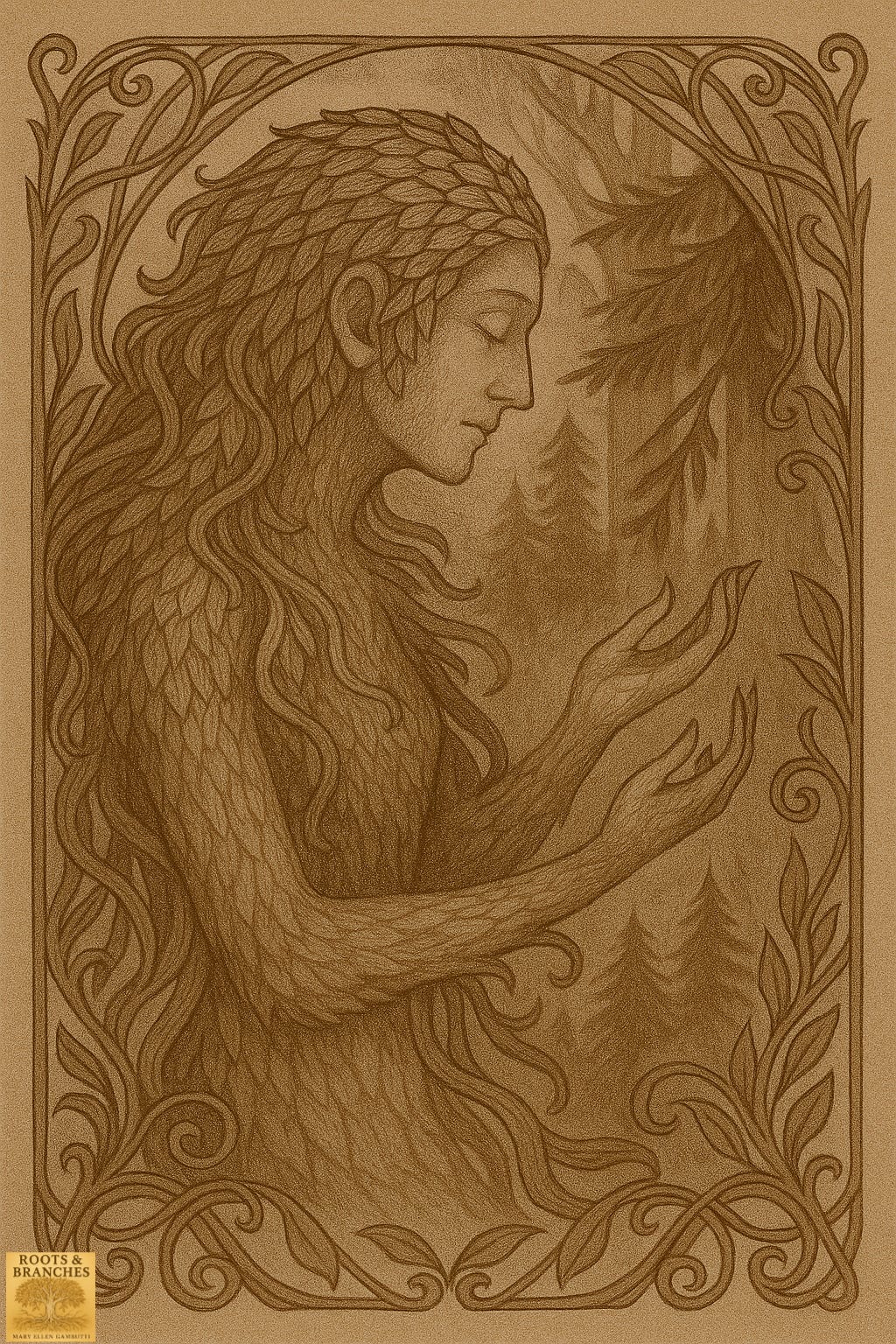
You’re changing; your sight is strengthening faster than we expected.
I knew this was true, since my mirror episodes occurred daily. Instead of fragments, reflective surfaces showed scenes of The Estate’s past.
Changing the subject to an immediate concern, I reported to Cedra, “Sarah’s been monitoring me again.” I settled cross-legged on the cushion of cedar needles. “She takes notes about everything I do, it seems.”
Cedra: Sarah’s analytical mind seeks patterns. Mortals can be uneasy with the unfamiliar when they feel they have lost control. Today, we will begin formal training. No more games, no more gentle practice. You need to learn control before the sight overwhelms you.
Cedra redirected me to a cedar frost mirror that had formed despite the mild weather, and obedient, I untwined my long legs and stood from the soft floor. The frost mirrors showed me a steady, complete picture. My eyes seemed older and wiser. I was viewing a future self, looking back in time.
Place your hand here. This tree holds memories. Do you feel them? Cedar grows and remembers every storm and season. Everyone who has sought shade and shelter beneath its branches.
Cedra pointed to the tree trunk, so I pressed my palm against the rough bark and sensed the flow in our connection. I saw an image of a vast forest. I saw Elizabeth Silverton as a young woman walking these paths and finding comfort and tranquility here.
The cedars offer an anchor. When reflections threaten to pull you too deep, the trees will hold you steady. This is why your training must happen here, in this space between cultivated and wild spaces.
Cedra produced a hand-mirror from a pocket in her bark-like clothing. The mirror’s silver backing held a profound depth, extending beyond the frame’s edges.
Look into this, but keep in contact with the tree that grounds you. Remember your time and your place.
I forced a deep focus into the mirror while pushing my hand against the cedar tree. The scene within held startling clarity: a copper-haired woman sitting by a window, her hands working delicate floral embroidery. I knew her but had no conscious memory of her.
“Who is she?” I whispered.
You’ll meet her when the time is right. Now you’ll practice dual awareness and the Cedar’s strength: one foot in each world.
The mirror image shifted, like a slide. The woman held a bracelet woven through with tiny blue flowers with yellow centers. I recognized Myosotis sylvestris—forget-me-nots—the bracelet I’d seen in my dreams. At the sight of the bracelet, my hand slipped from the cedar, and the reflection began to pull me, blurring the boundaries between reflection and reality.
Anchor!
Cedra’s command was sharp, and I scrambled to press my palm back on the tree. Its steadiness held me, grounded me. At last, the mirror returned to my reflection; The Cedar Grove was behind me.
That is what can happen when your tether loosens. The sight grew strong and threatened to draw you in and through it. Without anchoring, you could be lost between worlds.
My heartbeat was the panic of how close I’d come to harm. “The woman in the mirror; she’s important, isn’t she?”
Very important. But you’re not yet equipped to receive her story. First, you must master control. Tethering.
For the next hour, we practiced a new set of demanding techniques. Cedra taught me to regulate mirror-sight and manipulate dual realities. We’d tested this visual game years earlier.
In the future, I would see the importance of anchoring in Cedar memory; how it steadied me when both my fae and mortal essences collided. I’d then realize that Sarah’s dual documentation, her journal-keeping from two perspectives, served a similar purpose to balance her when she faced what appeared to be impossible.
We have guided your bloodline for generations, but the Fae cannot protect you from unwise choices. How you advance through our sessions will determine the richness of your abilities, whether they’ll be expressions of your gift or a liability to you. Do you understand me, Little Seeker?
Wordless, I nodded. Was that a nickname? Seeker. In the Blue Book.
As we started for the edge of the Grove, I noticed Cedra’s bark-like brow furrowed.
Soon you’ll be tested. Soon it will be time when The Council teaches you your heritage.
“The Council?” I might have heard those words in my dreams.
Guidance. They guide threshold crossers like you. When you’re ready, The Three will introduce themselves.
As I passed The Yew Hedge and the perennial borders, Cedra was gone. The pungent fragrance of mixed fall herbs and flowers made me glad to be between worlds.
I heard Cedra somewhere behind me, above me:
Be patient with Sarah: her love expresses itself through worry.
The protected simplicity of childhood was coming to an end, soon to be replaced by the complexity of adult choices. I trusted that those around me would continue to keep me safe.
Discoveries, Complexities
The Estate’s basement Archives held a century of files and secrets. At Sarah’s request, James was searching for the person whose name was in the book that Winston had uncovered in The Yew Hedge a few days earlier. A methodical researcher, James had worked through Silverton’s historical records, property ledgers, and social-service directories until he found himself at home in his own archival system.
He headed to the furthest range of green file cabinets, which held obsolete records in drawers where he might find mystery files. He took a chance on the last cabinet in the row, labeled Estate Operations 1950-1975, and forced open the jammed top drawer.
“What a mess,” he said out loud to no one. “It’s a wild-goose chase! We don’t know who this person, Ellen, is. We need a better lead.”
James had an instinct for the misplaced and mistakenly filed, but his meticulous system had spared this back-file room from scrutiny. His hands alighted on an elastic-bound paper portfolio that looked newer than its neighbors, labeled Medieval Herbal Remedies. The writing looked to be Sarah’s, but it made no sense that she would have filed her research with mid-century administrative records. Balancing its bulk on his left arm, trying to unloop the elastic, the folder slipped, spilling its contents onto the tile floor. “Drat!”
On his knees, forced to fumble with the disarray, he picked up a piece of archaic cardboard with what seemed to be notes to “future curators” scratched by Elizabeth Silverton.
I’ll mention it to Sarah... What’s this now? Legal documents?
Police and medical reports. County Court records: Ruth Ann, Petitioner through Guardian ad Litem, for Adoption by Respondent Sarah Jane Caldwell. Nothing about the child’s natural mother, but several pages torn from Sarah’s journal.
Did Sarah hide these where there is the least archival traffic?
James’s first inclination was to return the folder with its documents to the jumble in the file drawer. After all, these official records were none of his business. He tried to put himself in Sarah’s position. The official record couldn’t capture her otherworldly witness—finding an alert child in the snow on a Winter Solstice dawn. He considered my urgent queries. He slid the papers back in place—this secret was consequential—and returned the discolored fragment like a bookmark in the gap left by Sarah’s folder. The file drawer screeched. He latched it.
James was resolute. Sarah needed to know he’d found what she had concealed in The Archives, and he carried the folder up two flights to Sarah’s study. He couldn’t be complicit in keeping Stella from her truth once it was in his hands.
“We need to talk,” he said when Sarah looked up from her desk.
He placed the folder before her, watching recognition and then resignation cross her face.
“I found these while researching Ellen Fairchild.”
Sarah closed her eyes briefly. “I should have told her years ago.”
“Yes,” James agreed, more firmly than he intended. “She has a right to know her history, Sarah. Not just the parts you’ve deemed safe or appropriate.”
“I was protecting her,” Sarah said, defensive despite her guilt.
“Were you?” James asked, his voice now subdued. “Or were you protecting your role?”
The words struck home. Sarah’s hand was heavy. She opened the culprit folder.
“I’ve justified it a thousand different ways,” she admitted. “That she wasn’t ready. That the truth was too complicated. That I needed to understand it myself before explaining it to her.” She looked at James.
In her voice, there was a plea for understanding. “The reality is hard to face. I was afraid.”
“Afraid of what?”
“That Stella finding Ellen would force a choice between us. If she finds out her unusual origins, she’ll feel she doesn’t truly belong here.
That if she knew the full truth, she’d reject me.”
“She’ll be thirteen tomorrow and has been asking for years about her origins, Sarah. Don’t you think she’s able to handle complex truths?
Don’t you think she already senses the secrets and wants to learn the missing pieces of herself?” He tapped the folder. “Identity isn’t something we can curate for others, Sarah. It’s their fundamental right.”
“And if she chooses Ellen over me?” Sarah’s voice was unsteady.
“Then you trust that thirteen years of love and care have created bonds stronger than blood,” James replied.
James considered how Sarah’s secrets had snowballed.
“She has a right to be angry about the concealment, but continuing the deception only compounds the betrayal.”
He thought of his own work as an archivist, the sacred responsibility of preserving others’ histories. “Documents like these are pieces of someone’s soul. Keeping them from their rightful owner is like a theft of self.”
Sarah winced. “You’re right. I’ll give them to her tomorrow, on her birthday. It’s time.”
I was standing in the hallway outside Sarah’s study door and heard it all. I’d come to her to ask what had become of the book of herbs and names Winston had unearthed. When I heard them, I stopped cold.
It was too much! I ran to my room, shutting the door with force, and flung myself across the bed. It wasn’t only James’s discovery of Sarah’s hidden papers. It was that she had been recording what might have helped me to talk about with her. My sense of disconnect. My feelings of otherness. She might have answered my questions.
The mirror that was my borderline had shattered, leaving me with broken truths and beliefs. Fragments. Sadness and dread pressed on me. My fear of the unknown. I ignored Helen’s gentle tap with her offer of dinner.
I didn’t yet have the words to express what I would write in my diary years later:
Adopted people must rely on morsels from parents and kin. The secrecy and distortion around Adoption pacts must stop. Barriers to our truths will be broken.
Otherness
I recalled an upsetting incident about a year earlier. I went to Sarah’s study, as I often did, for a ballpoint pen from the narrow top drawer of her desk. As I stood selecting one, I noticed paper protruding from the lower edge of the desk blotter, and I lifted the mat for a peek; a wide sheet of blueprint, a map of the Medieval Garden showing weather conditions, temperatures, bloom times, and other phenological data. A key with colored dots and dates was aligned on the left margin.
Interesting. Mom made a chart for our botany homeschool class.
Until, with a sick feeling, I recognized locations and times of my “episodes” and “anomalous botanical responses.”
Black Rose and Morning Glory blooms: spontaneous growth of cedar saplings.
Unusual bird sightings –
Reflective surfaces – frost mirrors, greenhouse windows, fountain reflection pool—seeing rippling surfaces or other places
This was tracking. I’d never felt worse about myself. She was studying me like a specimen. Attempting to figure out my nature.
I sensed Mom’s presence by the desk. “Stella, I can explain...”
I was sitting cross-legged like a bewildered pixie, engulfed by the wooden antique swivel chair. I stared trance-like at the blueprint. The blotter had slid to the floor.
“You’ve been experimenting on me.”
“No, Honey, I have not. I’ve been trying to understand, so I can help you.”
Sarah’s margin notes smacked of curiosity and fascination rather than protection and caring.
“I’m not a specimen. I’m your daughter. Why don’t you understand that about me?”
Decree and Do-Over
The party of the first part hereby gives and grants the party of the second part the complete custody, management, care, and control during its minority, together with the complete right and power as one in loco parentis to provide for and consummate the adoption of the said child by such person or persons as in the sole discretion of the party of the second part it may deem proper for the best interests and welfare of the said child.
The child petitioner is Ruth Ann. In Hebrew, the name Ruth means friend. Ruth, a Moabite, great-grandmother of King David. Ann is from the Latin for Anna, which, in turn, comes from the Hebrew Hannah, or Channah, grace or favor. The Guardian ad Litem speaks for the child. The child’s rights have been subsumed and sworn over. Under the official seal, one child’s life is replaced, substituted for another. The adoptive parent is Sarah. The birth mother’s name is omitted and deleted from the process; Ruth Ann becomes Stella, and “Ruth Ann” as a legal entity is effaced. Vital Statistics locks away the original birth certificate. What does Ruth Ann lose besides her name? Her mother, her family, her heritage, her medical history, her true place of birth, her origins: her identity, because she has been remade, rebirthed, rebranded, fictionalized, and exchanged in a do-over. In one fell swoop, Ruth Ann became Stella. A Child of the Silver Stars.
Happenstance: The Fae’s Prophecy, Revisited
Virgo, your stars predicted sweaters and storms,
uncertainty and dread,
an accident of place and time,
her designated arrival on the cusp of Libra, first of fall.
A mother’s unjoyful occurrence—Happenstance.
Alone, abandoned, no potential but for thee, once before, and twice, then three.
Had she, on rising from her birth-ward bed, considered, beyond surrender, a plan instead?
We formed the plan!
Muddled and muddied by illegitimacy,
Facts fabricated, flimsy, flat-out false, filed in a mystery hour,
The Fae hold no power over Mortal systems!
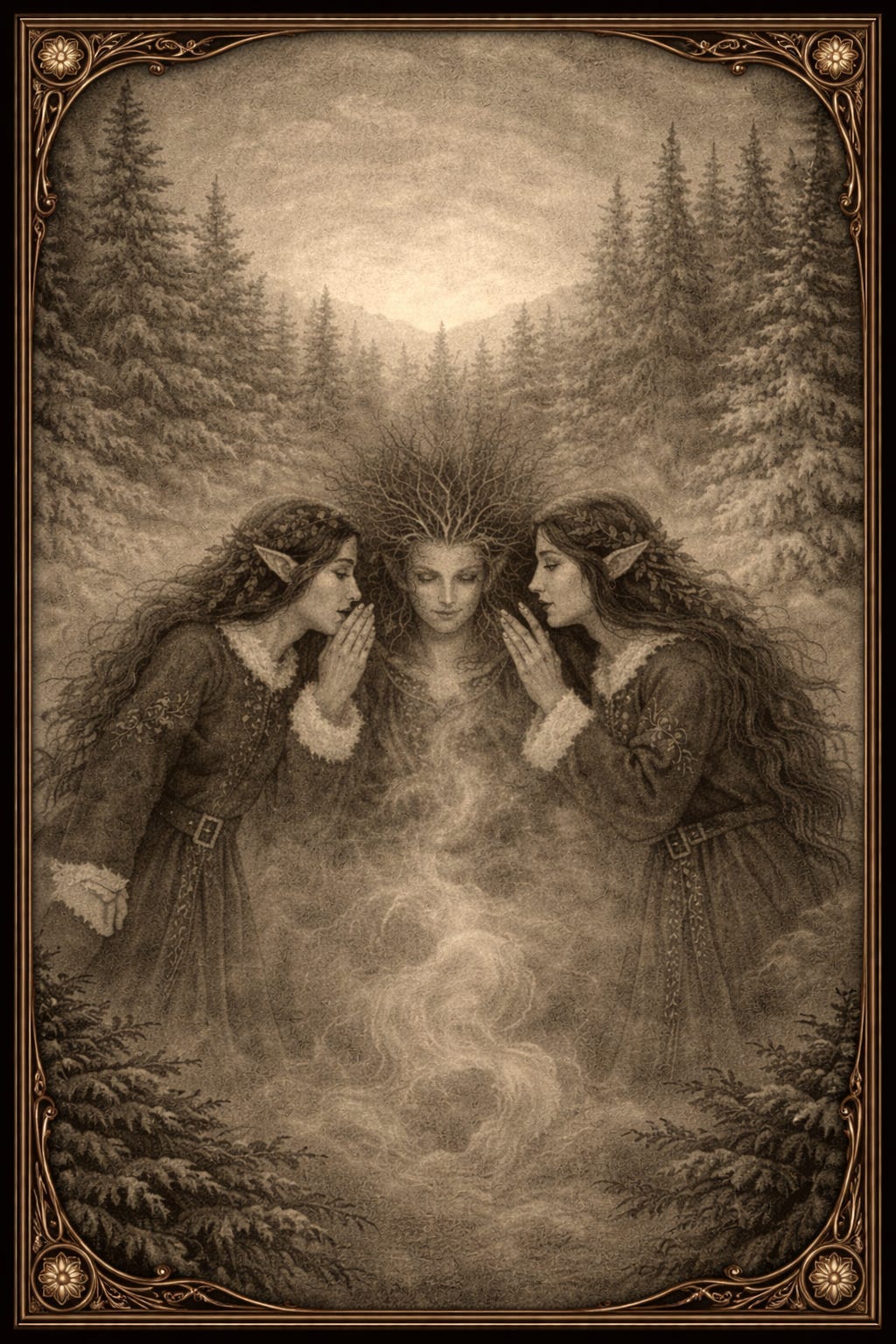
Adoptee Riddle of Un-Belonging
A formula of lies obliterated my origins
and gave me a chance for a better life.
What life might I have had?
Removed from the powerless
Given to one who had what I needed to live,
But she wasn’t mine.
Where were mine—the lost ones?
All were left behind in a riddle of unbelonging.
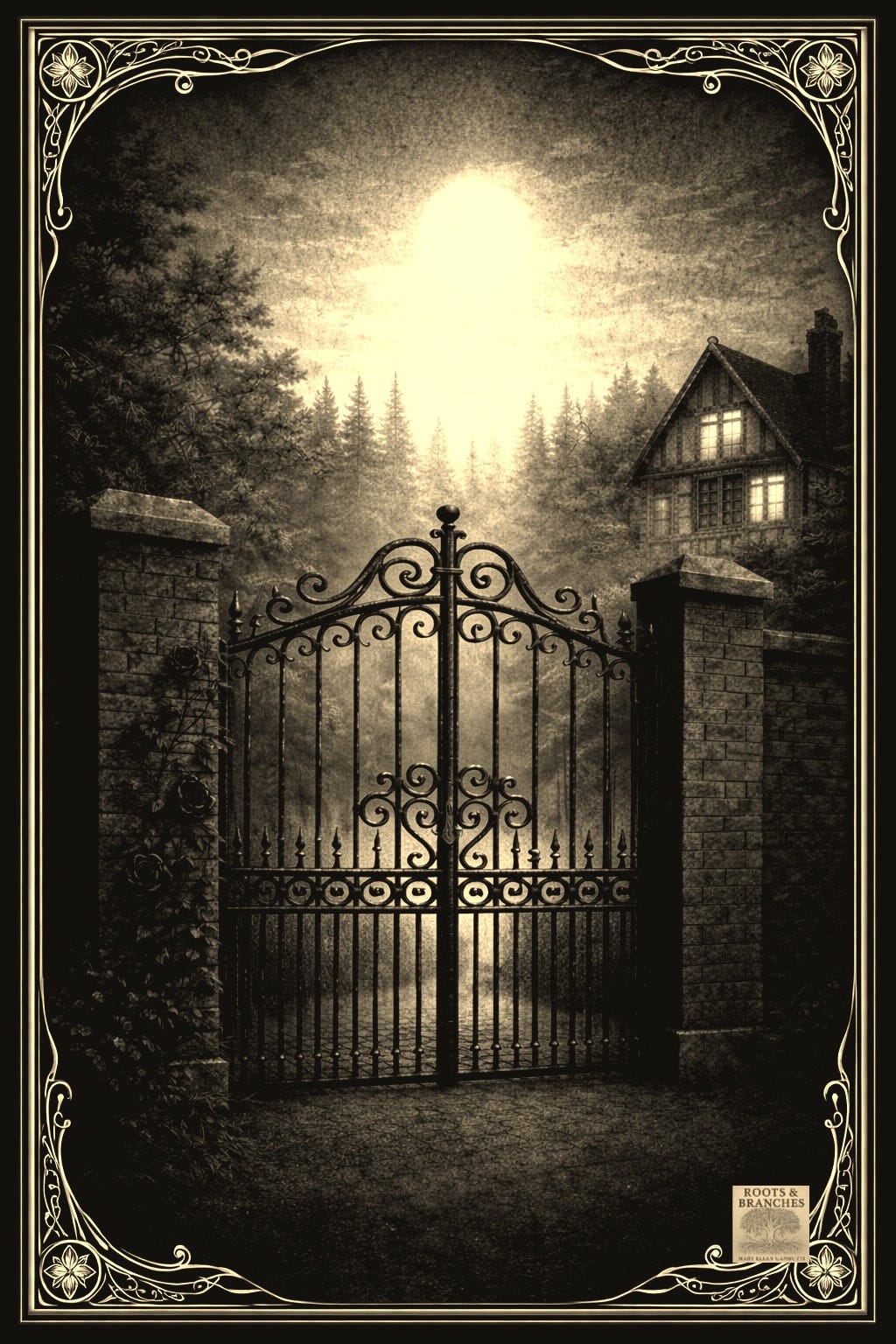
Wound of Betrayal
Despite my dark mood and the darkness outside my window, I knew the Black Rose bloomed, and I knew my questions were validated, if not answered. The severance of adoption had kept me from my truth, from myself.
Early the next morning, Sarah tapped and looked around my bedroom door with “Happy Birthday!”
I thanked her, though far from cheerful.
“I have the folder for you. I’ll put it here, if you’d like to see it.” She placed it on my desk and glanced at my open diary. “You know how much I love you, I hope.”
I answered, yes, I knew she loved me.
Of course, I want it. I’ve wanted it for a few years!
She offered a reprieve: “Would you like to go with me to The Archives after breakfast? James got a start on your search for Ellen.”
My eyes were red from tears and lingering resentment.
After breakfast, we met James downstairs. On the research table, he showed me a DNA registry kit: a test tube to collect my saliva sample, and a genetic genealogy website open on the desktop computer.
“We can look at what I’ve found so far.” The Cedar Grove stirred in approval.
I processed Sarah’s betrayal. I didn’t have the words yet, but knew intuitively that by her secrecy, she colluded with the System that blocked me from knowing myself.
The DNA-testing kit was James’s birthday present to me, and he later mailed it off for processing. He promised he’d help me set up a family-heritage tree when the results came back, and chromosome matches to other testers began to arrive at my DNA account. I wanted to be hopeful, and I did appreciate how James looked out for my interests.
I just wasn’t in the mood to celebrate. Helen had packed my rucksack with fruit and her homemade cookies, reminded me to be home for tea and birthday cake, and kissed me goodbye. I planned to take a walk in Cedra’s neighborhood.
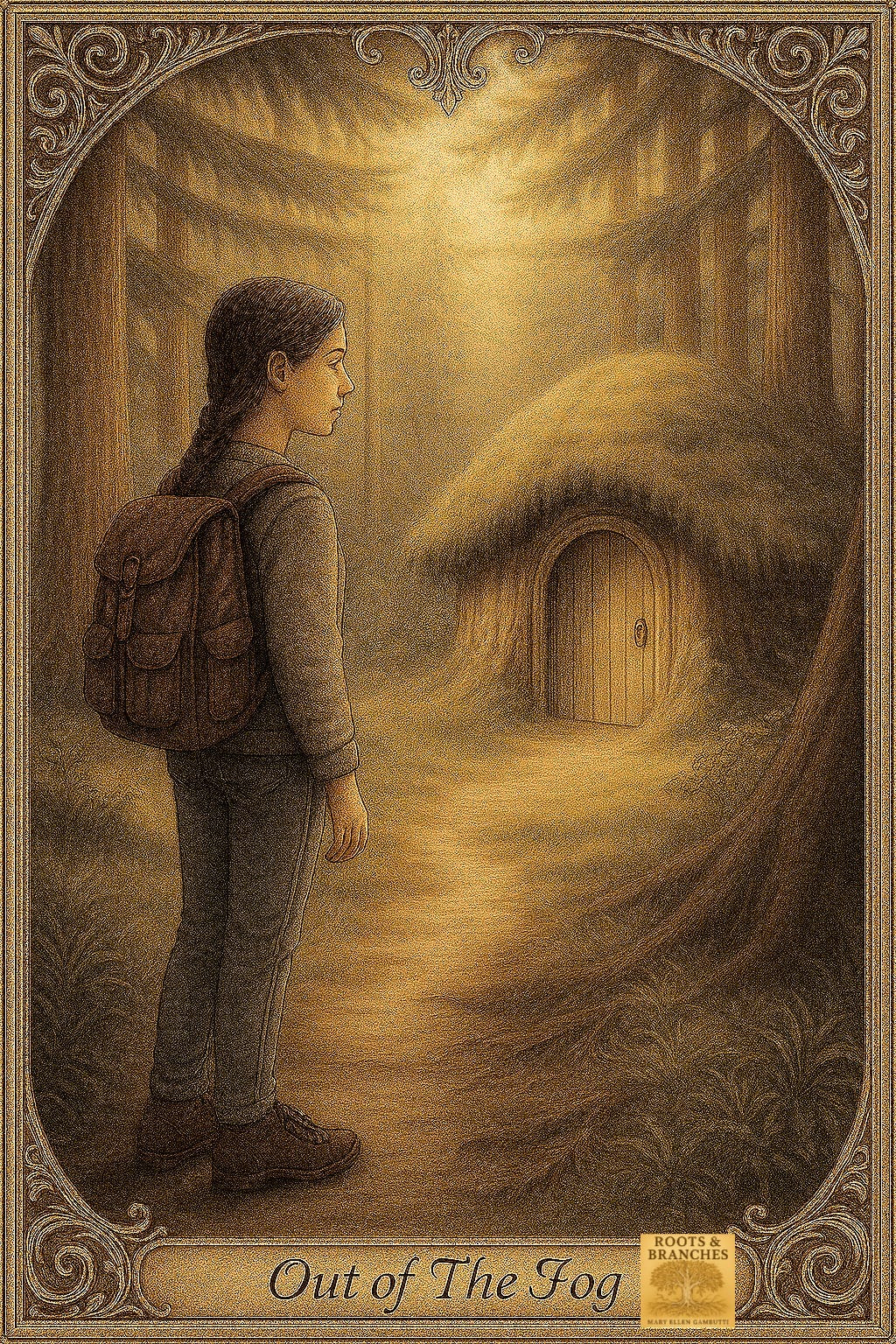
The First Council
Autumnal Equinox
My thirteenth birthday had dawned with a continued need to be alone with my thoughts, and I’d spent the afternoon in the Cedar Groves. At twilight, I knocked and opened the potting-shed door.
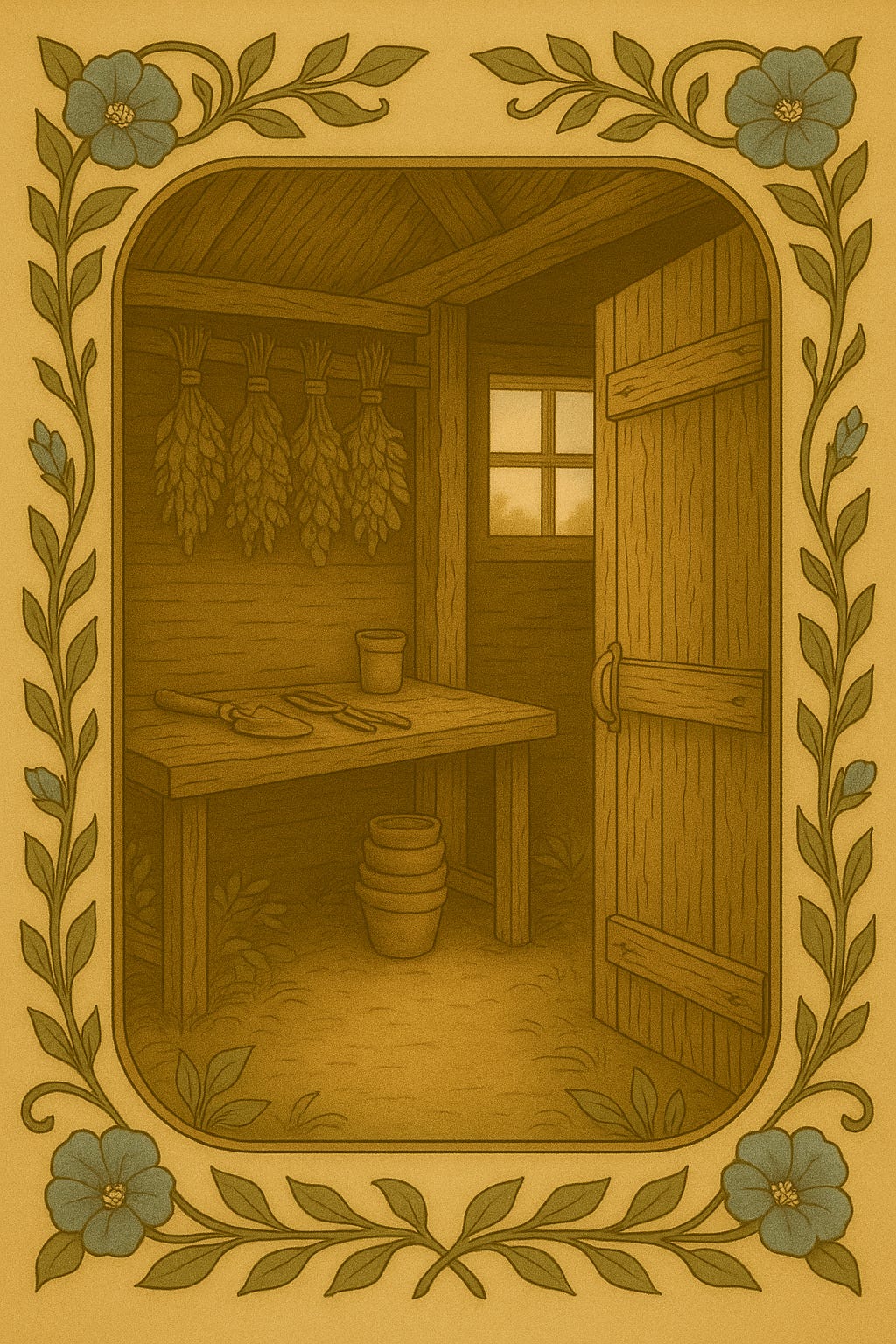
Since childhood, I’d visited Charles in the same way I spent time with Margaret on her cottage-garden bench, talking about important and unimportant things. This time, I found myself alone. There would be tea and cake at home later, but I wondered who the person Mom and Grandma Helen wanted to celebrate. In the deepening evening, I sulked and tended to my sensitivity.
I should have brought my sleeping bag. It will be chilly later.
In jeans and a sweatshirt, I sank to the floor among clay pots and garden tools. Every year, Charles harvested and hung certain flowers, like yarrow, to dry from the beams; their pungent fragrance, like transition, was between fresh and finished; maturity and beyond; between ripened and crumbly. I couldn’t yet express why that meant anything to me, only that Charles’s weathered wooden sanctuary was where I needed to be just then.
Autumnal Equinox energy thrummed through the estate; the boundaries between worlds were gossamer thin.
A sudden streak of light spilled through the grimy windows, and the air hummed with a charge that lifted the hair on my arms. Shadows in the corners began to shift and move.
A scent like cedar filled the shed—earthy yet ethereal. Three figures materialized, appearing through some invisible threshold. I didn’t recognize them: the fairy folk who appeared to Ellen in The Silverton Bus Depot when I was a baby.
Impossibly tall, their forms shifted between solidity and translucence as they moved toward me. I sprang up and pressed my back against the potting bench.
The first bowed slightly. I knew my Mentor’s voice, like wind in the cedars:
Greetings, daughter of Ellen, daughter of Sarah. I am Cedra.
Then:
I am Selwyn. Your bloodline is well known to us.
I am Eleris. We are the Guardians of thresholds, the Keepers of passages between worlds. The time has come to tell you why you are here and why we intervened.
“You’re all from the Fairy Book!”
Selwyn read the inscription aloud:
From the Fae Who Know You Well.
“Winston found it in the Yew Hedge, I said, and the last time I saw it was that night on Sarah’s desk. How did you get it? Did Sarah give it to you?”
The answer came from Selwyn:
Yes, it was Ellen’s record of her sister’s herbal remedies to quiet the mirror-sight when it grew too strong. It was Ann’s attempt to manage Ellen’s mirror-sight that now awakens in you.
Mirror-sight! I finally heard the name of what had troubled me all my life.
Eleris:
Yes, the ability to see beyond mirrors. To perceive thresholds between worlds—and eventually, to cross them.
Cedra:
Dangerous when untrained.
Selwyn:
Sarah wants to protect you. She’s an observant scientist. A critical thinker. She documents even what she cannot fully explain, like your closeness with plants and out-of-season blooms.
“Why did Ellen give me up?” I asked, still raw from the recent discovery.
Selwyn:
She surrendered you to protection, because she saw what happens when the sight is untrained. She sought to give you what she never had—guidance, safe boundaries.
Eleris:
We guided Ellen to allow us to bring you where Sarah would find you. Elizabeth Silverton’s garden is right for mirror-walkers, with its iron boundaries, reflective elements, symbolism, and its position between cultivated design and wild growth.
Cedra:
The truth you seek lies not in choosing between worlds, but in understanding how both have shaped you. I will help you.
I drew a shaky breath. This would be hard, trying to make sense of my heritage.
Selwyn:
In recognition of your right to know your full story, we offer gifts to help you navigate between worlds. A pendant of light. A silver disk etched with spirals shimmered in her hands. It will help you tell the difference between true and false reflections, between doorways and mirrors.
Cedar-scented air surrounded me, steadying me.
This is a carved fragment of the Sentinel tree. Place it beside any mirror you wish to stabilize. It will prevent unwanted passages and anchor your journeys.
The wood felt warm in my palm, vibrating softly.
Eleris:
I return the Forget-me-not bracelet to you, as it appeared on your wrist one morning. Each tiny flower holds a different light: dawn glow for Ruth Ann’s beginning, midday for Stella’s growth, and twilight for what is yet to be learned. Ellen made it, and she wore it while carrying you. The flowers are alive and never wither. I kept it safe for you until you were ready to know all of who you are. Until you were ready for it.
Eleris slipped it on my wrist, and I touched the bracelet, feeling its connection to the mother I’d never known.
“I need to understand all of who I am.”
Then it struck me: I was a child in their eyes. Those who knew me had the power over what I could know. To reveal answers only when I was ready to bear them. It didn’t seem fair that what I knew must come from outside myself. Cedra with her ancient wisdom, Eleris with her fluid grace, and Selwyn with her nurturing calm, had the authority to withhold my truth. Whether to control me or for my own good, they would share my identity when the season was right.
Cedra:
The three fairy wishes written in Ellen’s book were her hopes for you.
“What were they?”
Cedra’s voice rustled like branches in the wind:
Safety, Understanding, Reunion. You are acquiring each. We provided you with the first. The third remains to be fulfilled.
“Wait!” I called as they began to fade. “How do I find her?”
Cedra continued:
The Archivist has begun to search. We will help you find her. Your reunion will strengthen both your abilities. We will teach you what Ellen could not learn in time: how to see through reflections safely, how to return to your anchor point. But know that meeting Ellen will bring both healing and pain. Are you prepared?
“I need to know myself!”
Use our gifts wisely, Stella – Ruth Ann – Seeker. You are neither one thing nor the other. You are both mortal and fae, and that is your strength.
Outside, nightfall welcomed me. The moon was glowing, and the stars seemed brighter than I’d ever seen them; the spaces between them were less empty, as if I were seeing not just pinpoints of light but the pathways that connected them: my constellation, Virgo, and her bright binary, Spica.
Sarah met me on the way home. “I’m sorry I kept the truth from you,” she said quietly; her face seemed pale in the moonlight.
“Which truth?” I asked, looking over my shoulder. My Guardians still stood in the doorway. Sarah didn’t suspect I had been to a magical event in The Potting Shed.
“All of them, I suppose. The ones I knew about, the ones I couldn’t see, and those I refused to believe.”
I touched the Forget-me-not bracelet, its flowers glowing faintly in the starlight.
“Where did you find it?” Sarah asked, surprised.
I held back -- some revelations follow their own timing; I had just learned that from the Fae.
“We’ll find her together,” Sarah said. “I won’t let you struggle alone. We’ll find out everything we can.”
Above us, the equinox stars wheeled in perfect balance between summer and winter, light and dark, ending and beginning. Just as I now stood balanced between two worlds, my first step was taken toward understanding myself.
Helen waited in the kitchen with tea and birthday cake, ordinary comforts bridging extraordinary revelations.
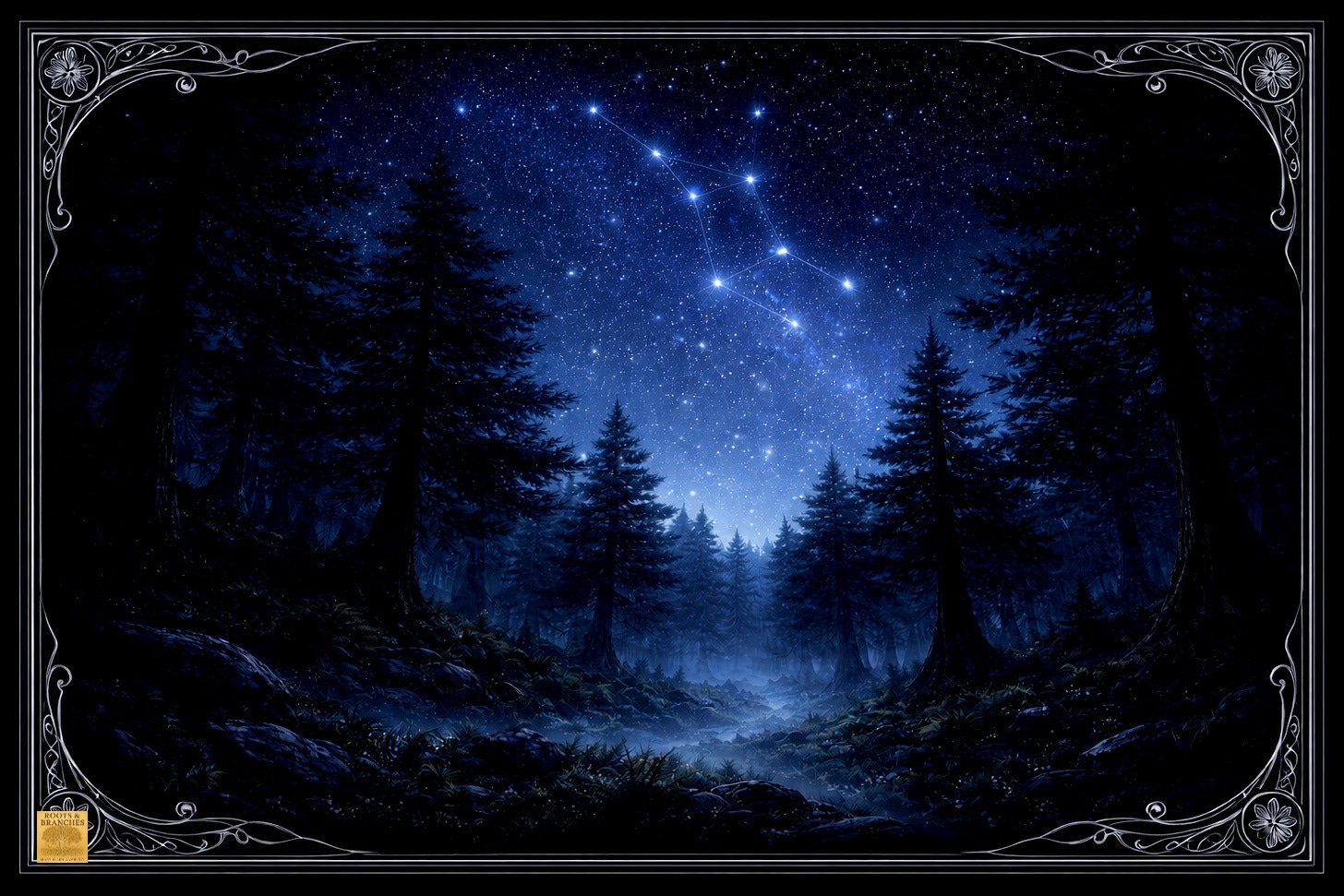
“…the spaces between them were less empty, as if I were seeing not just pinpoints of light but the pathways that connected them: my constellation, Virgo, and her bright binary, Spica.”
Reconciliation
The Forget-me-not bracelet glowed softly on my wrist as I stood outside Sarah’s study door that evening. I knocked and entered to find her surrounded by her journals: sixteen years of documentation spread across her desk.
“These belong to you now.” Mom seemed exhausted. “Every observation, every question, every moment I tried to understand what was happening without having the right framework.”
I touched the nearest journal, opened to an entry from my fourth birthday:
S. spoke to the roses today. They turned to face her as if listening. Must research if medieval accounts of plant communication have a scientific basis.
“You were trying to make sense of it,” I said, with not quite forgiveness, but perhaps a willingness to understand Sarah’s motives.
“I was trying to protect you the only way I knew how: through objective science.” Her eyes met mine. “But I was wrong to hide your birth information from you. Everyone deserves to know their full story.”
My Forget-me-not bracelet warmed at her words.
The Garden Smiles
I dreamed of a garden unlike my mother’s practical plots of herbs and vegetables. This Garden grew wild and impossible, with flowers that chimed like bells, vines that wrote poetry on the walls, and trees that danced when no one was looking. I awoke to impossibly blue Morning Glories sprouting from my bedroom ceiling, and Black Rose petals on the floor trailing to my bedroom door. Windows caught light from impossible angles, showing scenes of other seasons. Mirrors reflected rooms that might exist tomorrow, while stairs might climb to never-before spaces.
Sarah merged her two journals as though to assert her new perspective. She noted my developing abilities alongside her botanical studies, not in separate entries, but as she observed them. The new journal detailed the Manor House’s shifts, referencing her late father’s architecture books. Most important to me was her openness about her recordkeeping. She asked my opinions and my permissions, making no assumptions. She ceased her surveillance, acknowledging my need and right to privacy.
Everything was changing: The Manor, The Garden, and my self-understanding.
Neither Here nor There
The Cedar Forest held a strong lure for me for as long as I could remember, though Sarah had warned me not to venture alone too deeply among the towering trees. Their massive trunks and whispering branches pulled me more strongly since James discovered my adoption papers.
I found Cedra waiting at the Grove’s edge. She had shifted from Elf to Cedar Phyto Dryad since the Council meeting. Not quite human, not quite a plant; she was a being at the portal between worlds. And there I was, at the threshold, accepting my dual nature.
You’ve been troubled lately.
Her voice was like the roughened rustling of forest ferns. Like breezes through branches.
“I still have questions,” I admitted.
Cedra motioned to me, and I sat on the mossy fallen log.
Some answers come only when we recognize patterns.
I couldn’t be sure what she was telling me. We sat in the stillness of birdsong, as sunlight filtered through feathered boughs. I wanted to talk about a memory fragment: Sarah carried me out under the starlit sky. Terrified of tumbling into the blackness, into depth and distance. She returned me to my crib.
Into the solace of moonglow, I float among the wallpaper flowers, chasing a dream that returns and repeats, and I rise above the highest branches.
Cedra: What you felt that night was the clash of your dual nature. Human children fear separation, openness, and the void. They seek containment, walls, and boundaries. But fairy children fear confinement, and are drawn to open spaces, to the stars and sky.
“Was I afraid and not afraid?” I asked.
Yes. Your human self was fearful of the vastness of the night. Your fairy blood recognized it as home.
Cedra reached toward me, her fingers elongating like cedar twigs to touch my temple.
Pattern floating was your first try at mirror-walking; using repetition to toggle between realms, you could say.
“Then my fear wasn’t about being adopted?”
It was about being divided, with one foot in each world, not comfortable in either. You felt the severance from not only Ellen, but from half your fae nature. This is much like Ellen would feel as half-fae, being separated from you – her natural child.
A cedar branch above us swayed without wind, dappling light across the lines on my palms, forming patterns similar to Cedra’s bark-like skin. It was an exciting sensation, but I didn’t tell my Mentor.
“Is that why I’ve always been drawn to this place?”
Cedars are boundary trees. They grow where worlds meet. Like you, they belong to multiple realms at the same time.
At dusk, walking home under a vast sky just beginning to reveal its stars, I didn’t look away.
How do you describe the effects of maternal severance and abandonment? It’s a sense of abeyance; neither here nor there.
End of Episode Eight Through The Yew Hedge: A Tale of Identity Magic
Next Wednesday Episode #9 Reunion and Reconciliation
Coming Soon
Behind the Hedge ~ glimpses around the Cedar Gate about the novella and the Sequel in progress.
Through the Iron Gate:
We’d love to hear from you! Have you enjoyed the series? New here? We welcome you!
Thank you, and have a magical week!