

A Dispatch from Beyond the Hedge
A Once-in-a-While note from my story-world where imagination and memory meet in the Gardens
The Gardens
Dear Readers,
I hope this end-of-winter message finds you well. Thank you for your long-standing subscriptions!
Most recently, my work has found a form in fiction, and I’ve just published a magical realism novella under the pen name, Islay Corwin. You can find it in serial form in the section, Through the Yew Hedge a A Novella Series. It’s all there! Or you might prefer to read a digital copy.
The Silverton Estate is the backdrop of Through the Yew Hedge. Its enchanted garden shapes the lives of Stella, her adoptive mother, Dr. Sarah Caldwell, and their close-knit community.
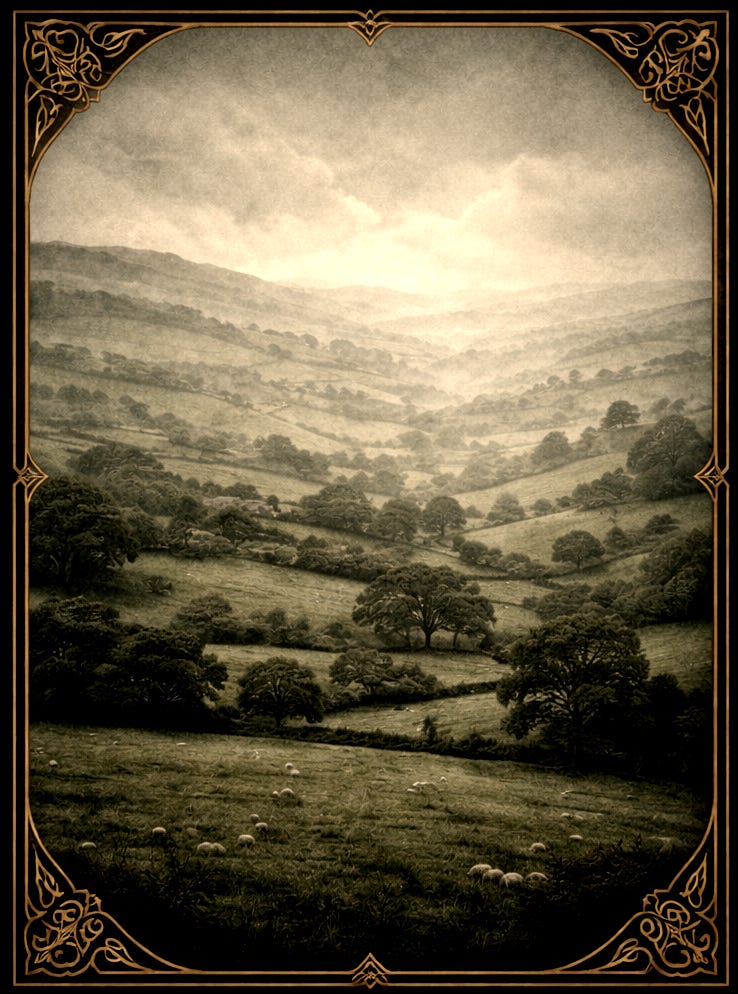
Elizabeth Silverton’s vision was to build a restorative botanical estate, a contemplative space modeled on historical precedent where scholars of her university community could find rest and relaxation. A medievalist and a botanist, Elizabeth carried her expertise from the British Isles to New England; her stated purpose to acquire land and design gardens where the integrated healing traditions of the Celtic monasteries could be studied, preserved, and experienced.
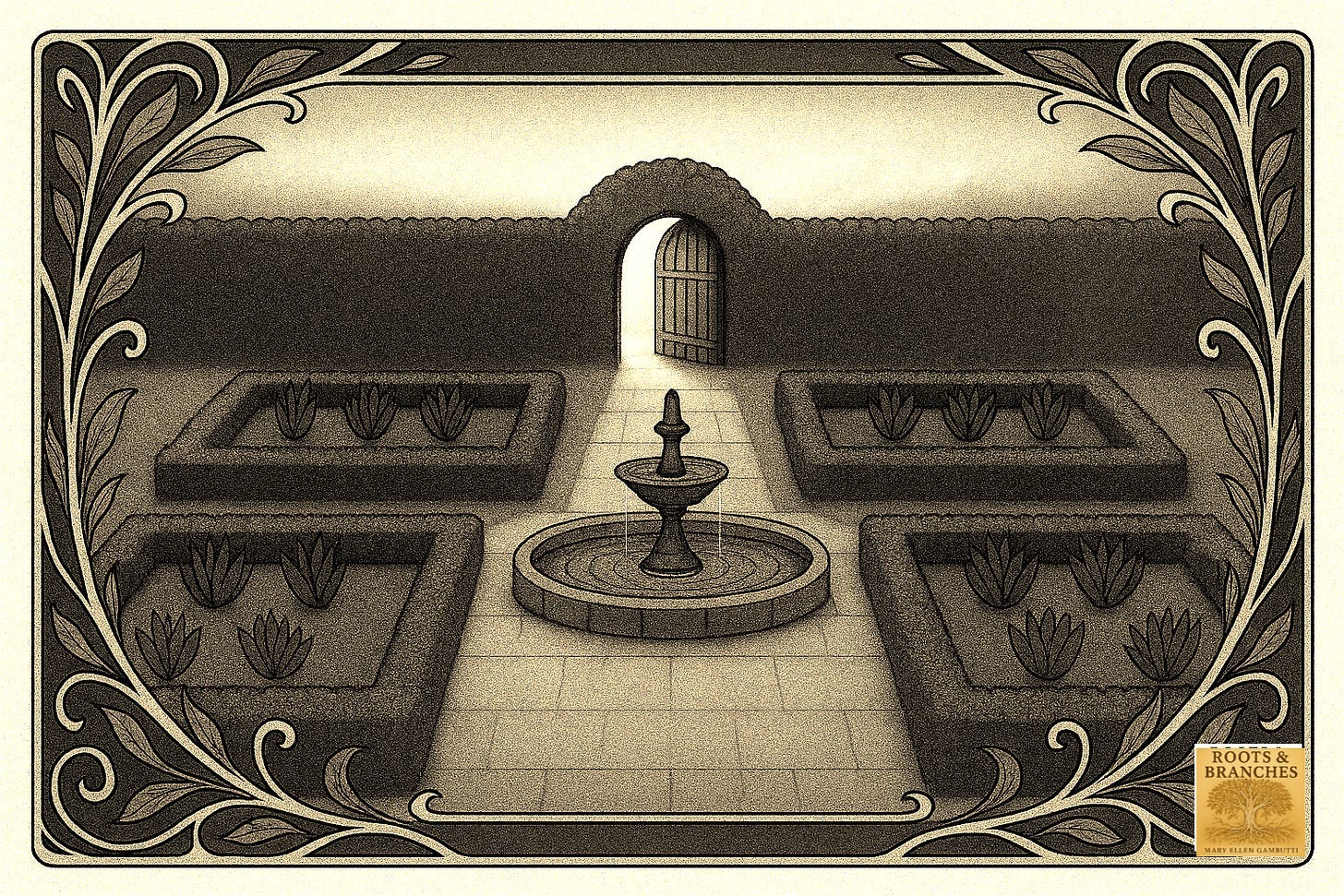
Her plan for quadrant layout with reflection pool and fountain at the central axis, and concentric herb beds was guided by ancient apothecary herbals. The astronomical alignments; the iron fountain, the obelisk, and the arbor marking solstice lines echo patterns documented in the Welsh Myddfai manuscripts.
The Physicians of Myddfai were thirteenth-century gardeners and healers whose manuscripts Elizabeth studied, classified plants by their effects on the body, emotional conditions, spiritual transitions, and interpersonal bonds. Long before the modern view of separation of body from spirit, the Celtic monks and herbalists developed a pharmacy rooted in place.
In Elizabeth’s scheme, herbs for calming the mind grew in one bed. Those for strengthening the heart in another. Those for clarifying vision in a third. The arrangement itself was part of the medicine which clients from the university community might benefit.
Elizabeth, directed by three fae, ancient as the cedar groves, designed the medieval-styled garden with wall and yew enclosures, boundaries and thresholds, progressions from outer to inner spaces, and herbs chosen for resonance as much as remedy for those with difficulty navigating unprotected places. Like Stella and Ellen, her natural mother.
The Silverton Estate, its Gardens and Cedar Groves, are Thin Places. The rhythms of Silverton Estate are the narrative’s truest metaphors. The garden offers Stella what her loved ones struggle to explain: that loss has seasons, that transformation doesn’t demand resolution, that some things renew on their own timeline. Here, Stella’s gifts are not merely tolerated or endured. They are accepted. Even in her half-fae nature, she is at home.
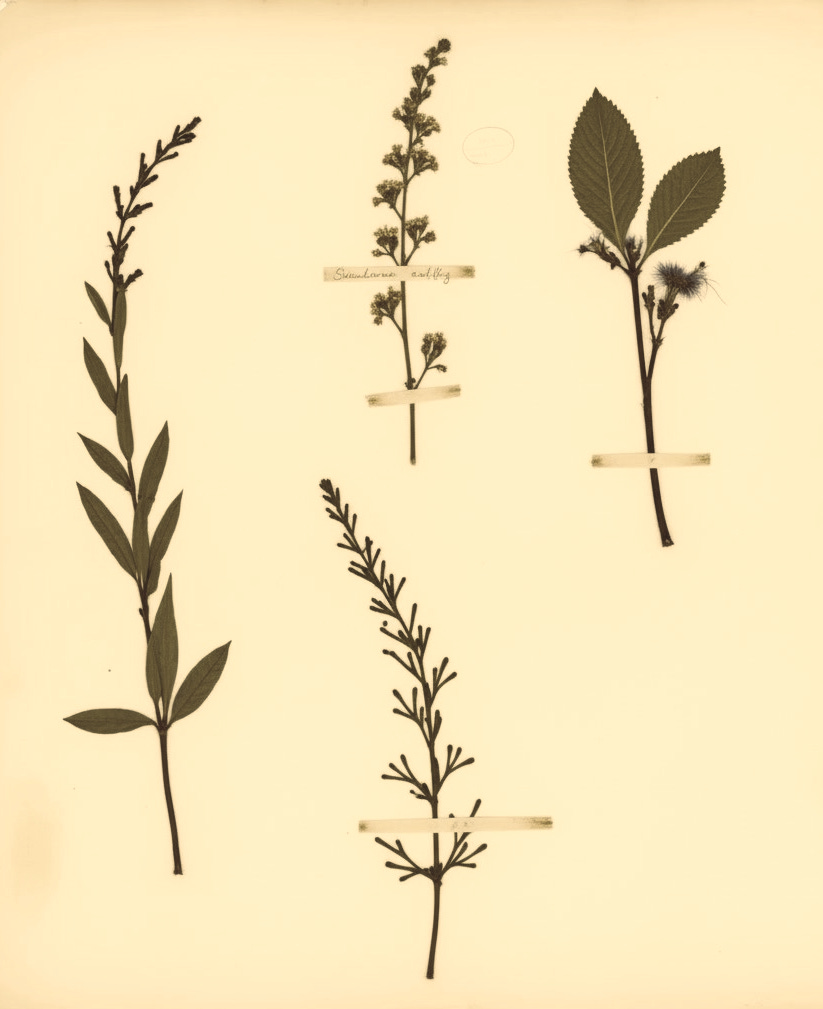
When Sarah and Helen later decoded Elizabeth’s herbarium, they discovered that she had cross-referenced every pressed specimen with both standard taxonomy and older Celtic classifications. She annotated properties beyond what modern pharmacology would recognize in Victorian times, as well as in Sarah’s modern day. Elizabeth was not merely recreating history. She was testing it. Sarah was skeptical.
This is one of the threads I found most compelling: the tension between Sarah’s disciplined method and the older, stranger knowledge Elizabeth left behind. Sarah documents, measures, and observes growth patterns and soil composition. Yet Elizabeth’s notes keep pulling her toward a system of understanding that resists the tools Sarah trusts most. Sarah’s mother, Helen, the folklorist, reads the same evidence differently. For her, the framework of healing traditions was never irrational. It operated according to principles that the modern world gradually forgot.
An adoptee’s perspective
Stella’s mirror-sight, her ability to perceive reflections, ripples, and presences in water and glass that no one else can see, is the story’s magical expression of something very real. Research on adoptees consistently documents heightened sensitivity: hypervigilance to emotional undercurrents, acute responsiveness to the environment, attunement to the resonance and nuance of unspoken words. These are often survival adaptations from early severance. The infant’s system must calibrate to loss before language.
In the world outside the Garden, that sensitivity is treated as pathology and managed conventionally. When Sarah finds Stella frozen before the hallway mirror at age eight, the pediatrician calls it a disorder to be managed. Sarah hides away the prescription. Margaret Hawthorn brews tea from the garden’s innermost circle to soothe Stella’s spells. In time, those closest to her, accept her differences in perception as her own faculty, like ordinary eyesight or hearing. Cedra teaches her to steady herself in mirrors, dewdrops, and cedar ice reflections.
The Garden does what Elizabeth, guided by the fae, designed it to do. It does not explain. It simply demonstrates, teaching Stella to trust the spaces between knowing, the seasons where nothing seems to be happening, even as everything shifts beneath the surface.
As a horticulturist, long retired from working on large estates, I relate to the meaning of garden as a sanctuary. A sacred place. The garden, elevated to its highest form, is a refuge. Nature itself. Working in old estate gardens taught me that landscapes hold time and memory. Gardeners witness the walls built by hands long gone, beds dug and amended by generations, decades-old trees whose shade we inherit without knowing whether it was sown by a bird or grafted by hand. Woodlands where leaves and moss have accumulated, layered like time. Like meaning. A garden is never just a design. It exists from season to season in cycles of growth, dormancy, decay, and renewal.
I return to gardens in my writing for the same reason I returned to them in life. They are the most honest spaces I know. A garden does not pretend. It shows you exactly where it is in its cycle. It does not hide its dead wood or bare soil. Beauty and decay occupy the same bed without apology.
For Stella, shaped by sealed records, the silence of systems, and the guardians who mean to protect her, it is the garden’s honesty where she thrives. Here is a space that conceals nothing. Here is a space where every stage of life is visible, where memory is written in bark and root and volunteer seedlings.
Elizabeth Silverton understood that. She designed a contemplative space for a university community, yes, but she also planted something deeper. A place where ancient knowledge could take root again, where an ancient cedar forest is preserved. Where the full truth of a life could be held without flinching.
That is the sanctuary she left behind. That is what Sarah tends. That is what Stella, slowly, learns to trust. And that, for me, is the heart of the story.
Thank you for reading,
Mel x
© Mary Ellen Gambutti 2026
Lovely! Such a garden sanctuary of Thin Places where one moves from inner to outer worlds and beyond—magical and precious, healing and beautiful.