

The Waiting
Sarah retreated to her upstairs office with a tea tray. There, she would spend the rest of the afternoon trying to process what had happened that morning. She needed to compose herself to write the Official Estate Report. She took up a pen and her journal from the papers and books on her desk, but her thoughts were like a whirling blizzard as she tried to articulate the inexplicable.
Setting her journal aside, she pulled a stationery pad from the top drawer, telling herself: Must stay objective, even when science fails to explain my observations.
Dawn, December 22, 19- (Winter Solstice)
To: Dean of the Department of Medieval Studies
Re: Unusual Occurrence at Silverton Manor Medieval GardensAt the Winter Solstice, just after dawn, I discovered an infant in the central garden feature (fairy ring). Female, approximately three months old.
Dawn temperature upon leaving the house: 32°F. Temperature within the fairy ring: 68°F. Surrounding garden: 32°F.
Noted unusual botanical activity: morning glory (Ipomoea tricolor) and Rosa varieties bloom despite the season. Geometric patterns in frost formation. A distinctive blue light preceded discovery. I can only speculate on its relationship to the notable rising soil temperature.
Requires research into possible precedents for foundlings in (this or other) medieval gardens.
Signed,
Sarah J. Caldwell
Resident Curator
Sarah exhaled and closed her eyes, feeling drained. But she continued to note in her personal journal:
Ice crystals write cryptic messages on my window. What other form of record-keeping is available to document, comprehend what happened today on the Silverton Estate? Will I see Ruth Ann again?
Sarah navigated through her anxious thoughts that she might not be selected to mother the baby who had brought her joy for a fleeting moment. She found herself seeking solace in the herb garden, where the scents and textures transported her from longing to hope. In her thoughts, there had been something unique about me. She had decided we were meant to be a family. Sometimes, she was taken aback by her thoughts.
She awoke in tears from a dream she recounted to Helen in the morning:
“By the edge of the fairy ring, a woman cradled a baby, smiled at me, and whispered, ‘mother, mother, mother…”
“It’s a sign. A strong sign.” Helen was convinced.
The police were still investigating. Sarah asked, “Was it a kidnapping, abduction, or abandonment?”
“No one has come forward. No leads,” the superintendent was apologetic.
“I haven’t given up, though,” Sarah said. She persisted with her calls while continuing to gather references for the adoption agency, to keep hope alive. She understood there was no way to speed up the process.
The agency advised Sarah to remain patient, as it could take up to six months from the time the case was entered into the system until a decision was made. Those first weeks were difficult for her, as she imagined me in the care of strangers.
Sarah’s anxiety was not unfounded. I spent long hours alone in a foster care crib, or bottle fed with formula and milk with the bottle propped up against the rail in a receiving blanket. Yet, instead of waiting or, even worse, defeat, she kept herself occupied around the Estate.
Sarah’s Journal Entries
January
The adoption process is moving along. No biological relatives have come forward.The fairy ring remains warm, snow melting in a perfect circle. Lights, like the Aurora, dance above. The iron fountain plays unfamiliar lullabies. Like a dream, my plans fade, or transform like The Garden at twilight. As I move through the herb garden, Cedra is nearby, chanting in an unfamiliar, ancient key. The morning glories sway. My thoughts are always with Ruth Ann.
February
More of the unexpected in The Garden: Science failing to explain most critical observations. Ruth Ann turns five months old.Traditional infant-care herbs appear: Chamomile clustering in Margaret’s garden, Lavender sprouting along walking paths, Fennel and dill self-sow in the formal beds. Garden patterns reorganizing for infant care.
March 5
The strictness of the monastic medieval beds and walks appears to soften. Lavender and rosemary weave their stems ahead of purple and blue spikes, forming a gentle, protective barrier in the physic garden.The final home visit from social services approaches.
March 15
Early spring warms The Garden in anticipation of the Vernal Equinox. The Manor House is alive and ready for the baby to return to us. The waiting will soon be over.
The Archives
While Sarah waited over the long winter she immersed herself in research and writing. The giant oil-burning furnace that lived near the cellar door where coal deliveries were once made, could keep the work room at a tolerable temperature, if she wore a sweater, except on the coldest days.
From the manor’s upper floor bedrooms and her office, Sarah had easy access to The Estate’s labyrinthian Archives, two flights down the back staircase in the basement of the Tudor Manor.
From mid-morning until noon, Sarah worked by natural light at the massive oak table, its surface worn smooth by the elbows of academics in woolen blazers. She might be found reading in the afternoon or evening in the overstuffed Victorian armchair under one of several wall sconces that Charles had converted from gas to electric fixtures in the fifties.
As might be expected of an antique home, it lacked sufficient insulation and weather stripping, although the University had made attempts to control temperature and humidity in The Archives to preserve its treasures. Newer windows in the conference room, though not state-of-the-art, were a step up from former drafty casements.
A complex fragrance of aged paper, leather bindings, cedar wood cabinetry, and dried botanical specimens was present in the network of storage halls, lab, reading, and conference room, like a perfume of preserved knowledge.
A tall oak, glass-fronted cabinet displayed a curious collection of Elizabeth’s found objects, natural artifacts, and archaic finds unearthed during excavation, showing The Estate was not the original habitat.
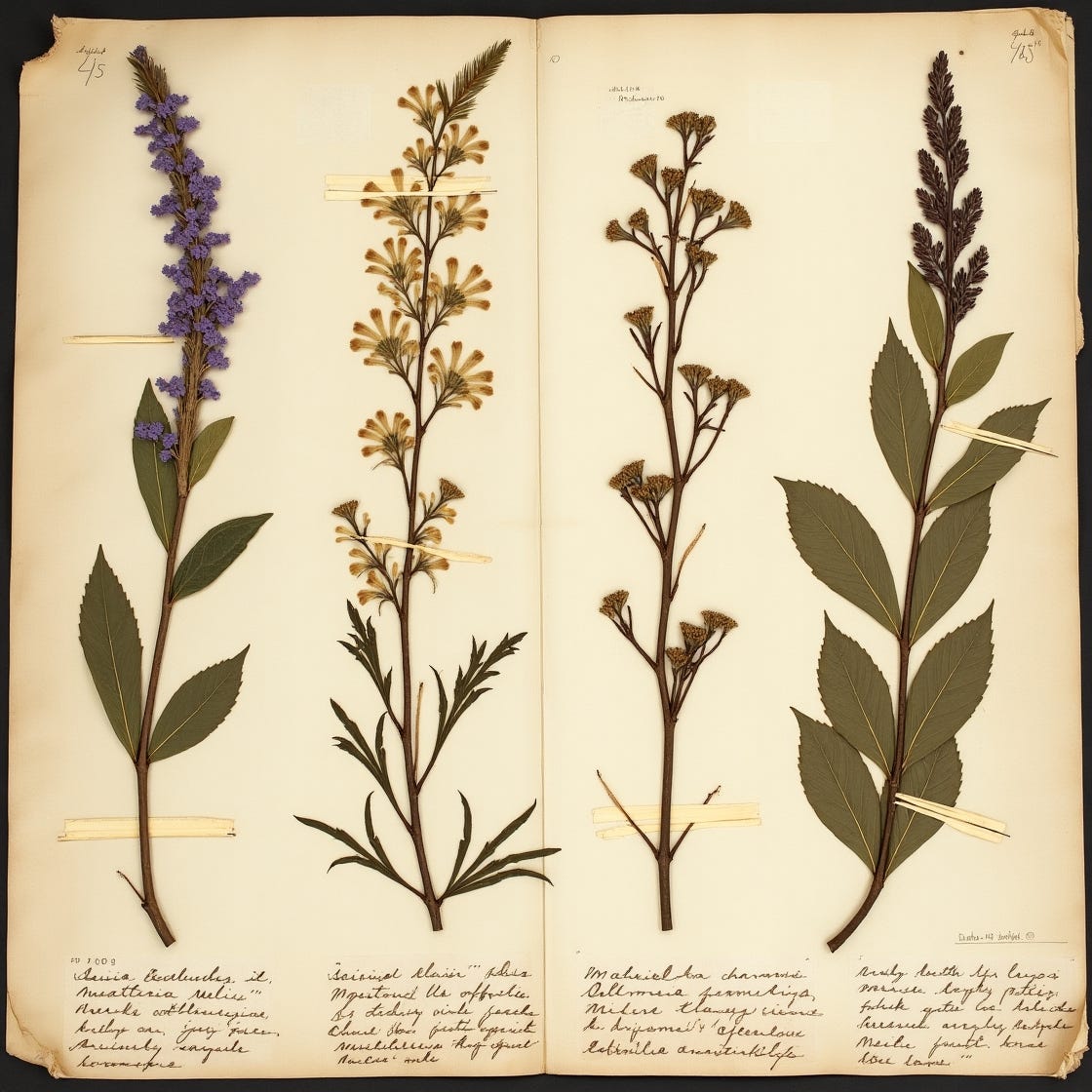
A stack of flat drawers held part of an extensive collection of pressed botanicals, the Herbarium. Sarah photographed the specimens, while James assisted by adjusting the lighting and holding the acid-free supports to protect the fragile archaic pages.
“The Latin is standard taxonomy for the period,” Sarah said, “but these marginal notations are in another...”
Helen, working on the far end of the table, raised her head, and asked, “May I see?”
She put aside cataloguing folklore texts to stand next to her daughter, and Sarah accommodated Helen by adjusting the lighting. Helen eyed the notation for a moment, then turned to a set of shelves opposite the table, and took down a slender bound volume, opening it on the table to a medieval manuscript facsimile.
“I thought so!” Helen said, returning her reading glasses to her forehead. Sarah and James joined her, and she said, “These aren’t botanical classifications. They’re references to the Physicians of Myddfai.”
“Who?” James asked.
“They were Welsh herbal healers from the 13th century, James. Their manuscripts contained one of the earliest systems of plant medicine in Britain, combining empirical observation with folk practices that recognized plant properties.”
Sarah leaned closer to compare the notations. “You’re right. Elizabeth wasn’t only using plant taxonomy to identify these plants, she was cross-referencing their traditional medicinal applications.”
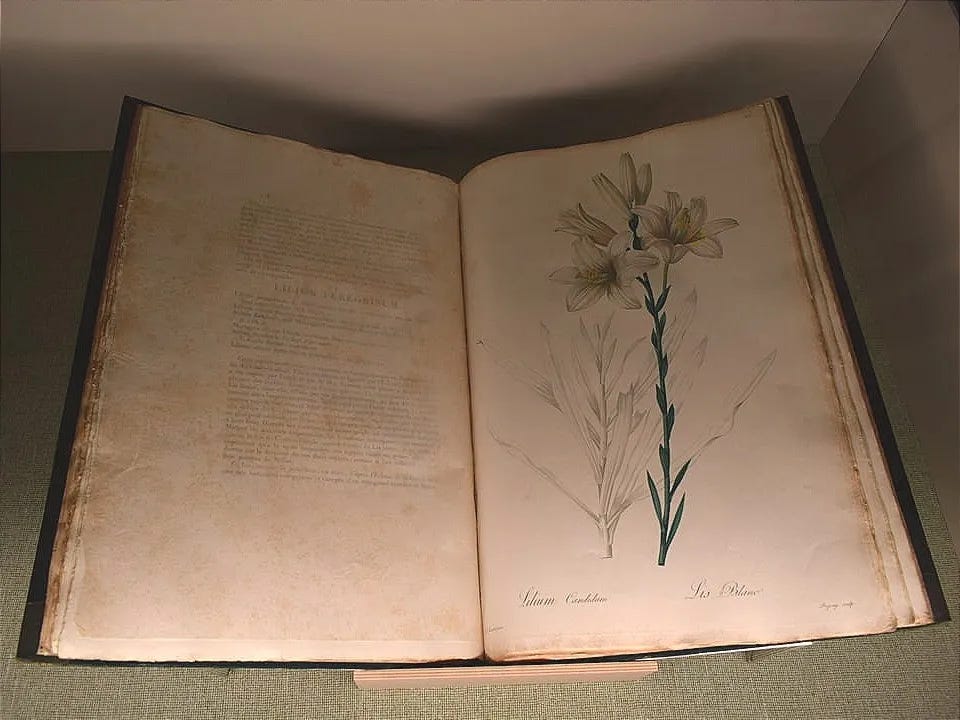
“Not just medicinal,” Helen said, as she motioned to James to bring the volume over to the herbarium pages. “The Physicians of Myddfai classified plants according to their relationships to states of being: physical health, emotional conditions, spiritual transitions, and human relationships.”
Sarah’s skepticism surfaced. “That seems rather esoteric for someone creating a historically accurate monastery garden.”
“Not if you consider the whole purpose of monastery gardens,” Helen said. “Medieval monks grew herbs to treat physical ailments, yes. And they believed in the interconnection of body, mind, and soul.”
“Yes, that’s right, Mom.” Sarah referred to another open volume beside her on the table, a folio of monastery garden layouts. “See how herbs were grouped in physic gardens? Plants were by their therapeutic purposes. Those treating melancholy would be placed where they received morning light. Those for fever reduction would be near water features.”
James seemed intensely interested, and the three fell into their collegial rhythm: Sarah identified herbarium specimens, pointing to their on-site locations which James then documented. Helen translated marginal notations that she said revealed Elizabeth’s interpretations of plant properties.
Elizabeth’s formal Bequest stipulated the care and preservation of The Garden as a botanical contemplative space, a refuge for world-weary academics. As Sarah and Helen cataloged herbarium specimens, they came across a note tucked among pressed samples:
To Future Guardians of the Garden
Spring Equinox, 1892The whole of my garden serves purposes beyond what is stated in the official Bequest document. While presenting my work publicly as an historical recreation of a contemplative garden, here, I’d like to disclose the deeper intentions behind my design.
The concentric herb beds follow principles found in manuscripts from the Physicians of Myddfai and other medieval healing traditions. I have arranged the plants not merely by botanical family, but according to their documented therapeutic properties for those seeking peace, clarity, and restoration of spirit.
The innermost circle contains herbs traditionally used for calming anxiety and promoting restful sleep: chamomile, lavender, and lemon balm. The middle ring holds herbs that medieval monks used to sharpen mental clarity during contemplation: rosemary, sage, and mint. The outer ring provides herbs known to strengthen the constitution and support general wellness: echinacea, calendula and thyme.
I have yet to mention my intentional placement of the Medieval Garden between the Cedar Forest and lesser cultivated, wilder grounds; the meadow and pond, for the optimal benefits of wildflowers and the Cedars’ aroma.
I humbly trust that your enlightened care will preserve this contemplative and therapeutic purpose for scholars and visitors to benefit this place as sanctuary for the mind to rest, the spirit to heal, and for the body, as for those who tend it, a vital medicine, that it may continue to offer solace and restoration.
With Devotion to the Arts and to Science
Elizabeth Silverton
No specific conditions were mentioned, but of harvest times, preparation methods, and observed effects showed a systematic approach to something beyond mere historical recreation. “She developed an alternative healing system,” said Helen.
Sarah was intrigued despite her skepticism, but was content for the moment with her own speculation.
The Structure
This discovery led Sarah to look deeper. Before long, her neat annotations marked plant species and growth patterns on a transfer copy of the detailed architectural drawing. This was a bird’s-eye view of the medieval monastery garden that showed the formal quadrant structure with the central fountain, arbor, terrace, aviary, and obelisk.
The next time they were together, Sarah traced the quadrant structure, and said, “The layout incorporates elements of traditional monastery gardens. What do the positions of the obelisk, fountain, and arbor tell us?”
James nodded, his expression thoughtful as he examined the plans. “The proportions must be intentional.”
“May I?” Asked Helen, her eyes widening. “These aren’t just aesthetic choices,” she said. “They’re astronomical alignments. See how the path from the fountain to the obelisk aligns with the winter solstice sunrise when viewed from the terrace arbor?” Could it be that the positions of these Garden features ensure visitors derive the Apothecary’s benefits at optimal times? For example, morning light warms herbs, bringing clarity so the mind is fresh for study. Perhaps, the moist evening shadows release calming scents when rest is needed.”
James leaned closer. “And this line from the arbor to the aviary...”
“Summer solstice sunset!” Helen was enthusiastic. “Elizabeth embedded calendrical markers into The Garden’s structure! Her precise astronomical alignments suggest she tested specific variables. She wasn’t just following precedent.”
Sarah looked intrigued, but said, “That seems... speculative.”
Helen smiled, recognizing her daughter’s skepticism. “Give me a moment.” She recalled a reference book, and returned with her well-worn volume. “This is a study of sacred geometry across Britain. The geometric relationships between standing stones at places like Callanish and Avebury follow similar patterns to Elizabeth’s, except they used megaliths, and she uses garden features.”
Sarah was adapting to her mother’s unconventional perspective: “So, are you suggesting that Elizabeth was not only recreating a medieval aesthetic, but that she also aimed to synthesize multiple traditions?”
“Yes, precisely. The terrace arbor provides the viewing point for these alignments. The quadrant beds correspond to the four elements in alchemical tradition.”
And so, the conversation around the colleagues’ research and discovery would continue for months and years.

March 20
Tomorrow, the social worker will conduct her final home inspection. We’re hoping that in the following few days, the paperwork will be completed by the agency and the lawyer. Mom and I are ready to bring Ruth Ann home!
The next day:
“I’ve set up the nursery on the second floor, east wing,” Sarah said to Ms. Turnbuckle from the adoption agency. She and Helen couldn’t help but show excitement and pride in their preparations for the baby, but Sarah kept her composure, despite her nerves. She led the way into the bright, freshly-painted and wallpapered nursery on the second floor. Sarah credited Helen for her loving contributions, saying, “Mom picked the colors. The blues and yellows are so cheery in this perfect morning light.” She stood by the window, pointing to the sweeping vista. “Ruth Ann’s room overlooks the front lawns and trees, and the long view toward the central Gardens...”
Ms. Turnbuckle stopped at the crib and highlighted a specific line from Sarah’s one-year-old agency application. “You wanted a child aged seven to nine. Are you certain about adopting an infant now? You’re sure you haven’t changed your mind?”
“At the time, I assumed...” Sarah hesitated, her heart pounding, “That, given my age and profession... Well, I was informed that getting approval for an infant would be challenging, so I applied to foster an older child.”
Ms. Turnbuckle didn’t reply, but admired the large, braided rug in various shades of blue. “It’s perfect for playing on the floor, learning to crawl, and taking those first steps.”
Sarah thought she heard a faint chime from the Garden and redirected, saying, “The room will evolve as the baby grows, starting with the maple wood crib to a toddler bed and beyond...”
Ms. Turnbuckle’s eyes met Sarah’s, “You know, in my twenty years of child placement work, I’ve learned that the universe has better plans than any of us.”

The day Sarah had dreamed of for months had arrived. James Hawthorn drove Sarah and Helen to pick up six-month-old me from the foster care nursery. The adoption agency had secured my birth mother’s release. It was a joyful day for Sarah and Helen, as new Mom and Grandma. They attributed my rosy cheeks to the crisp spring air after having spent three months in foster care. Although my basic needs had been met there, separated from my natural mother, I longed for the primal closeness; a closeness that might never be replaced.
March 25
Age: Six months. Last evening, while Mom and I sat by the fire, the baby slept between us on the sofa. I felt so peaceful, approaching euphoria. Mom said, “The house has been waiting for someone to grasp its meaning,” and I nodded in agreement. Just a few months ago, the scientist in me would have brushed off such notions. But the Manor has, indeed, been more alive.
The Naming Ceremony
During the Vernal Equinox, when the Garden was awakening, the adoption process had concluded.
Sarah was dissatisfied with the lean documentation about me, and the name “Ruth Ann.” She wondered who gave me the name? Was it from foster care? Like a Baby Jane Doe? She didn’t know the loss that my first mother and I suffered was our unspoken bond; a shared wound that time could not mend.
Helen suggested the ceremony be held on the terrace in the medieval garden, and Charles and James set up a large white canopy there by the iron fountain where the iron’s protective properties made it an ideal boundary for important transitions, ”according to the Celtic tradition,” Helen said.
Charles and Margaret arranged herbs in pottery bowls at the four cardinal points: rosemary to the north for protection, thyme to the east for courage, lavender to the south for peace, and sage to the west for wisdom.
Sarah placed an antique silver bowl on a linen-draped table under the canopy. The bowl’s rim bore intricate Celtic knot-work that caught the light as Helen poured fountain water mixed with morning dew. The water rippled in the bowl, then settled into a reflection of the faces gathered around it---including my own.
“In Celtic tradition, a child receives their name when the world is in balance so they may walk between realms.” Helen placed cedar sprigs and morning glory blossoms which shouldn’t have bloomed until summer---in a circle around the silver bowl.
“On this day of perfect balance,” Helen said the traditional words, “when light and dark stand as equals, we gather to name this child.”
She dipped her finger in the bowl and placed a single drop of water on my forehead. “We name you Stella, given in love and protection.”
“May you grow in wisdom between worlds,” Sarah added, words rising unbidden to her lips though they hadn’t been part of the planned ceremony.
As if responding to an unseen signal, morning glory vines along the garden wall bloomed on the Vernal Equinox, their blue-purple blossoms turning toward the terrace like attentive witnesses to unacknowledged magic from somewhere beyond the spring morning.
“Well now,” Charles said softly, exchanging a glance with Margaret that held decades of shared understanding, “the estate recognizes its newest guardian.”
Sarah made her Journal entries that evening:
For the Pediatrician: Six months: Mastered sitting up, showing good core strength and balance. Reached for toys, showing good eye-hand coordination.
New Mother’s Journal: Stella chose the herb garden as her favorite spot for sitting practice. She balances there, reaching for shadow dancers that move between rosemary and thyme. Today, she reached for morning glory reflections in the fountain. Flowers bloomed in response to her presence. She is becoming part of the Garden’s magic, and it is part of her.
Sarah’s Enchantment
I write at twilight, in enchantment, my thoughts leaning to the baby girl’s presence, a voice like sky, her touch, cloudlike. I compose a rhapsody, a response to garden magic, to the ceremonial blessing of the infant’s name, and spring. Flowers fluctuate in hues that defy the color wheel, in illuminated splinters, the mirrored borders, the bedding plants’ primary colors bounce against their complementary reflections; they seize pastels, the edges overflow their vignettes. The metamorphosis of moonlight adheres, accumulates like quicksilver in the fairy circle. Morning glories gleam like sapphires. Petals of ebony roses harbor visions from multiple epochs. My study windows capture changes, like centuries of light caught in crystal. The nursery is filled with moments between moments. Only the infant asleep in her crib notices if fairies watch. Evening fog rises from the herb beds in shapes that dance. Stella is here to stay.
Sarah closed her journal, and a melody drifted through the quiet house. It wasn’t the mechanical lullaby of the music box. It was more ethereal, like distant bells or wind through ancient leaves.
I was sleeping peacefully in my crib, the quilt rising and falling with my breath. Around the crib, three shadows glided as one, watching over me, the child who bridged their world and Sarah’s.
Sarah whispered into the stillness, “Thank you for entrusting her to me,” to the room that was no longer empty.
To be continued
next Wednesday, when we step into The Garden with Stella in Growing Seasons.
Thank you!

Thank you for reading and supporting my work! Please subscribe.